Chapter 15:
The Exit Wound
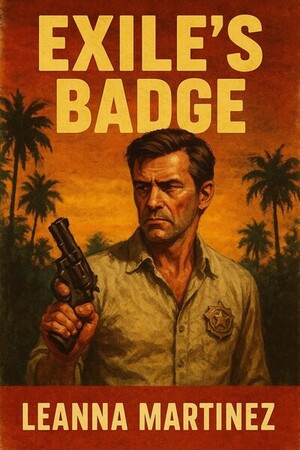
Exile's Badge
The safehouse smelled of sweat and stale coffee, a haze of cigarette smoke drifting just below the ceiling. The agents had dragged in a battered corkboard, maps of the waterfront pinned beside blurry surveillance photos. Red string stretched between pins like veins, drawing connections they all pretended added up to something larger.
One of the younger agents, barely thirty, hair cropped tight, slapped the board with the flat of his palm. “We’ve got him on the run. Two shipments seized, one lieutenant in cuffs, three couriers flipped. Caruso’s bleeding. He won’t recover from this.”
The room buzzed with energy. Laughter, quick bursts of optimism. Someone popped the top off a warm beer, passing it around as though they’d earned a celebration.
Doyle stood in the corner, jacket off, tie loosened. He didn’t join the noise. He let them talk, let the adrenaline work itself out. When the room quieted, his voice cut through the smoke.
“These are wins,” he said, tone flat, measured. “But don’t mistake them for anything bigger. We’ve nicked his supply lines. The money will reroute. It always does.”
A few of the younger men shifted uneasily, eyes falling to the board as though the red string might rearrange itself into a victory.
Sam sat in the back, cigarette smoldering between his fingers, the smoke curling past the stubble on his jaw. He didn’t look at the board. He’d seen versions of it before, different names, different faces, the same false sense of progress.
This was San Francisco all over again. The same war, just with salt air and Spanish accents. Nickel-and-dime wins against a machine built to outlast men like him. They could take lieutenants, couriers, a d dockhands. It didn't matter. Caruso had layers of insulation. He could shed pawns forever and still walk into church on Sunday smiling.
The cigarette burned down to the filter. Sam crushed it out in the ashtray and reached for another. His hands were steady, but inside he felt the trap closing.
Ghost work. That’s what Doyle had called it once, half a joke. And that’s what it was: endless nights, endless bodies, nothing to show for it except scars and ghosts that never let go.
He thought of the dockhand, throat cut, left for the tide to claim. The kid on the smuggler’s boat, barely twenty, face pale as he slid into the black water. Men with names no one would remember, except maybe Sam, because he’d looked into their eyes before they disappeared.
The agents wanted to believe these deaths added up to something. That the charts and strings meant progress. Sam knew better. He’d spent his life watching the machine grind forward, no matter how many bodies it consumed.
Across the room, Doyle’s eyes flicked toward him, sharp and knowing. He didn’t need Sam to say it aloud. They both understood the same truth: none of this would touch Caruso. Not really.
Sam lit the second cigarette and leaned back, the smoke filling his lungs. He didn’t speak, didn’t join the chatter about next week’s surveillance rotation. He just watched the board, the neat strings and pins, the illusion of order pasted over chaos.
And for the first time, he admitted to himself that he was done.
Not tonight, not tomorrow, but soon. He could feel the end of it pressing against him, the weight of a choice waiting to be made.
The ghosts would keep piling up. And he wasn’t sure how many more he could carry.
* * *
The cantina was nearly empty, the night air heavy with the smell of spilled beer and salt drifting in from the bay. A jukebox in the corner played a song so old the record hissed louder than the guitar.
Sam pushed through the door, eyes adjusting to the gloom. Doyle was waiting in the back, coat off, tie loosened, a glass of mezcal sweating on the table in front of him. He looked less like a federal agent and more like a man who’d been drinking alone too many nights.
“Sit,” Doyle said, voice flat.
Sam slid into the opposite chair. Neither man spoke at first. The jukebox crackled through another verse before Doyle finally lifted the glass, took a slow sip, and set it back down with deliberate care.
“You’ve been doing good work,” he said, tone almost casual. “Better than some of my own boys.”
Sam didn’t answer. Compliments from men like Doyle were just smoke, useful for covering something else.
Doyle leaned forward, elbows on the table, his eyes sharp even in the dim light. “But you need to understand something. Caruso? He’s not going anywhere.”
Sam’s jaw tightened. “We’ve been cutting his lines. Shipments, lieutenants—”
“Scratches,” Doyle interrupted, his voice still calm. “That’s all they are. He’s got protection in city hall, muscle in the unions, judges on his Christmas list. Hell, I wouldn’t be surprised if parts of federal law enforcement are on his payroll. Men like him don’t fall because someone seizes a few trucks.”
Sam’s cigarette flared as he lit it, smoke curling between them. “Then what the hell are we doing here?”
Doyle let the question hang. He swirled the mezcal in his glass, watching the liquid catch the light. “Quotas. Reports. Wins that look good on paper. That’s the game. We seize a shipment, Washington nods, someone gets promoted. Meanwhile, Caruso reroutes and keeps smiling for the cameras.”
The jukebox clicked, the song ending in a hiss of static before another one sputtered to life.
Sam exhaled smoke through his nose, eyes narrowing. “So all this… ghost work, the dead bodies… it’s for nothing?”
Doyle’s lips twitched, not quite a smile. “Not nothing. Keeps the numbers up. Keeps the headlines in our favor. But justice? You’ve been around long enough to know better. Men like Caruso only fall when it’s useful for someone higher up. Until then, they thrive. We bleed, they thrive.”
Sam felt something cold settle in his chest. He thought of San Francisco, of nights chasing shadows through fog, of names pinned to corkboards that never led to the man at the center. He thought of Maggie, Emily, and how his family had been collateral in a war that never cared about justice.
“It’s the same damn thing,” he muttered. “Same fight, different city.”
Doyle lifted his glass, nodded once. “Exactly.”
The jukebox crackled again, a slow bolero filling the silence.
Sam ground his cigarette into the ashtray, the ember dying with a hiss. His hands were steady, but the truth cut sharper than any blade. He could keep bleeding in this war, keep chasing the illusion of progress, but the wound would never close. Caruso would still be out there, untouchable, smiling with the same polished charm.
He leaned back in his chair, the mezcal bottle between them catching the dim light. “So what happens now?”
Doyle’s eyes held his, steady and unblinking. “Now, Holden, you decide if you want to keep being a ghost in someone else’s war. Or if you’re smart enough to walk away before it swallows you whole.”
The words hung in the air, heavier than the smoke, heavier than the drink.
And for the first time, Sam allowed himself to wonder if walking away wasn’t surrender, but survival.
Doyle poured another finger of mezcal, though he didn’t drink it. He stared at the glass as if the swirl of liquor could show him the next move. When he finally spoke, his tone had shifted. Less frank, more final.
“You’re too hot, Holden. Caruso knows you’re here. He knows you’ve been talking to people who talk to me. And that means you’ve got a target painted on your back.”
Sam leaned back, arms crossed. “So that’s it? You cut me loose?”
“Not exactly.” Doyle tapped the glass with one finger, a hollow sound in the dim cantina. “The brass doesn’t want you on the board anymore. Too compromised. Too messy. But I’ve got a way to make it look like an opportunity instead of exile.”
Sam didn’t answer. He knew the rhythm, first the problem, then the pitch. Doyle never wasted words.
“There’s a liaison rotation opening up in Belize. Small coastal town, police force nobody cares about. They want someone with experience to keep the books straight, run some training, make the locals feel seen. It’s low-stakes, off the radar, and most importantly…” Doyle finally met Sam’s eyes, steady, unflinching “…it’s far from Caruso’s reach.”
Sam let the silence stretch. The jukebox sputtered and hissed, the bolero cutting off mid-verse. For a moment, the only sound was the ceiling fan clicking overhead, steady as a clock.
“Sounds like exile dressed as a gift,” Sam said at last.
Doyle’s mouth twitched, not quite a smile. “Call it what you want. But it’s distance. And distance, Holden, is survival.”
Sam drew in a breath, cigarette smoke curling out with the exhale. He didn’t argue. He didn’t ask for guarantees. He knew there weren’t any. Staying meant more dead informants, more smugglers sinking into the bay, more blood that wouldn’t matter in the end. Staying meant death or corruption.
Walking away meant he kept something Caruso hadn’t already stolen.
It wasn’t victory. But it was choice. And choice was enough.
* * *
Back in his room above the cantina, Sam sat on the bed with his duffel open. The same one he’d carried since San Francisco, canvas frayed, zipper catching when he tugged too hard. He folded shirts without care, shoved in trousers, socks, a razor he barely used.
At the bottom of the drawer, the revolver waited. He lifted it out slowly, the steel cold against his palm. For a moment, he just held it, thumb brushing the worn grip. This weapon had been with him through every turn of the spiral, stakeouts in San Francisco, raids with the DEA, nights on the dock when the ghosts wouldn’t let him sleep.
He wrapped it in a shirt and slid it into the bag. Not as a symbol, not as an oath, just because it was the only constant he had left.
The room was almost bare when he finished. Just a bed, a table, an ashtray full of cigarette butts. He stood at the door, hand on the knob, and let his eyes sweep over it one last time.
There was nothing here worth remembering. Nothing except the weight of silence and the smell of cheap tequila soaked into the walls.
Still, he paused. Just long enough to take in the emptiness, to feel the scar of it settle into him.
Then he opened the door.
The night air was heavy, damp with the promise of rain, cicadas buzzing in the dark. Somewhere down the street, the cantina spilled music and laughter, a world that had already forgotten his name.
Sam stepped into the humid night, the duffel strap biting into his shoulder, and didn’t look back again.
Not redemption. Not justice. Just distance. Enough to keep breathing.





Please sign in to leave a comment.