Chapter 9:
Chapter 9 The pain of a memory.
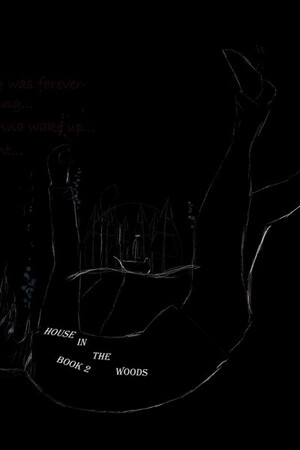
The House in the Woods. Book 2. Two sides of the Crown
He paced the room with an awkward rhythm, the book tucked tight beneath one arm like a rescued animal. The walls pulsed faintly in the low haze of ink fog, and the specks in the air danced like something microscopic and alive. The room had grown still again, save for the deep throbbing in his injured hand and the low buzz of awareness scratching at the back of his skull. Something wasn’t right. Something had shifted.
Then, a sound.
A soft creak.
It was not the fish. That thing had fallen silent after its final warble. This came from the corner—from the bed, or more precisely, beneath it. It sounded like the hesitant opening of a box, a wooden groan followed by a hush, like breath caught in a throat.
He stopped pacing, drawn by the faintness of it. Curiosity overtook caution. He crouched, wincing at the fresh sting of his hand, and ducked lower until the edge of the bedframe hovered above his field of vision. The barbed wire wrapped across the mattress frame loomed above him now, crisscrossing with cruel intricacy, each strand tarnished and rusted as though long exposed to some humid, unseen rot. But beneath the bed—ah, that was different.
Softness.
There was a rug under there. Not just a worn piece of cloth, but something... almost plush. A shag of deep gray fibers, surprisingly untarnished, flattened only where something had clearly lain time and again. It was clean. Preserved. Comfortable.
He reached out and brushed his fingers across it. Thick. Warm. Soft in the way that suggested care, maybe even love. This wasn’t a coincidence. This wasn’t just a leftover furnishing from before the rot took hold. This was intentional.
And suddenly the thought came. Unbidden, bitter.
The boy who wrote the journal—Book Boy, as he’d begun to call him—didn’t sleep in the bed at all.
He couldn’t.
The barbed wire wasn’t metaphor. It wasn’t random. It was punishment. A deterrent. A threat. This was a distorted memory, some echo of an abusive truth. The boy had been made to sleep beneath the bed, perhaps not just out of fear, but survival. It was safer. It was warmer. It was his secret.
The bed’s monstrous coils, its intentional pain, made sense in a way only trauma could.
He felt his throat tighten. He looked again at the softness of the rug, at how it cradled even his knees now, how the under-bed was shaped like a hiding place. A child could disappear under here and never be seen. A child could sleep in quiet, unnoticed exile. And maybe—maybe that was mercy compared to the company he would keep above.
Eddy Woods.
The name tasted sour. Book Boy had mentioned him in those pages with something close to loyalty. Denial, even. He spoke of Eddy like a friend, even while the book filled with phrases too frantic to ignore. Don’t listen to Eddy Woods. Don’t trust him.
And this? This was evidence.
A bed of knives.
He shifted onto his elbows, sliding further under the bed, now fully committed to this grim revelation. His shoulders ached against the wooden floorboards, and his shirt caught on a stray tack near the leg of the frame, but he didn’t care. He had to see more.
Because he knew now:
This cabin wasn't real. Not entirely. It was the dream-memory of a frightened boy. It was warped by pain, shaped by the same rot that stained the journal. This wasn’t a place made to live in. It was a place built to remember in. And remembering hurt.
And still—beneath the bed, there was peace.
A lie of it. A memory of it.
And something else.
Something under the rug.
A soft rise, barely a lump, yet enough to unnerve him. Like a cyst in the flesh of the world. His shoulders tense as he exhales, mist curling from his lips even now—why is it always so cold here?
Crawling under the broken bedframe again, barbs above and comfort below, he presses his weight against the plush fabric of the rug. It yields too easily. Soft, inviting. But not innocent.
His fingers slide under the edge and grip. Slowly—firmly—he pulls it back.
The floor beneath isn’t wood.
It wants to be wood. It pretends at being planks. It even sounds like them when knocked.
But it’s not.
It’s too smooth. Too perfect. Seamless, cold, and iron-like—no grain, no warmth, no aging. It reflects light faintly, like brushed steel painted to appear old. A mimic. A lie.
In the center of this impossible patch of floor is a small black box, so unassuming that it might be missed by a hasty eye. About the size of a curled hand, or a jewelry case. Shaped like a little music box. But it’s sealed shut by a single keyhole—no lid seam, no hinge, no latch. Just that one tiny hole. Waiting.
And from the open compartment—a sound.
Beep.
Beep.
Beep.
A hospital monitor. Slow and steady.
Then, layered beneath—the wet gasp of a breathing tube. Mechanical, haunting. The kind heard in late-night emergency rooms and memory-scars.
He stares. The noise doesn’t echo, doesn’t vibrate the ground. It’s not in the air—
It’s inside the compartment. Like a radio playing from another dimension.
His eyes dart up—nothing but the thorn-bed above. The barbs reach down like fingers, as if disappointed in his discovery.
One last look.
And he reaches in.
The moment he touches the box—cold shoots up his wrist. It isn’t pain. But it should be. Like shaking hands with absence.
He lifts the black box from its rest.
And instantly—click.
The compartment below begins to fold. The fake wood seams shut around the opening with smooth grace, as if it never parted. As if it was never there at all.
The sounds vanish. No more beeping. No breathing. Just quiet.
He sits back, knees bent in the low crawlspace beneath the bed. The box heavy in his lap. And in that stillness, the understanding hits him.
This is it.
This is the puzzle.
No keys in sight. No instruction. Just a memory of steps, scratched into cursed pages. And the sense that something is watching.
Waiting.






Please sign in to leave a comment.