Chapter 13:
SHADOW
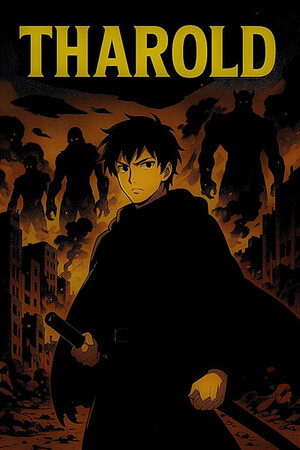
Tharold
I check the windows every night in the same order: press the right wing, tap the top latch with a finger, turn the bottom lock twice… I did the same moves that evening, but the emptiness inside me didn’t feel as satisfying as the click of the lock. Maybe it was the silence pooling in the corridors on the way back from D Base, maybe the metallic smell that had clung to me for days. At 02:14, I still hadn’t slept.
The curtain stirred as if someone in the room had breathed.
“Wind,” I told myself, but wind doesn’t move in rhythm with a human shadow. When I looked up, the orange streetlamp outside went dark at my window. A lock sound—thin and short, one I’d never heard before—triggered something in me. When I stood, my chair almost toppled.
The shadow let silence in first. Then it stepped in as if it owned the room: one step, then another. A little taller than me, shoulders strangely loose; the stance of someone who’s seen war but not weariness. A face behind a mask. The mask was scored with stitch-like lines, the eyes replaced by black glass. For a heartbeat I thought I saw a glint behind the glass—or was it my own reflection? I couldn’t tell.
“Who are you?” My voice cut the room. I didn’t reach for my weapon; a stranger’s intent is fastest revealed by their first second of breathing. Their breath… was steady. No haste, no pride. Cold.
Instead of answering, it came at me. Between us: a table, the edge of a bed, a narrow corridor. I don’t like tight spaces; I also rarely meet someone who uses them better than I do. The first move was a straight right. The target wasn’t my face; it was my step. If I gave up the ground under my foot, it would twist my momentum. I planted and met it with my shoulder; the moment my elbow brushed its chest, its body slid with a brief, indescribable slickness—as if my touch had struck a shadow.
“Are you phasing?” I blurted. No answer.
The second move was a feint; it pretended to grab my wrist, but instead of controlling my fingers it walked into empty space. Normally you track where that space leads by watching a person’s shoulders, knees, blink. I watched the breath. A half-beat pause before every move—as if not deciding, but recalling. Doing something a thousand times before, then adjusting to my reflexes.
“I asked who you are.” This time my hand went to the hilt. The metal’s cold drew my fingers in. The shadow tilted its head a fraction, as if choosing an answer.
“You’ll learn when it’s time.”
Its voice had a broken-glass timbre; like two voices superimposed inside a speech-modulated mask. For an instant I felt I could move closer to one of them and recognize it; a sting at the edge of my mind. I flung its hand aside and caught its wrist—this time it couldn’t slip free. I drove my elbow into the lock and pinned its position with my knee. In training we call this “make the enemy forget their balance.” It forgot; but a thought stabbed me: “Do I know this body?”
“What’s your intent?”
“To warn you.” Its voice was calm though its wrist was in my grip. “Many are watching you.”
“If many are watching me,” I said, “few dare to come in.” I hardened. “Who are you?”
“Don’t tell anyone about this conversation, Kiyoshi.”
The way it spoke my name clipped my breath. How it said it, where it stood, which syllable it leaned on—strange. A familiar rhythm played by a foreign voice. I don’t know if I let go or not, because it suddenly shifted its weight into another plane and, at once, there was only cold air in my fingers.
It went to the window. The lock made a sound as if it opened by itself. The curtain danced for a beat; then the shadow slid out like a figure from that dance. Wind, curtain, and I remained.
A small glint at the edge of the table caught my eye. I bent down. A tiny shard of metal, as if torn from the edge of black fabric. A warped scratch marked it. I picked it up; the metal’s chill ran from my palm to my heart. For a moment… that day we were coming back from the market, my mother had smiled and said “you’re right, son”; there was a giant ship in the sky instead of the sun; the wind had smelled this sharp. That memory poured into me like metal from my palm.
I sat at the table. I opened my notebook. The first sentence would be, “Unknown individual, late at night, slipped in through the window.” The pen hovered on the page. My heart was beating faster than during the fight. That hair-thin line between writing and not writing… was splitting me in two. If I reported it, it would no longer be mine alone; if I didn’t, this city wouldn’t forgive me.
I set the pen down. I went to the window. The last streetlamp was flickering outside. The old pipes humming in the ceiling rose from nowhere like the bass of a sinister song.
“When it’s time, huh?” I said under my breath.
No answer came. Better that it didn’t. I put the metal shard on top of my file. In the notebook’s left corner, I marked a small sign: “S.” S—for shadow. S—for secret. S—for scapegoat. I didn’t know which S it was.
The rest of the night passed like a weight on the back of my thoughts. Whenever I closed my eyes, that rhythm behind the mask… the half-beat pause… as if it wanted to say something and couldn’t. “Many are watching you,” it had said. Who? Why me? And why that voice?
Toward dawn I finally reached the shore of sleep. Like a ship waiting at the dock; the lines loose, yet not sailing. The alarm rang. I splashed water on my face. In the mirror, the redness in my eyes reminded me of the mask’s glass. I checked the window once more; this time I made the lock click myself. “A sound that echoes in my own house,” I said, “ought to be my sound.”
I swallowed the day like an order: D Base would be relocated, A Base would take over, morgue and research unit would be readied. And I… I would carry a piece in my pocket. Lying to my own silence with “when the time comes.”
I closed the door behind me. My footfalls in the corridor became the night’s witness. Somewhere far off in the city, if someone drew a breath half a beat late, I didn’t hear it. But I kept the feeling in my chest.
“I won’t report today,” I said, descending the stairs. “Today I’ll try to understand.”
Maybe it wasn’t the right call. But some decisions are like the first light of morning: they aren’t warm yet, but they define the rest of the day.
By the time I reached A Base’s gate, the sun was rising.





Please sign in to leave a comment.