Chapter 28:
Vault 7
Immigrant Diaries
The ferry to Jakarta felt like a coffin floating on diesel and rain. The smell of saltwater and rust clung to every surface, and the air was thick with sweat and smoke. Malik and I sat in the lower deck, pretending to be migrant workers heading for construction jobs. My forged ID said Arman Azin, laborer. His said Rahul Malik, mechanic. Neither of us believed our lies anymore—but they were the only armor we had left.
Three days on the water. Three days of restless sleep and whispered paranoia.
Every sound—a footstep, a cough, a wave slapping the hull—felt like a threat. Malik barely spoke, and when he did, it was always the same question.
“You sure about this?”
Every time, I gave the same answer. “No.”
Jakarta was a beast of a city—alive and rotting at once. The harbor stretched endlessly, cranes clawing at the sky, ships creaking in and out like dying whales. The humidity hit us like a wall, but it wasn’t the heat that made me sweat.
It was the feeling that they already knew we were here.
We rented a windowless room above a fish market. The kind of place where no one asked questions, as long as you paid in cash and didn’t bleed too loud.
Malik spread out Rahman’s note on the floor. The ink had bled from the rain, but the numbers were still visible:
“Vault 7 – Port of Jakarta – Dock 43A.”
I pointed at the map. “That’s restricted. Cargo control zone. We’ll need clearance.”
Malik snorted. “Clearance? Arman, we’re wanted men. We can’t even clear a taxi meter.”
He wasn’t wrong. But I wasn’t going to stop here. Not after Rahman died for this.
That night, I walked to the docks alone. Cargo containers towered like red and blue tombstones, the air vibrating with the sound of engines and the screech of metal on metal. Workers moved crates under floodlights, and guards in Megatech uniforms patrolled every few meters.
And there, at the far end of the dock, half-hidden under a warehouse roof—I saw it.
Vault 7.
No sign, no door. Just a steel hatch guarded by two men with assault rifles and a security keypad glowing faint blue in the dark.
So it was real.
When I came back, Malik was waiting. “You found it?”
I nodded. “Tomorrow night.”
“Tomorrow night what?”
“We go in.”
He sighed, rubbing his temples. “You’re insane.”
“Maybe. But insanity’s all that’s kept me alive this long.”
The next day, we bought what little we could afford from the black market—an EMP pulse generator barely larger than a shoebox, a crowbar, and two fake maintenance uniforms. Malik picked up a pistol from a fisherman who didn’t care why we needed it.
At midnight, we made our move.
The rain returned—loud, drenching, merciful. The perfect cover. We slipped through the fence near Dock 43A, hugging the shadows, dodging floodlights. Every few seconds, I could hear Malik’s breathing quicken behind me.
When we reached the hatch, the guards were still there. Smoking, laughing, bored.
Malik whispered, “I’ll take left.”
I hesitated. “No killing unless necessary.”
He gave a crooked grin. “You always say that.”
Before I could stop him, Malik threw a small pebble toward the far end of the dock. It clattered on the wet concrete. Both guards turned, guns raised.
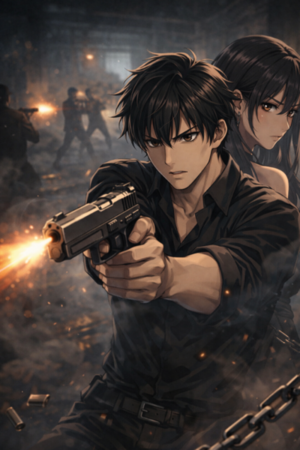
In that second, Malik was behind them—silent, brutal. Two muffled thuds later, both men lay on the ground, unconscious but breathing.
“Happy?” he whispered.
I exhaled. “Let’s just open it.”
The keypad was digital—fingerprint, retina, passcode. But Rahman had prepared us well. I placed the EMP box on the ground and pressed the switch. A soft pulse rippled through the air, and the keypad blinked out.
I wedged the crowbar into the edge of the hatch and heaved. It gave way with a groan that echoed through the night.
Inside, the air was colder—conditioned, recycled, wrong. Fluorescent lights flickered on, revealing rows of computer servers stretching deep underground. A low hum filled the space.
We stepped inside.
Malik whistled. “This looks less like a vault and more like a brain.”
“That’s because it is,” said a voice.
We froze.
From the far end of the room, a man stepped out of the shadows—tall, clean-cut, dressed in a black suit. His hair slicked back, his expression calm.
“I was wondering when you’d show up, Mr. Rahman,” he said.
My stomach twisted. “You’ve got the wrong name.”
He smiled. “No. I don’t.”
He walked closer, unhurried, as if we were guests in his home.
“My name is Adrian Cole. Head of Southeast Operations, Megatech Global.”
Malik raised his gun. “Stay back.”
Cole ignored him. “You know, we’ve been tracking you since Batam. You’ve caused quite the mess. Rahman’s death. The data leak attempt. Vault breach.”
He circled around me slowly, studying me like a scientist watching a lab rat.
“You were never supposed to get this far. But I’ll admit—I’m impressed.”
“What is this place?” I asked.
He gestured to the servers. “Vault 7 is a continuity system. A backup of everything we are—contracts, intelligence, operational data. But it’s more than that. It’s the birthplace of Project Lazarus.”
That name again. It made my chest tighten. “What’s Project Lazarus?”
He chuckled softly. “Resurrection. The idea that no man ever truly dies—if his purpose remains. You, for instance, were Lazarus I. The failed prototype.”
“Failed?” I said, my throat dry.
Cole nodded. “You weren’t supposed to survive Dhaka. But you did. And because of that, we learned. Lazarus II will not make the same mistake.”
Malik took a step forward. “What the hell are you talking about?”
Cole turned toward him. “Bangladesh. Three weeks from now. A coordinated strike designed to destabilize their government and push through our security contracts. A new world built from controlled chaos.”
I clenched my fists. “You’re insane.”
“Maybe. But profitable.”
I lunged forward, swinging the crowbar. Cole sidestepped easily and slammed his elbow into my wounded shoulder. Pain flared white-hot. Malik fired, but the bullet hit the reinforced glass wall behind Cole.
Cole moved like a ghost—grabbing Malik’s wrist and twisting until the gun fell. He kicked Malik in the stomach, sending him crashing into a server rack.
“Still predictable,” Cole muttered.
I forced myself up and swung again—this time catching him across the jaw. He staggered back, blood dripping from his lip.
For the first time, the mask cracked.
“You’ve got spirit, Arman,” he spat. “That’s why you’ll never survive this game.”
He pressed a button on his wristwatch. The entire vault started flashing red. Sirens blared, and the floor beneath us began to tremble.
“Self-destruct sequence,” he said, smiling. “If I can’t have the data, no one can.”
He turned and ran toward a side exit. Malik grabbed my arm. “We need to go, now!”
We sprinted through the maze of servers as sparks and flames erupted around us. The heat was unbearable, the alarms deafening. I clutched the drive from Rahman’s remains in my pocket—a useless relic, unless…
At the control terminal, I slammed the drive into a port. The system recognized it instantly. Rahman had left a failsafe—an override.
“Come on,” I muttered, typing fast. “Come on!”
The screen blinked: DATA TRANSFER – 67%… 80%… 94%... COMPLETE.
I yanked the drive free. “Got it!”
We ran toward the exit just as the vault erupted behind us—an explosion of metal and fire that threw us into the mud outside.
When I opened my eyes, the night was silent again—except for the sound of rain falling on twisted steel.
Malik coughed beside me. “You alive?”
“Barely.”
He looked at the drive in my hand, its light still blinking. “Please tell me that’s worth something.”
I stared at it—the only proof left of everything Megatech had done.
“It’s worth everything.”
From the shadows, a figure appeared at the edge of the burning dock. Not Cole—someone smaller, wearing a hood.
I raised the gun instinctively. “Who’s there?”
The figure stepped closer. A woman’s voice, low and steady.
“I’m here to finish what Rahman started.”
Lightning flashed—and I saw her face.
It was Lina.
The same woman from the refugee network. The one who helped me escape Malaysia.
But her eyes now held something else—cold, calculating, dangerous.
“Arman,” she said softly, “welcome to the real Lazarus.”




Please sign in to leave a comment.