Chapter 14:
The Labyrinthine Tower + Compendium Entries
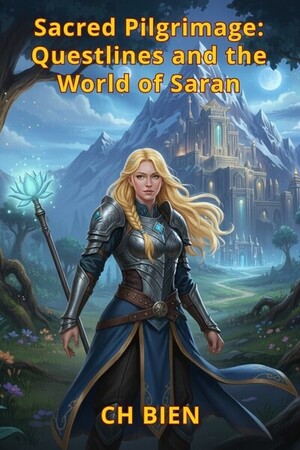
Sacred Pilgrimage: Questlines and the World of Saran
After the Smoke
The days that followed the summoning were eerily calm. Too calm.
The bells rang again — not alarms this time, but routine. The same dull rhythm of daily lectures and late-night study sessions returned, as if nothing had happened.
The Alchemy Hall was sealed now, its doorway chained with glowing wards. The corridor leading there still smelled faintly of burnt salt and iron. Every time I passed by, I half expected to hear the whisper of a spell gone wrong.
But there was nothing. Only silence.
I sat in the courtyard with Sera, watching students cross the bridges between towers. The sunlight danced off the runic glass, catching the faint traces of soot still lingering on the walls.
“They’ll say it was a magical accident,” Sera muttered. “That’s what they always say.”
She wasn’t bitter — just tired. Her skeletal raven perched on her shoulder, its empty sockets staring into the morning sky.
“The professors?” I asked.
“The Church,” she said. “The Radiant Inquisition will pretend not to see. The Archmage will rewrite his report. The dead will stay silent.”
I didn’t argue. She was probably right.
When I reached the upper observatory that evening, Archmage Arcen was already there. The sky outside shimmered violet, a storm of mana drifting across the horizon. He stood by the railing, hands clasped behind his back.
“It’s remarkable,” he said softly, “how easily the Tower forgets.”
I approached quietly. “Is that good or bad?”
He smiled faintly. “Both. Forgetting keeps us sane. Remembering keeps us wise. We must balance the two, if we’re to endure.”
He turned toward me then — eyes sharp, the kind that saw too much.
“Professor Malrec’s notes have been confiscated. I will not burn them. They are dangerous, yes… but ignorance can be deadlier still.”
He looked back to the horizon.
“The question is whether we will study them to prevent the next disaster — or to repeat it more beautifully.”
I wasn’t sure if he was speaking to me or to himself.
Down in the courtyard later, Eleanora was arguing with Magnos again, both of them knee-deep in repairing the barrier pylons.
Eleanora: “If you didn’t overcharge the conduits, maybe they wouldn’t explode every semester!” Magnos: “Explode is a strong word. I prefer aggressively discharge.” Eleanora: “You’re an aggressively discharged brain cell.” Magnos: “Love you too, lightning girl.”
For the first time in days, I almost laughed.
That night, Lirien Mossbrook found me in the library. She placed a faintly glowing crystal on the table — one of the stabilizers from the Mirror Chamber.
“Keep it,” she said. “It hums when demons draw near. Or when your conscience does.”
I pocketed it, not sure which would haunt me first.
As she turned to leave, I asked, “Do you think it’s over?”
Lirien stopped by the door, her silhouette framed by the candlelight.
“Demons are like thoughts,” she said. “You don’t destroy them. You just stop listening.”
The next morning, life resumed as usual. Students hurried to lectures. Professors buried themselves in research. The Tower breathed again, steady and unchanged — a monument to both brilliance and blindness.
I stood by the sealed door to the Alchemy Hall one last time. The wards hummed faintly, casting a soft light on the stone floor.
“May your next spell be wiser,” I whispered.
Then I turned away, and the Tower kept its secrets.
Compendium of Arcane Institutions:
By Magister-Archivist Thelon Agrappil of the Imperial Academy, Zarathil City, Anno Victoriae 1012.
The Labyrinthine Tower
Symbol: Minotaur’s Head
Founding: 835 AV
Origin: Formed by expelled scholars and magical dissidents from other academies.
Location: Karthuun Peninsula Northeasternmost of Ardellon Continent, atop ancient labyrinth ruins.
Nickname: The Heretics
Relations: Neutral to most, but often investigated by Church.
Rumors / Secrets: A defunct dimensional gate lies beneath the Tower’s lower vaults.
The Labyrinthine Tower, known among the scholars as Aethervault Spire, rises at the eastern edge of Karthuun peninsula under dominion of the Zarath Empire. The Labyrinth began as a refuge for outcasts: necromancers, illusionists, alchemists, and scholars who delved too deep into taboo fields. They built downward instead of upward, digging a sprawling subterranean ruin beneath black volcanic stone and use the labyrinth as both archeological site and research facilities.
Its maze-like structure serves both as fortress and metaphor: knowledge without direction can devour the seeker. Rumors claim they consorted with demons in their early years — though none can prove it.
Now, the tower stands as a center of magical innovation and controversy, whispered to still hum with forbidden echoes.
The Verdant Spire
Current Symbol: Tree of Life
Founding: 332 AV
Origin: Once a druidic sanctuary.
Location: Zarathil, the imperial capital.
Nickname: The Emperor’s Dogs
Originally an order of wandering healers, the Verdant Circle was absorbed by the early Zarath Emperors to form a state-sponsored magical institution. Over centuries it evolved into the Verdant Spire, a marble and crystal tower woven with living vines — a symbol of growth, unity, and loyal service to the Empire.
Its scholars specialize in restoration magic, natural alchemy, and the maintenance of leyline balance across imperial territory. The Empire relies on them to keep the land fertile and the cities warded.
Critics, especially from independent towers, call them servants of power — keepers of order, but also of obedience.
The Radiant Chapel
Current Symbol: Five-Pointed Star
Founding: 598 AV
Origin: Formed by the Church of Radiance after the First Demon War.
Location: Seraphveil, the holy capital.
Nickname: The Fanatics
Originally a branch of the clergy studying “divine harmonics,” the Chapel became a magical order when miracles began to be formalized into repeatable spells. They replaced faith with formula — though still calling it prayer.
They train Aethermancers — magi who wield divine resonance rather than raw mana. Their power fuels exorcisms, blessings, and miracles of light. To the faithful, they are proof that science and holiness can coexist. To others, they are zealots who mistake sanctity for superiority.
Their star symbol is not ancient; it was adopted only two centuries ago, replacing the earlier sunburst sigil considered “too pagan.”
Field Guide Entries:
By High Arcanist Selmarin Thale, Department of Thaumaturgical Biology of the Imperial Academy, Zarathil City, Anno Victoriae 1012.
Monsterization and the Origins of Monsters
In the lands of Saran, a beast is simply a creature shaped by nature—whether it walks on four legs, crawls on scales, or soars on feathered wings. Yet nature is not immutable. When a beast dwells too long in a region saturated with unstable magic, such as a fractured leyline or an abandoned battlefield where ancient spells still linger, it may undergo a violent metamorphosis known as monsterization. This process floods the creature with raw mana, forcing its body to adapt in ways no natural evolution ever intended.
A monsterized beast typically becomes larger, stronger, and far more aggressive than its original form. Its muscles thicken, bones harden, and instincts sharpen to a feral edge. Most defining of all is the formation of a magic stone, or monster core—a crystallized node where excess mana condenses. The exact location of this core differs from one species to another. Serpents and reptiles tend to manifest it deep in the dantian, where their natural mana pathways are strongest. Predatory mammals, whose instincts and senses are vital to survival, usually develop the core within the skull. Creatures built for flight or endurance form their core in the chest, stabilizing the overwhelming mana that floods their circulatory system. These stones are highly prized among mages and alchemists, both for their role as condensed power sources and for the rare reagents they provide.
Not all monsters, however, begin life as beasts. Many arise spontaneously, forming from the world’s raw magical pressure. Deep underground or in heavily enchanted ruins, mana sometimes condenses into a dormant core with no living host. Over years or even centuries, this core gathers matter and elemental energy until it forms a body around itself. When it finally awakens, the resulting monster emerges fully grown, driven not by biology but by the primal will of magic. Trolls, golems, and certain forms of giant spiders are well-known examples of such manifestations. Their behavior often feels alien because they are shaped by mana first and matter second; they obey the logic of magic rather than any natural instinct.
A third category of monsters arises when inanimate objects become saturated with ambient magic until they achieve a crude semblance of life. A tree that absorbs too much mana may awaken as a treant, its bark pulsing with faint runic glow. A long-dead corpse may stir once more, animated not by its former soul but by an intrusive current of necrotic energy. Even crafted objects—such as a mask, sword, or abandoned statue—can awaken after centuries in an enchanted region, animated by the residual spells woven into the land. These monsters often act according to the “memory” of their old form: enchanted weapons swing themselves at intruders, statues move to guard what they once protected, and revived corpses continue the motions of life without true awareness.
For field researchers, adventurers, and scholars alike, monsterization serves as a reminder that magic in Saran is both lifeblood and wildfire. When it flows calmly, it nourishes. When it surges uncontrolled, it reshapes the world according to its own unpredictable will. Monsters, in all their varied origins, stand as living evidence of magic’s capacity to twist nature, awaken the inert, and give form to forces that should never have possessed shape to begin with.
Environmental Zones with High Monsterization Risk
Monsterization rarely occurs at random. It follows the currents of Saran’s magic, concentrating wherever mana becomes unstable, oversaturated, or tainted by ancient forces. Veterans of the field quickly learn that certain regions produce monsters with alarming consistency, and wise travelers approach these places with utmost caution.
The most infamous of these areas are leyline fractures, where the world’s natural mana pathways twist or rupture. In such places the ground feels faintly warm, the air trembles with invisible pressure, and animals behave as though perpetually startled. Beasts that linger near a fracture absorb uncontrolled mana directly into their bodies, accelerating monsterization at a rate that can transform a creature within weeks instead of generations. Many of the Academy’s earliest monsterization cases were traced to these sites, and though sealing rituals exist, they are difficult and temporary.
Another high-risk region is any ancient battlefield where large-scale spellcraft was unleashed. Residual magic saturates the soil for centuries, particularly if catastrophic spells such as soulfire, abyssal frost, or geomantic ruptures were involved. These lands are often barren of vegetation but teeming with unnatural life. Skeletons sometimes reawaken in such places, not through necromancy, but simply because the ground is so thick with displaced souls and lingering arcane turbulence that even the dead cannot rest. Beasts that graze or scavenge here become twisted reflections of their former species—muscular, half-mad creatures whose bodies pulse with the remnants of forgotten wars.
Equally dangerous are the enchanted forests, where the flora itself absorbs mana like a living reservoir. The oldest trees develop sap infused with faint magical currents, making the ecosystem highly reactive. Animals in these regions become sensitive to ambient mana, and even minor disruptions—an errant spell, a ritual mishap, or a surge in the leyline beneath the roots—can trigger sudden monsterization. Treants and awakened vines are common here, but so are less conspicuous threats: birds with crystalline feathers, foxes with flickering ember eyes, and insects that grow larger than they have any right to be.
The deep underworld creates its own hazards. In mana-rich caverns, mineral deposits naturally capture and amplify magical energy. Over time, such deposits crystallize into dormant monster cores. When enough cores cluster together, monsters may spontaneously manifest without any biological origin at all. Explorers often tell tales of tunnels where the walls glow faintly with embedded crystals, each one pulsing like a heartbeat, as though waiting for the right moment to awaken. These caverns are unpredictable; a stretch of tunnel may be utterly safe, only to give rise to a fully formed troll or stonebound beast a week later.
Another often-overlooked threat lies in regions where the veil between realms thins. These rifts or convergence zones allow faint traces of foreign mana—the energies of other planes, spirits, or divine echoes—to bleed into the material world. This alien mana destabilizes living creatures more violently than natural magic does. Beasts exposed to such energies rarely transform gradually; they mutate in erratic bursts, their bodies warping according to forces they were never meant to endure. Many of the strangest monster species catalogued by the Academy originate from these borderlands.
Finally, the Academy warns against abandoned ritual sites, especially those involving binding magic, elemental summoning, or soul manipulation. Even when the original ritual circle has collapsed, echoing impressions of the incantations linger like burn marks on reality. Travelers report hearing whispers or seeing fleeting sparks of light near these ruins, signs that the site still resonates with unspent power. Any beast that wanders too close risks becoming a vessel for energies seeking release.
In all these zones, monsterization is not merely a possibility but a natural consequence of the environment. As the Academy teaches: “Where mana gathers, monsters follow.” For those who explore Saran’s wilder corners, recognizing the signs of magical instability is often the difference between an uneventful journey and an encounter with something that should never have existed at all.






Please sign in to leave a comment.