Chapter 1:
The beginning pt 1
the fox and the sparrow
A young lady of noble birth or good name is restricted in her actions by her archetype, and so the same rules that dictate the reluctance of the people of Old Edo to take windfall money also dictate her conduct. Every public action – and a good many private ones – may be scrutinized and distorted by the gossip gallery or in a column of the newspaper, chasing any real or imagined deviation from her script. Her countenance must never slip, her clothes never be too much or too little of anything, her hands soft yet her needlepoint perfect. It is a balancing act only acknowledged by the other half of society when they wish to mock it.
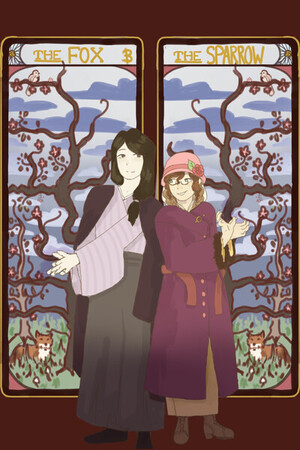
Miss Chie seemed to many to be the perfect young lady: beautiful, rich, well-mannered and utterly content to play attendant for the rest of her days. A foreign grandmother had bequeathed her a copper tint to her hair and eyes with but a splash of green in them, and a tall and shapely figure besides that. When she was young, Miss Chie spent a good deal of time with her grandmother, so she developed a somewhat old-fashioned charm to her manners. The men who spoke of her in hushed, admiring tones at soirees often heaped praises on her delicate nature, her bright eyes and her soft voice, like a princess in a folk tale. This grandmother was a Frenchwoman, the daughter of a wealthy merchant family, who had left the West as a young woman to accompany her father on a business trip. While away from home, she had met the young lady’s grandfather – who was at that time merely the second son of the Nishimuras, a good old family who had managed profitable textile shops in the city for at least four centuries – and utterly bewitched him. The young fellow had near run himself ragged to try to win her hand, and, in the end, she declared to her father that she would marry him with or without parental permission; after all, she reasoned, he seemed sweet enough and no other man had ever put such effort into impressing her. The couple had been blessed with two daughters, adopted a bright young clerk as an eldest son-in-law, and then their dear and only granddaughter was born. Miss Chie thought, as her grandfather had, that her grandmother was the most beautiful woman in the world. She was tall enough that a child sat on her strong, wide shoulders felt they could reach the sky, with a figure that was pronounced in such a way that her hip perfectly cradled any burden, and what the young Miss envied most of all was her hair. It fell in a perfect silken estuary of cinnamon curls, coiling like the waves in a winter storm, and had not yet begun to grey as her husband’s had. Miss Chie had inherited more than a little of her grandmother’s looks and, although propriety made her dim its light, a great deal of her wilful wildness of spirit. They had the same dancing eyes, although the young Miss’s had a great deal more brown mixed in with the green, and the same stubborn curls at the nape that required jars and jars of pomade to tame.
Besides this good fortune, an artist had seen her by chance at a gathering in the spring and done a quick sketch. This sketch led to her unknowingly being the model – although her name was not attached, it was clear to anyone – for the ‘Modern Beauty’ in a work, part of a fine collection of woodblock prints. She became, without any particular desire on her part, a sort of emblem of the new, cosmopolitan Kyoto that was blooming into its first flush. Through this sudden thrusting of fame onto her, she had maintained the air of a girl totally unaware of her own beauty and grace; for, while a woman ought to cultivate her looks, this cultivation should present itself as utterly unintentional. She hadn’t even known anything about this until someone asked her about it at a party – and it did explain why people had been looking at her oddly in the park when she went for walks. There had been a few requests since then for interviews or for her to sit to be painted for advertisements, but she had ignored all but one. It wouldn’t do to show off, but she didn’t want to seem too proud to say yes either. The prints were beautiful, but she wished he could have chosen some other girl to base it on.
This year was Miss Chie’s first season without her grandmother by her side. A sudden dive in her health had forced her to retire to mountain air, although she had made her dear granddaughter promise to write regularly – and not miss out any of the gossip. Perhaps noticing his daughter’s listlessness, her father had arranged an outing to a new dress shop with the latest Western-style designs.
As the motor-car pulled out onto the street, Chie allowed herself to slump into the cushioned seats. Although she knew her cage to be finely gilded, she still found herself chafing at the restraints. It would be misleading to suggest that her air of contentment extended beneath the skin – indeed, the roots of her underlying resentment grew deep, watered each time she hid her favourite novels within the dust-jackets of more respectable titles or kept a smile through conversation with another dire prospective husband. She tried to remind herself that it was something that she had these books at all and a choice, albeit between various bad options, of her husband. To be unmarried – not even spoken for! – and on the way to her twenty-first birthday was a luxury, but this did not soothe the ache. True, it would undoubtedly be worse to be chained by poverty, but would it not be better to live unrestrained by status or money? When she let such thoughts slip, her father ruffled her hair like she was a child.
She wasn’t some naive fool, she could understand the need for some manners – say, frowning upon public nudity – but why enforce decency differently for men and women? And it would be understandable to keep a small child from reading Sheridan le Fanu, but a young lady of twenty ought to be free to make such choices for herself. After all, she was aware that many young men read far more egregious … novels, if they could even be called as such. She could appreciate eroticism, Gothic or otherwise, but a novel ought to have plot and characters! Mere titillation cannot cover for bad writing.
The car was warm, although it was bitingly cold outside, even for early November. Snow was falling lightly, and Chie was very grateful for all her warm layers. Her mother sent packages home each season with her various protégées – various attractive young European women, all star-struck by the beauty of the city and the surrounding countryside, which they all insisted on calling ‘the Orient’. They were very sweet, although it was a struggle to understand their accents sometimes, and this latest gift was really quite a nice coat. It was a rich wine purple, and it had wider sleeves than most of the other Western-style wool velour trench coats she’d seen, with buttons down the bottom edge of the sleeve all the way to the elbow and a fur lining that showed at the cuffs and collar. Her mother had probably requested that to make it easier to wear over kimono. The new, shorter European dresses with stockings, even woollen ones, were just so cold in the winter – the lovely ladies of New York, Saint Petersburg and other northern metropolises must be shivering in their furs. It was very glamourous shivering, no doubt. Chie would have to hand it to the French for one fashion innovation, however: cloche hats were a delight. Not only did they help conceal her now-famous hair, but they were also wonderful for keeping one’s ears warm in the winter. Ladies in the countryside, and those who spurned or had not the money to keep up with fashions still wrapped their heads in warm scarves as their grandmothers had, but the little bell-shaped hats in colourful wool were on the head of many a bright young thing on the shopping streets of Kyoto.
The shop was towards the edge of the area, charming yet somewhat shabby. It hadn’t opened yet, so Chie decided to go for a quick walk to warm up her blood. Shivering, she took a while to notice how awful this corner of town was. Dirt and smoke stained the buildings, and the day was dim and misty, which added to the … charm of the area. The maid that her father had insisted accompany her looked rather nervous, so she decided to tell the poor girl to go back to the car and wait. After all, it was just a short walk through a patch of greenery that seemed to have once been a public park. The trees were bare, the darkness of the wet bark standing in stark contrast to the snow and frost on what remained of the grass. Each footstep crunched. She walked through a small glade of half-dead trees and under a broken trellis archway, carefully avoiding the bumps from tree-roots bursting through the cracks in the pavestones. Although the park was run-down, it had a faded charm – like a noble lady who’d fallen on hard times, sat in her crumbling palace.
There was some noise coming from up ahead, but it was so muffled by the snow that she couldn’t tell what it was. She tucked her hands into her sleeves, shivering. At least the snow was beautiful. It draped over everything like a Western bride’s lace veil, hiding the world until Spring unveils his wife in all her floral beauty.
The sound of shouting dragged her out of her reverie. Abruptly, Chie realised that the noise ahead was some rough-sounding men fighting. She really should pay more attention to her surroundings…
Carefully, she inched back behind a nearby tree. Maybe wearing such a bright colour hadn’t been a good idea, but there was no use realising that now. Her hat had snagged on a branch, and in her panic, she slipped on a patch of ice and fell, hard. Drat! The street brawlers stopped fighting, which was definitely a bad sign. She could feel herself breathing fast and hard, her blood roaring in her ears so loudly it blocked out everything except the sound of footsteps. As she struggled to her feet, the sinking realisation that she couldn’t run far enough in time dawned on her. The snow was falling fast and thick now, making the whole world a grey blur – especially with all the snowflakes blocking her glasses.
She took a few hesitant steps, then slipping again. This time, though, instead of the cold ground catching her, she fell into the warm arms of a total stranger. Through the haze of snow, she could just about make out dark hair, an orange scarf wrapped around it, and clothes that blazed in vibrant blues and pinks. The stranger, a young woman based on her clothing, smelt of a heady mix of tobacco and musky perfume that cut through the cold air, with a slight hint of expensive liquor. She set Chie back on her feet, grasped her hand firmly and dragged her away from danger without hesitating. Chie stumbled several times on this breakneck run, her rescuer slowing to check on her each time. It felt like they ran for miles and miles through an endless maze of alleyways, although it was probably not all that far, but eventually they made it out onto a totally unfamiliar street.
The storefronts were all shuttered, signs obscured by what must have been decades of neglect. Chie shivered, and not only from the cold. Although, she was freezing. When she fell, snow must have found a way into the gap above her boots and below her coat and kimono, soaking into her stockings. Wool was supposed to keep you warm even if it got wet, but maybe ‘warm’ was used as a relative term to, say, freezing to death.
Her rescuer spoke, in a surprisingly husky voice.
“Miss, I have to get back to work. You can come too, to warm up, although it …” She gave Chie a more through look up and down, her tone changing. “It’s … not a place a young lady like you will be used to.”
She supposed she should put up some token resistance – not that she actually cared about such things – but Chie was too cold and shaken to bother with such a thing. If the gates of Hell opened up before her, she’d probably stop to warm herself in front of them for a good quarter-hour before running for the hills. The girl was too well-dressed to be a streetwalker but not so well-dressed as to be a proper courtesan, which left a bar or the raunchier sort of theatre as options – perhaps a foreign-style cabaret. Showgirls in illustrations were always so well-dressed, and she could imagine the hypnotising movement of fringe and beads as they danced.
“I – such things don’t bother me. If they’re your co-workers, I’m sure they’re just as noble. Thank you for rescuing me.”
Her rescuer flushed – perhaps she was shy? They were still holding hands, but Chie couldn’t be bothered to do anything about that either.
“It’s nothing, really. Any – anyone would have done the same. Those boys are trouble – someone ought to put the fear of God into them sometime. The other girls at work always complain about them.”
She was self-consciously fiddling with the ends of her scarf. It was really quite sweet. Chie’s rescuer must be very popular with guys. There was something about her that just made Chie want to pet her on the head like a well-behaved dog.
Miss Chie and her hero walked through the silent and snow-covered streets, which became louder and more marked by boot prints the closer they got to their destinations. The poor girl was frightfully shy – her name was Yuki, apparently, which was all the information Chie could get out of her before she deflected into small talk. They agreed that yes, the cold was terrible, but at least the snow was pretty. She wouldn’t stop calling Chie ‘Miss Nishimura’, despite Chie’s insistence that, since they were about the same age and she owed Yuki a great favour, more familiar modes of address were appropriate. Chie had never been one for sticking to the strict formalities around names, a habit she’d probably picked up from her foreign cousins. Besides, she didn’t even know Yuki’s family name – she seemed reluctant to make even this small reference to her family – so it felt fair to stick to first names. In the end, they reached the neutral ground of ‘Miss Chie’.
When they ran out of weather phenomena to discuss and honorifics to argue over, Chie began to ramble about the books she’d read lately. Mr Shaw’s Pygmalion had been a riot, and she hoped to see it performed someday – although there was the difficulty of translating all the jokes. A book could have footnotes to explain each reference, but that didn’t translate to the stage well. She was lucky to be able to read the French editions, which tended to be easier to find than Japanese translations, although there were parts she didn’t get and had to ask her grandmother about. And there were the serial chapters her mother had stapled together years ago for her personal collection and later passed down - M. Leroux’s delightful Phantom of the Opera. Her father disapproved of such frivolous things as romance novels, but thankfully his French was too poor to understand much beyond the titles. If books were food, Chie was like a dog that eats too fast and makes itself sick.
In many ways, the pages were far more her friends then the girls her age she had tea with each month. She almost felt bad about that – they were good company and had been her loyal companions through her school days – and reminded herself often to be thankful. And thankful she was – but she couldn’t help but feel that propriety had smothered the fire of their friendship. They could speak vaguely about love or boys, but she could feel the constant weight of all the words they all left unsaid. There was a part of her that yearned to be like Christine or Guinevere or Cathy – to be the sort of woman worth breaking rules for. As she poured her deepest secrets and daydreams out to Yuki – things a young lady ought not to dream about, let alone speak aloud – something within her ached. She wasn’t sure what made her trust a stranger so deeply.
Yuki looked at her in a way that Chie wasn’t used to. Maybe it was understanding. It felt strange that they had just met. As the greeting cards say, strangers are just friends you don’t know yet.







Please sign in to leave a comment.