Chapter 8:
No Joke
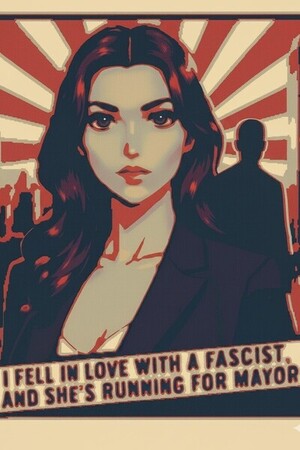
I Fell in Love With a Fascist, and She’s Running for Mayor
I’d never heard someone laugh so hard in my life. I felt humiliated. The laugh was sincere and good-natured, and that only made the embarrassment that much worst.
-Hey, what’s your problem? I blurted out.
-No problem, Jeff said through his laughs, which had subsided to chuckles. No problem. It’s funny. Admit it. Listen, U, I like you, but aren’t you, like, a communist or something?
-Because I think everyone deserves a living wage and a robust social safety net in the richest country on the planet?
-No, U, Jeff laughed. Because you call yourself a Marxist.
I didn’t like that, though in retrospect it made sense that Kendra had told Jeff more about me than he let on that first time we drank together. Kendra’s always evasive about Jeff, and he’s not around anymore to ask. She shuts down any questions I have about him by telling me I’m just being jealous because I think he’s an ex-boyfriend and he’s not. I’m sure he was, but that’s not why I press Kendra for more, even when it gets her turning cold on me.
-I do, I responded to Jeff. Three years have passed since those first drinks with Jeff. It seems like a lot longer. Me and Kendra’s romantic relationship started almost exactly halfway between those drinks with Jeff and today. I have to stop to think about that, because the year and a half before the relationship feels so much longer than this last year and a half, even though so much more has happened in this last year and a half, since our romantic relationship started. I’m getting ahead of myself again.
The conversation with Jeff was important—I brought up how long ago it was, and how long ago it felt, to say that I still remembered it so clearly.
It had been some time since I articulated my ideas as they had been gesticulating [sic] in my mind in the recent years before.
-I’d say I used to call myself a Marxist, and still do, I told him, but now it’s more to be honest than as a political choice. My ideas look and sound Marxist Jeff, but they’re actually American. America was the first classless, stateless experiment, before Karl Marx was a twinkle in his grandfather’s eyes.
-You mean, like, the Indians?
Indigenous people, but I didn’t correct him.
-More than just that, I said before continuing.
This is a romance story, not a political treatise, so I won’t relay verbatim what I expounded to him, though I’m tempted to. My core thesis is that the elements that went into what we call America, from the indigenous population to those brought over enslaved and even those colonists escaping European power structures all resembled in different ways classlessness and statelessness. American geography lent itself to the communist experiment—Marxism before Marxism. European powers tried to wipe it out from the beginning, but the tendency toward statelessness is deeply baked. The American Dream, or its idealized form, is an original Marxist project. The Bill of Rights, in its first two amendments, represents a kind of revolutionary charter against a permanent ruling class. The dream was corrupted from the beginning, from the crimes against humanity of chattel slavery to the indigenous genocide to the hoarding of power by the two-party system and banking interests.
But we also have a blueprint to legally socialize America, without a violent resolution. America is the land of abundance and its people deserve a social dividend, a share of the abundance created by our collective labor over the generations. We have to demand a political system that replaces corporate welfare with public ownership—some two and a half years later the president would do something sort of like that with a big microchip company, converting public subsidies into stock. That was one of the first moments it really felt like Kendra was moving in my direction politically. Here was her hero doing something I’d been telling her was a core strategy in my political program. But once again I’m getting ahead of myself.
I made my elevator pitch to Jeff, and he brought up the usual complaints, which all boiled down to a version of “why should I have to work so hard so someone else can freeload.”
I explained that that was a false dichotomy. It ought to be so simple. I always assumed more people got the message during Occupy Wall Street. There is so much wealth in this country, the richest in the history of the world. No one is poor because of the taxes they pay, and the taxes they pay aren’t going to social services anyway. But they can be.
-You shouldn’t have to work that hard either Jeff.
-But I want to work.
-And that’s great too. Everyone deserves to feel fulfilled. We should work to better ourselves and our community, not to scrape by and barely make ends meet. Government is a massive jobs program already, it’s just not an efficient one. But it can be. The family on food stamps isn’t your enemy Jeff.
-They’re not my problem, either.
-It could be you or your family next. That’s unconscionable in a society as rich as ours.
-I work hard, it’ll never be my family.
-That’s the point. When the economic forces reach a certain level it’s out of your control. We don’t have to live this way. The government is already spending the money—it’s just doing it in a completely wasteful way.
-You trying to turn me into a commie?
-I’m trying to help you realize you’re getting played. I like you Jeff.
-You’re not so bad yourself. And you think you’re in love with the Councilwoman huh? How do you think she’d feel about all of this.
-Opposites attract, don’t they?
Maybe I’ll call her for you, he chuckled as he fumbled in his pocket for his phone. We were both a lot more drunk than we realized, but it was no joke.











Please sign in to leave a comment.