Chapter 30:
The Crimson Dawn part 1
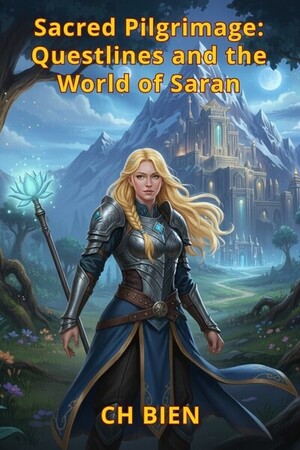
Sacred Pilgrimage: Questlines and the World of Saran
The Blood in the Ashes
The road to Faunia smelled of cinders and old death.
By the time I arrived, the village had already stopped screaming. Only smoke lingered — curling from the husks of homes and barns, carrying the stench of burnt straw and blood. The crows perched along the roof beams had grown fat and lazy, tearing at what the fire had left behind.
I drew my weapon — the silver edge dulled by travel dust — and stepped into what remained of the main square. Charred wood creaked under my boots. A prayer bell lay half-melted in the ash. Someone had tried to ring it, I thought. No one had answered.
Then I saw them.
Three bodies, pale as tallow, slumped beside the well. Not burned — drained. Throats torn, eyes open, as if death had taken them mid-scream. The markings were clear: punctures too clean for beasts, too deliberate for men.
Vampires.
Not the kind of elegant noble parasites the bards whisper about — these were the rabid ones, the feral kind that feed until their skin bursts with stolen blood.
I followed the trail of carnage eastward, into the ruins of an old chapel. The doors had been torn from their hinges, and the stained glass lay shattered across the floor like broken halos. Candles still burned on the altar — half-melted and set in a strange pattern. A ritual circle.
“Welcome… wanderer.”
Her voice slithered through the dark like silk over bone. A figure emerged from behind the altar — once human, now something else. Skin pale as parchment, veins dark as ink. The tattered remains of a nun’s robe hung from her shoulders.
“Sister Elandra,” I muttered, recognizing the name from the half-burnt missives found near the gate.
“You know me?” she asked, tilting her head, her eyes glinting crimson. “Then you know I was faithful once. The light abandoned me first.”
“The light doesn’t abandon,” I replied, circling slowly, “only those who close their eyes to it.”
She smiled, revealing fangs slick with old blood. “Then open yours, child. See the truth of what we are.”
The fight began with a shriek that cracked the silence. She moved faster than any human should, darting through the shattered pews. My blade caught her side, but she didn’t bleed red — the blood that came forth shimmered black and smoking, hissing as it touched the ground.
She clawed, hissed, and vanished into a cloud of shadow.
“Coward,” I spat, slashing through the mist. The silver edge flared faintly with the oil of blessed sage I’d prepared. The vapor recoiled — and there she was again, right before me, eyes wide in fury.
The final strike was not glorious. It was desperate — a thrust through her chest, straight into the blackened cross she wore around her neck. She gasped, eyes flickering with something like sorrow.
“Tell your gods,” she whispered, “they made us monsters.”
Then her body turned to ash.
I staggered back, breathing hard, the chapel now silent except for the groan of collapsing beams. I knelt, brushing the ash aside. Beneath it lay a single relic — a tarnished sun emblem, the old sigil of the Radiant Church.
That was when the light broke through the shattered roof. Not sunlight — something purer, sharper.
Bootsteps echoed from the doorway. I turned to see them: armored figures clad in white and gold, their tabards marked by the blazing sun of the Crimson Dawn.
The man at their head stepped forward, his presence commanding, his eyes sharp as a drawn blade.
“High Inquisitor Garran Salvatore,” he introduced himself. “And you’ve done what few could — slain one of the Fallen without flinching.”
“I didn’t do it for faith,” I said. “I did it because it needed doing.”
“A fine start,” he replied with a faint smirk. “But faith has a way of finding those who act in its name, whether they seek it or not.”
He glanced around the ruined chapel, then at me. “The Radiant Church watches those who stand against the dark. You have the scent of fire about you — tempered, but unyielding. Tell me, wanderer… would you burn brighter, if given purpose?”
Behind him, the other inquisitors watched silently — their eyes gleaming with something between respect and challenge.
I looked once more at the ashes on the floor, then back at Garran.
“Where does the path lead?” I asked.
He extended a hand. “To Citadel Solaria. If your conviction survives the trial, the light of the Dawn shall be yours to wield.”
I took his hand. The ash rose faintly around us, caught in the new sunlight filtering through the ruins.
Maybe it was an omen. Or maybe just dust.
Either way — the hunt had only begun.
The Trial of the Dawn
Citadel Solaria was not what I expected.
From afar, it gleamed — a bastion of marble and gold rising over the cliffs of Jerrath’s western rim, its banners bright against the endless dawn. But up close, the grandeur faded. The gates were ironbound, streaked with soot. The walls bore scars of siege and fire. Faith, it seemed, did not keep the dark at bay so easily.
The guards at the entrance looked me over without a word. One handed me a token etched with the sun’s sigil — half-burnt around the edges — and motioned for me to follow the torchlight down a narrow corridor.
No one spoke as we walked.
The air grew colder the deeper we descended, until the echo of my boots replaced the murmur of prayer. The passage opened into a vast chamber beneath the citadel — the Sanctum of Dawn, they called it. A place where initiates were judged not by their words, but by what they could endure.
High Inquisitor Garran stood upon the dais, his armor glinting faintly under the pale light of soulflames. Behind him loomed three statues — faceless, robed, holding swords of stone angled toward the ground.
“You’ve come far for a wanderer,” Garran said. “But the Crimson Dawn does not accept wanderers. Only hunters.”
I said nothing. The silence stretched until he motioned to the sealed door at the far end.
“Beyond that door lies your trial. Three torches, three shadows. Light the flames, and the Dawn accepts you. Fail, and your ashes join the rest.”
He gestured to the floor — I noticed then the faint trace of white powder forming a ring around the chamber. Bone dust.
He turned away. “You may begin when ready.”
The door groaned open.
The air beyond was heavy, the kind that tasted of iron and rot. I stepped inside with only a single torch and my blade. The door sealed behind me.
The first torch lay upon a stone altar. Around it — bones, arranged like offerings. As I reached for the torch, the shadows shifted. Something rose from the floor — a phantom, thin and starved, its eyes burning red beneath a hood of smoke.
A vampire shade. The remnant of those who failed before me.
It lunged without sound. I ducked, the torch falling to the floor, its flame sputtering. My blade met the thing’s claws — each strike echoed like a church bell in a storm. I forced it back, drove the torchlight into its face. It screamed, smoke pouring from its body as it disintegrated into ash.
The first torch flared to life.
The second was harder.
It lay deep in the catacombs, beside a pool of stagnant water. The reflection in the pool was not my own — it was her. Sister Elandra. Pale, smiling.
“Did you think it ends with one?” she hissed.
Her illusion rose from the water — bloodless, translucent, yet cruelly real. She whispered every word I had doubted since Faunia: The light abandons. The light lies.
I pressed my hands to my ears, but the whispers were inside, crawling beneath my skin.
I struck blindly — my blade cutting only air until at last it met resistance. The illusion shattered like glass. The second torch flared behind me. The whispers stopped.
By the time I reached the final torch, I was bleeding, exhausted, and shaking from cold.
The last chamber was circular, the walls lined with mirrors. My reflection watched me from every side — except one.
I turned.
Where my reflection should have been stood another version of me — cloaked in red shadow, fanged and smiling. My hand tightened on my weapon.
“So this is the light you chase,” the reflection said. “The same fire that burned the world you walk.”
“I’m nothing like you.”
“You could be. All it takes is hunger.”
It moved faster than thought. The clash of blade against blade shattered the mirrors, splinters of silver light raining down like snow. My breath came ragged. I fought harder, faster, until I realized — every time I struck, it matched me perfectly.
Then I understood.
The trial wasn’t to defeat it — it was to outlast it.
When the reflection raised its blade for the final blow, I dropped mine. The strike passed through me, harmless. The illusion faltered, confused. I reached for the last torch and lit it with my own flame.
Light filled the chamber.
The reflection screamed, dissolved, and the mirrors shattered completely.
When I returned to the Sanctum, Garran was waiting. He regarded me in silence for a long moment, then nodded.
“You faced shadow and did not falter. You understand the first truth of the Dawn — that light is not the absence of darkness, but the will to stand within it.”
He placed a medallion in my hand. A sunburst carved in silver, warm to the touch.
“Welcome, hunter,” he said. “You are one of us now.”
As I rose from my knees, I looked again at the statues behind him. For a moment, I thought I saw their swords raise slightly — as if in acknowledgment.
Or maybe it was the torchlight playing tricks again.
That night, I stood atop Citadel Solaria’s ramparts. The city below was quiet, its streets bathed in the pale glow of the moon. Somewhere out there, vampires still hunted, their laughter carried on the wind.
But for the first time in years, I didn’t feel like a wanderer.
I felt like the hunter I was meant to be.
And the Dawn had only just begun to rise.
The Pale Hunt
Three days after the trial, the sun finally rose red.
Not dawn-red — blood-red. A warning.
From the citadel’s watchtower, I could see the scarlet haze spreading over the northern horizon. The bells of Solaria rang once, twice, then fell silent. Every hunter in the courtyard froze mid-prayer. We knew what it meant.
Vampires were on the move.
High Inquisitor Garran gathered us in the Hall of Radiance — a chamber of marble and flame where the air always smelled of incense and steel. The others stood in lines, cloaks drawn tight, eyes gleaming behind their half-masks.
“The Pale Hunt begins,” Garran declared. His voice carried through the hall like a blade through smoke. “Our scouts have found signs of an ancient bloodline stirring in the ruins of Malwyn. A noble, once thought destroyed — Count Meryth of the Black Chalice.”
The name stirred whispers among the hunters. Even I’d heard it — a vampire lord who ruled over the Malwyn Highlands a century ago. His court was said to bathe in the blood of pilgrims and toast beneath the moon with golden goblets filled from their veins.
“If he rises,” Garran continued, “the Crimson Dawn’s work will burn for nothing. His brood festers beneath the hills, feeding on the living like cattle. You will ride there. You will cleanse it.”
He turned to me. “You’ll lead the vanguard.”
I blinked. “You trust me that much?”
He smiled faintly. “No. But I trust the Dawn to reveal its own.”
The journey to Malwyn took two days. Mist clung to the hills like cobwebs, and the air grew colder with every mile. Birds avoided the road entirely. The land felt wrong — drained, like the earth itself had been bled dry.
Our group was small: myself, two inquisitors — Martin and Brother Cael — and a wagon of silver-bound stakes and flasks of blessed oil.
We camped by the old chapel ruins that night. The air was too quiet.
“Do you think we’ll find him?” Martin asked, staring into the fire. His voice was soft, but his hand never strayed from the hilt of his blade.
“Count Meryth?” I asked. “If we’re lucky, he’s dust. If not… he’ll make us wish he was.”
Brother Cael chuckled darkly. “I heard he once drank a bishop dry and kept the bones as a flute.”
“Old campfire tales,” Martin muttered.
“Maybe,” I said, “but the tales have a habit of being true in places like this.”
That was when the wolves started howling.
Except they weren’t wolves. The sound was too sharp, too human.
We found the first body at dawn. A farmer — or what was left of one — slumped against a tree with his throat torn open and the ground around him slick with half-frozen blood. His eyes were gone.
Cael made the sign of the sun and muttered a prayer.
I knelt beside the body. “Still warm,” I said. “They’re close.”
Martin pointed toward the tree line. “Tracks. Not fresh, but recent enough.”
We followed them up the slope, through withered grass and frost, until the trees broke and we saw it: the Manor of Malwyn, the old Black Chalice seat, half-buried in mist and ivy. Its windows glowed faintly red, as though the house itself bled light.
The gate creaked open as we approached.
Inside, the silence was suffocating. Chandeliers dripped with wax, the musty scent of old tallow heavy in the air. A grand dining table stretched across the hall, covered in half-rotted food — bread blackened with mold, wine turned to thick, clotted sludge.
And then the laughter began.
Soft at first. Then rising — echoing through the halls, warped and elegant.
“Hunters…” the voice purred. “So long since I’ve had guests.”
A figure stepped from the shadows of the upper balcony, tall and draped in black velvet, his skin as pale as moonlight through glass.
“Count Meryth,” I said.
He smiled, showing perfect fangs. “Ah. So the Dawn still sends children to do a god’s work. Tell me — do they promise you salvation for slaughter, or just the comfort of obedience?”
I raised my weapon. “There is no promise, only judgment. We deliver sentence.”
“Then deliver yourself,” he said, and the air shattered.





Please sign in to leave a comment.