Chapter 13:
The Ashes of Stratweiler
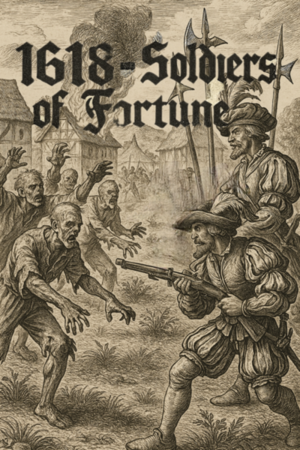
1618 - Soldiers of Fortune
I awoke late.
The strain of the day before had drained me and my body felt as though it had been beaten with hammers.
Daylight filtered through two narrow windows and showed me the full extent of the former prison chamber.
Ida had claimed she had fled up here when all this began.
Already that seemed doubtful.
Either she had lied, or she had made this place her refuge long before the dead began to walk.
Those questions circled in my head as I lay there.
At length I resolved to speak with her and turned, expecting to find her at my side.
But there was no one.
She was gone.
My crossbow gone.
My purse gone.
I let out a long sigh instead of a curse, since I could hardly claim to be surprised.
She had taken exactly what she had wanted from the very beginning: my weapon, my coin… and her sport.
She had left me my clothes, my rapier, and my pistol.
There was nothing for it but to return to the camp and look for her at the tavern, though I doubted she would show herself there.
I dressed, left the keep, and crossed the deserted courtyard.
The gate still stood open.
Ida had clearly been in some haste.
At the foot of the castle hill, the four dead Landsknechts of the Hellish Fähnlein still lay where they had fallen.
No one had come looking for them.
Then the truth struck me.
“The Fähnlein!” I gasped.
I had failed utterly to expose their treachery and I wondered if there was still time for me to stop them.
As if in answer, a cannon thundered.
Then another.
And another.
All from within the city.
What in God’s name?
I hurried down the slope until I reached a rocky ledge that offered a clear view.
Landsknechts swarmed through the streets like ants, all of them streaming toward the western barricades.
There, behind the armoury, where I had received my orders the day before, the defences lay in ruins.
Masses of dead poured through the breach.
The guns posted there spat fire without pause into the heaving flood of bodies.
Rotten limbs burst apart, flesh was torn away and flung aside, yet it did not matter.
However many gaps the cannon tore into the horde, they closed again at once.
Every man who fell to them rose shortly thereafter, shuffling toward those he had just fought beside.
At other barricades I saw figures tearing down the defences.
Remnants of the Hellish Fähnlein were dismantling the barricades themselves, clearing a way for the dead into the city, exactly as they had planned.
They must have turned back soon after leaving for the dovecote, slain the guards at the western lines, and then set about fulfilling their mad design.
I had had the chance to unmask them.
Instead, I had spent the night in bed with a thief.
Even now, as I tell this story, that thought still weighs upon me.
Back then it near crushed me.
I dropped to my knees as the full weight of it settled over me.
“My God,” I whispered. “What have I done?”
The Hellish Fähnlein had seized the cannons and were firing not at the dead but at the remaining intact barricades.
At last the dead surged into the eastern city, unstoppable.
The survivors of the Fähnlein fell to their knees, arms spread wide, as though to receive a blessing.
The dead reached them first and tore their willing flesh to pieces.
Word of the breach ran swiftly through the streets.
Panic erupted among soldiers and townsfolk alike.
Some of the citizens tried to flee through the eastern gate, but Hauptmann von Rundstedt’s men drove them back, at times with force.
In their terror many had forgotten there was nothing beyond the outer walls but more of the same horror.
There was no escape.
The other officers shouted themselves hoarse to restore order.
Some simply broke under the strain.
I sprang to my feet again, desperate, raking my mind for all that might have been.
I could have gone to van Arens.
To the Obrist.
To any officer who would listen.
The treacherous parts of the Fähnlein might have been arrested.
The city… might have held.
Instead...
Instead I had chased after Ida.
My anger broke outward.
“That damned whore,” I hissed. “She led me astray. She knew of their plot, so why did she not warn anyone? This is her doing, not mine…”
All I had forced down thus far surged up at once: the stench, the slaughter, the feeling that the world itself was ending.
Despair closed its fingers round my throat, and with it came a quiet, poisonous thought.
I could simply leave it all behind.
I drew my pistol and stared at it.
Was this truly the only way left?
I do not know how long I knelt there, the barrel resting in my hand.
Something pulled me from that stupor.
Fresh shouting, the roll of commands, more cannon fire.
Much of the eastern city had already fallen.
The dead tore through the camp and the quarters of the tross.
But on the high ground of the upper town the Obrist had gathered what remained of his strength.
He had sealed off the square around his headquarters.
In the middle of that square, mounted on a horse, he sat like a dark spearhead, bellowing orders.
For the first time since the dead had broken through, there was discipline again.
He had drawn up his men into a fortress of flesh and steel.
At every approach to the square three ranks of halberdiers knelt, blades thrust outward like an iron fan against the dead, between them shields were slammed into the ground by their comrades.
Behind them, on the raised ground of the square itself, stood the remaining crossbowmen in two lines.
When one rank fired, the other reloaded.
On the roofs around the square, more Landsknechts had taken position, most of them with the few long-rage weapons that remained, mostly muskets.
From that height even such clumsy guns could be of use, though their reload was painfully slow.
Whenever there came a lull in the assault, men dragged planks up to the roofs and bridged the gaps between houses, making a kind of walkway in the air.
From this path they could move quickly above the streets, hurling down whatever would hinder the undead, furniture, tiles, rubble, until alleys and lanes clogged and became impassable.
The Obrist never ceased his movement, riding along the lines, shifting men, shouting.
After a time it almost seemed the dead might be held.
The lines solidified.
For the moment, at least, some might yet be saved.
For a while.
I, however, had no notion what to do.
The city was, in truth, lost.
Sooner or later the dead would press even up to the castle.
Without a horse, there was no hope of escape, and I did not even know where the soldiery kept their own stables, if they still stood.
I looked down at the pistol again.
The thought of ending matters on my own terms grew steadily more tempting.
Slowly, I raised the loaded weapon to my temple and gazed out over the dying city of Stratweiler.
I closed my eyes and tried to make my peace with God.
Footsteps echoed on the path to the castle.
I turned, the barrel still pressed to my head, and saw a familiar face.
“Was the night with me truly so dreadful?” Ida asked.
This girl seemed determined to haunt me.
Rage flared hot and swift.
I lowered the pistol from my temple and levelled it at her instead.
“You,” I snarled. “All this is your doing. They are dead because of you!”
“My doing?” she said, brows lifting. “Did I drag you after me? Did I force you into my bed? Do not grow so saintly all at once. You might have gone to your precious Hauptmann at any time and told him all you knew.”
“I… you seduced me!” I protested.
She laughed, hard, without mirth.
“The way you stared at me in the tavern, as if I were blind, I’d say it was rather the other way round.”
I clenched my jaw.
She was right, of course.
It had been my own weakness that led me up the hill.
“But why did you not warn anyone?” I pressed. “You knew of the Fähnlein's plan. You said yourself you needed the knowledge from the dovecote and meant to escape this city!”
She smiled, a sharp, dangerous smile.
“Just so. And I shall have both.”
She had lost her wits.
“Have you even seen what is happening?” I cried. “The city has fallen. You are as trapped here as I am. The dovecote is as unreachable to you as to any man.”
“Oh, is it?” she said. “Look again.”
She stepped beside me and drew my gaze toward the western part of Stratweiler, where the dovecote rose beside the town hall and the kontor.
The streets below were red with blood and strewn with wreckage.
But they were almost empty.
Only a few scattered dead still wandered the western city.
The great swarm had poured eastward, drawn toward the camp and the panicked masses, toward their feast.
I stared at Ida.
“Not all the Landsknechts in the city together could have reached that dovecote,” she said. “But now? Now the streets to the west lie almost open. While the dead gorge themselves, we can slip by.”
“You would have me believe you planned this from the start?” I asked hoarsely. “You meant those people to die?”
The accusation struck home, I saw it in her face.
She did not like being called heartless, but what else could one call such cold reckoning?
“Do you think I took pleasure in it?” she finally snapped. “There was no other way. They would have died soon enough in any case. Food was already failing. Better a swift death than slowly rotting in this trap.”
I looked at her, truly looked.
Whatever else she might be, she was no simple serving girl.
That much was certain now.
“Well?” she said at last.
“Well what?”
“Do you still mean to creep away like a craven?” She nodded toward my pistol. “Or will you come with me and keep fighting?”
I hesitated.
Everything in me recoiled from trusting her again, from following her anywhere.
Yet the pistol felt suddenly heavier in my hand, colder, more final than it had a moment before.
So long as even the faintest chance remained, the pistol was no longer an answer, I realized.
I nodded.
Not because I trusted her, but because to turn away now felt like tempting God Himself.
“Good,” she said. “Then let us finish what was begun.”
She smiled and tossed me my crossbow.
“Forgive me for borrowing it,” she said. “I wished to try it.”
She turned and started down the path.
I followed.










Please sign in to leave a comment.