Chapter 3:
2. A Lesson in Invisibility
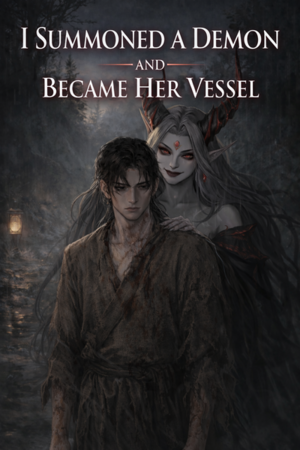
I Summoned a Demon and Became Her Vessel
I didn't advance at once.
The voices ahead resolved themselves gradually as I listened through Wei's ears: rough, uneven speech layered with deference and impatience. The cadence was familiar in pattern, if not in language. Authority announced itself not by volume, but by expectation. Others adjusted around it instinctively.
Hierarchy. Predictable.
Wei's breathing changed as the sounds grew clearer. His shoulders tightened, spine drawing inward as though attempting to make himself smaller without conscious intent. His body remembered this place even if his mind did not wish to.
I gathered the response.
"Remain," I told him.
He froze instantly.
I extended my perception outward, careful to remain shallow. This world resisted intrusion when approached directly but yielded readily through intermediaries. Through Wei, the air carried more than sound, scent, heat, and subtle pressure shifts. Damp earth. Wet pine. Iron. And the metallic smell of old blood.
A road, recently travelled. And recently contested.
Figures moved beyond the mouth of the tunnel. Several. Their footfalls were uneven, the movement of those accustomed to power without discipline. One carried metal that chimed softly with each step. Another radiated a faint pressure that set the living dust in the air trembling.
That one was different.
I leaned closer to Wei, not touching him, merely narrowing the distance. My presence slid into the space his shadow occupied, stretching it subtly across the stone. It was a simple trick of perspective, folding myself into the negative space of the light.
His pupils dilated reflexively. The faint tremor returned to his hands.
"Observe," I instructed.
He swallowed and obeyed.
The tunnel opened fully, spilling us into a narrow cave with rainwater. Lantern light bobbed ahead, casting a long, distorted shadow against the rock face. Wei's shadow did not quite match his movement. It lingered where I stood, heavier than the surrounding night.
Three men stood clustered near a broken cart, their robes marked with sigils stitched in thread that caught the light too eagerly.
Symbols of belonging. Branding.
One of them turned.
"Who's there?" He barked, hand dropping to the hilt of his blade.
Wei flinched.
His shadow deepened beneath him, forming unnaturally for a heartbeat before settling.
I felt the urge ripple through him to kneel, to explain, to apologise for existing. Years of conditioning compressed into a single moment of indecision. He wanted to offer his neck.
I didn't correct him.
I wanted to see which instinct won.
After a heartbeat, he straightened, only slightly, but enough to matter. His chin lifted a fraction. His eyes did not quite meet the man's, but they did not flee either.
Interesting.
"I—I'm just passing through," Wei said. His voice wavered, then steadied. "I was… injured."
The man's gaze sharpened. He stepped closer, lantern swinging. The light washed over Wei's face, lingering on the bruises, the blood-stained burlap, and the unmistakable signs of recent ritual work.
The lantern light slid across the ground and bent faintly at Wei's feet, as though encountering depth where none should exist.
Suspicion bloomed.
"What sect are you from?" the man demanded.
Wei hesitated. He did not know the answer. Was he still in his 'sect'? Was he a rogue? Was he mine?
I leaned in and whispered, not into his ear, but into the space behind his thoughts.
"Say nothing."
His mouth closed with an audible click.
The man's eyes narrowed. "Cat got your tongue?"
The pressure from the third figure, the one I had noted earlier, shifted subtly. Not aggressive. Assessing. The living dust stirred around him in response, drawn and repelled in equal measure.
A local practitioner, then. Crude, but functional.
"Move aside," that one said calmly, stepping into the light. He looked at Wei with bored, clinical eyes. "He's empty."
Empty.
The word carried weight here. An insult. A diagnosis.
The lantern-bearer laughed. "Looks broken to me."
Wei's jaw tightened. His hands curled slowly into fists.
I felt the sealed current within him respond, not surging, not leaking, merely present. Heavy. Patient. Waiting. It was not empty. It was full of something they did not have a name for.
The practitioner frowned.
He stepped closer, eyes narrowing as he studied Wei more carefully. His brow creased, confusion replacing certainty. The static around him buzzed in agitation.
"…No," he muttered. "That's not right."
Good.
I smiled, unseen.
The man reached out, fingers hovering inches from Wei's chest, hesitating as if unsure what permission he required. He was reaching for the Qi, expecting the flutter of a broken bird.
Instead, his hand passed briefly through the edge of my shadow.
I allowed Wei's fear to spike, just a little.
Enough.
The practitioner retreated, his hand snapping back as though he had touched a hot stove or absolute zero.
"What did you do?" he demanded, clutching his wrist.
Wei blinked, genuinely terrified. "I—I didn't—"
"Enough," the lantern-bearer snapped, impatient with the delay. "We're not here to play healer. If he's broken, he's not our problem. Leave the trash."
They turned away, attention already shifting back to their cart, their mission, and their hierarchy. They dismissed him because he did not register as a threat nor as a resource.
Just like that.
Wei exhaled shakily, his knees almost giving out.
I noted the reaction with satisfaction.
"You see?" I murmured to him as their footsteps faded. "They sort themselves. Predators do not concern themselves with stones."
He did not respond aloud.
He did not need to.
We waited until the lantern light faded and the pressure receded. Only then did I step fully free of his shadow. The darkness beneath him thinned, aligning properly with his body once more.
"You survived," I said. "How adequate."
…
Wei did not collapse.
That alone was noteworthy.
He stood there at the mouth of the cave, shoulders hunched, breath shallow, rainwater dripping from his hair onto the stone. His knees trembled, not from injury, but from delayed reaction. The body released what the mind had been forced to hold.
Mortals were inefficient operators. They experienced terror twice: once when it occurred and again when it was safe to remember it.
I watched the second wave crest and pass through him.
He swallowed. His fingers flexed once, then stilled. He didn't look at me. He didn't need to. The awareness of my position was already engraved into him, a constant spatial certainty at the edge of his senses. I had moved from presence to reference point.
Good.
"Walk," I said.
Not a command. A continuation.
Wei obeyed.
We followed the ravine until it narrowed into a forest path, mud thick beneath our feet, pine needles slick with rain. The sky above was uniform slate, heavy with unspent thunder. This region had not decided whether it wished to storm or merely threaten.
Indecisive climates often produced rigid cultures.
Wei's steps were uneven at first. His movement still favoured caution, each footfall placed as though the ground might revoke permission at any moment. I allowed it. Habits dissolve more cleanly when not directly challenged.
I adjusted my proximity instead.
At first, I remained partially aligned with his shadow, not fully separate, not fully merged. A parasitic angle of existence. When his pace slowed, my presence pressed forward, not physically, but conceptually, introducing a sense of lag behind him that his body instinctively sought to correct.
He quickened.
When his breath grew shallow, I receded just enough that the sealed current within him grew restless, pressing outward against its containment. Not pain. Pressure. Anticipation.
He steadied his breathing without realising why.
I did nothing else.
Observation didn't require interference.
Ahead, the forest thinned, revealing the outskirts of a settlement. Not a town proper, no walls, no wards worth naming, but a gathering of structures that pretended permanence. Wooden houses were elevated slightly above the mud. Smoke curling from narrow chimneys. The faint hum of human activity layered with routine and resignation.
We slowed.
Of course he did.
This was where his previous life had ended, not here, precisely, but in places like this. Places where one's worth was assessed quickly and enforced without malice. Cruelty was rarely personal.
"Continue," I said.
His jaw tightened.
He stepped forward anyway.
The first person we passed was a woman carrying a basket of roots. She glanced at Wei, her gaze sliding over him without pause. No recognition. No alarm. Her eyes moved on as if he were a gap between objects rather than an object himself.
The second was a man repairing a fence. His hammer slowed when Wei passed, not stopping, merely missing a beat. His brow furrowed, confusion flickering briefly before smoothing away. He resumed his work with unnecessary force.
The third was a child.
The child stared.
Children had not yet learnt what they were allowed to perceive.
Wei noticed. His shoulders stiffened, instinct urging him to bow, to apologise, to vanish. He did none of those things. He walked past.
The child's eyes followed his shadow, not his face.
I smiled.
We entered the settlement fully.
No wards flared. No talismans reacted. A detection array mounted above a central wall pulsed once, hesitated, and returned to dormancy.
The system didn't know what to do with him.
Excellent.
Wei's internal state adjusted gradually as the absence of reaction accumulated. His fear didn't spike; it redistributed. Without an external trigger, it turned inward, searching for instruction that didn't arrive.
He was learning silence.
I withdrew further.
Not completely, never completely, but enough that the dependency line slackened. The sealed current within him responded immediately, growing heavier, denser, settling lower in his core. It didn't circulate. It waited.
Wei stumbled once.
He caught himself against a post, breath hitching. For a moment, his eyes unfocused, his awareness folding inward as he assessed his body for failure.
I didn't intervene.
He straightened on his own.
Interesting.
We passed a small open structure that served as both notice boards and judgement posts. Paper charms fluttered weakly in the damp air, each stamped with seals of varying authority. Notices of debt. Missing persons. Recruitment calls were thinly veiled as an opportunity.
Wei glanced at them reflexively.
I noted the micro, expression, and habitual hope, instantly suppressed.
He didn't stop.
Good.
"Why are they not stopping me?" he asked quietly.
The question was not fear-driven. It was analytical.
Progress.
"Because you are no longer useful to them," I replied. "Nor are you threatening."
He absorbed this without protest.
We reached a narrow alley between two structures, the air thick with trash and old water. I paused there, stepping fully out of alignment with his shadow. The darkness beneath him corrected itself, snapping back into a shape that matched his outline precisely.
Wei noticed immediately.
He turned halfway toward me, then stopped, uncertain whether the action was permitted.
I waited.
He faced me fully.
Up close, the changes were more pronounced. His posture was still guarded, but the frantic edge had dulled. His eyes held exhaustion, yes, but also something else. A developing recalibration. As if his internal scale had been reset and was now searching for reference.
"What happens now?" he asked.
Not what will you do.
What happens.
I considered him.
"This settlement will forget you within the hour," I said. "You will not be recorded. You will not be remembered unless you force yourself into relevance."
His throat moved.
"And if I do?"
"Then they will attempt to categorise you," I replied. "Classification precedes control."
He nodded slowly.
"Is that… bad?"
"For them?" I said. "Yes."
A flicker of something passed through his expression. Not satisfaction. Not fear.
Relief.
I turned away.
"Come," I said. "There is nothing here worth claiming yet."
Wei followed.
As we left the alley, the detection array above the wall pulsed again, longer this time. A hairline fracture appeared along one of its etched lines before sealing itself shut.
No alarm sounded.
No one noticed.
I did.
This world was beginning to feel us.
And it did not like the shape of the silence we carried.




Please sign in to leave a comment.