Chapter 8:
4.5 What Am I?
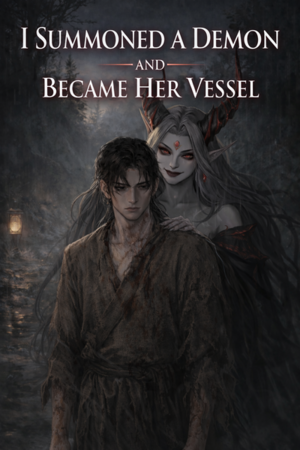
I Summoned a Demon and Became Her Vessel
I didn't know what I was anymore.
We walked for most of the morning without speaking. As the forest gave way to curated paths, I felt a familiar, suffocating weight settle on my shoulders. The stones here were stacked for function, not beauty. The earth was packed hard by thousands of feet, generations of people walking exactly where they were told to walk.
My pace slowed. My shoulders tightened. My breathing adjusted into a shallow, regulated rhythm I hadn't consciously chosen. It was the rhythm of a disciple approaching a master or a beggar approaching a magistrate. My body remembered what it meant to be evaluated, not by cruelty, but by procedure. The memory of it made my stomach turn.
I kept my eyes on the ground, waiting for Mistress to tell me to stop, to hide. She said nothing.
…
The structure stood at the edge of the settlement. It wasn't a palace, nor a dungeon. It was something worse: an administrative hall. It was a place where people went to be processed. I hated these places. These were the places where they told you what you were worth, and for me, the answer had always been nothing.
Inside, the air smelt of ink, dry paper, and restrained anxiety. It was the scent of judgement.
A man sat behind a long wooden table. His posture was straight, his expression neutral. He looked like every elder who had ever told me I was trash, every clerk who had ever denied me entry. Behind him, rows of scrolls were slotted into cubbies, thousands of lives reduced to weight and measurement. Bound. Filed. Dead.
He looked up as we entered.
"Name?" he asked automatically, brush already lifted.
I hesitated.
It wasn't just fear. It was a sudden, violent dissonance.
I opened my mouth to say it. Wei. Just Wei. Or maybe Wei of the Low Valley. Or Wei the Reject. The labels I had carried my whole life rose in my throat, but they stuck there. They felt heavy. They felt caustic.
I realised with a jolt of panic that I couldn't bear to say them. To speak that name was to invite all the history attached to it, the beatings, the hunger, the shame. If I said my name, I would become that boy again. I would be stepping back into the cage I had just crawled out of.
I wasn't him anymore. But I didn't know who else to be.
I opened my lips, then closed them again.
Mistress didn't intervene. She stood there, a tall shadow in my peripheral vision, watching me struggle with my own ghost.
The man frowned slightly. "Your name," he clarified, irritation threading his tone. He wanted a label. He wanted to file me away.
I glanced at Mistress.
She hadn't told me what to say. And looking at her cold, impassive face, I knew she wouldn't. She was letting me drown in the question.
"I…" I began, then stopped. My brow furrowed, confusion tightening into physical strain. The word wouldn't come. It was dead. "I don't—"
The man exhaled through his nose, a sharp, dismissive sound. "Everyone has a name."
"Not everyone," Mistress said calmly.
The man finally looked at her properly.
His gaze paused, slid, then returned, as though his eyes couldn't quite find purchase on her. He straightened, smoothing his robes with a reflexive tug, reasserting his posture as if form could restore his crumbling authority.
"And you are?" he asked.
"I am not relevant," she replied.
He laughed once, sharply. "Everyone is relevant here. That is the purpose of the Registry."
He turned back to me, dismissing her. "Sect affiliation?"
I shook my head. That was easy. I belonged nowhere.
The man's brush hovered, tip trembling slightly. "Place of origin?"
Another pause. My jaw tightened.
He wanted to know where I came from. He wanted a village, a province, a root. But my roots had been severed. If I told him where I was from, I was admitting I belonged to that land, to those laws.
"I don't know," I said.
That was true enough to be dangerous. To forget your home was to be broken.
The man's irritation sharpened into alertness. He dipped the brush into the inkstone, the black liquid gleaming. Ink was a binding substance. It didn't merely record; it asserted. He was going to write me down. He was going to trap me in paper.
"You understand," he said, voice slower now, "that this is not optional. If you are a rogue cultivator, you must be logged. If you are a mortal, you must be census-tagged."
"I understand," I said quietly. "I just can’t give you what you’re asking for."
The man’s lips thinned. "Fine. I will list you as ‘Unknown Origin'."
He pressed the brush to the paper.
The ink touched the surface.
And then it pooled.
It did not dry. It did not sink into the fibre. It sat on top of the parchment like oil on water, refusing to bind.
I stared at it, my blood running cold.
I knew how ink worked. It stained. It bit into the fibre. It marked things as real. But this... this was unnatural. The black droplet trembled on the paper as if it were repulsed by the very idea of describing me. It wasn't just failing to write; it was recoiling.
What is happening? I thought, panic fluttering in my chest. Am I a ghost? Am I already dead?
As the man watched, the black droplet quivered, then slid off the page entirely, dripping onto the wooden desk.
The paper remained pristine. White. Empty.
The man stared.
He dipped the brush again, harder this time, slashing a character for Rogue with enough force to score the page. He was angry now. He wanted to force the world to make sense.
The ink vanished.
It didn't fade. It simply ceased to exist.
My breath caught. It felt like a violation of the natural order. A name written down is supposed to stay. That is the law of the world. But Mistress had done something to me, or taken something from me, that made me incompatible with the physical act of being recorded.
That was the moment.
Not when he frowned. Not when his breath caught. But when he reached for language and found it insufficient. He looked at me, and for the first time, he didn't see a peasant. He saw a hole in the world. He saw something that his tools couldn't touch.
He tried again, his voice tight. "What are you?"
The question carried weight here. Not curiosity. Jurisdiction.
I inhaled.
My instinct surged to explain, to justify, to compress myself into a shape that would be accepted. Years of training screamed at me to make myself small, to beg for forgiveness, to be something he could understand so he wouldn't hurt me.
But I checked inside myself, searching for a definition, and found only Mistress's silence. I was a void where a person used to be.
"I don’t know," I said at last.
The man stared at me.
Silence accumulated. Around us, the room continued its function. Papers shuffled. Someone coughed. Life moved forward, indifferent to the fracture opening here.
The man cleared his throat. "Everyone is something," he said, too quickly. He sounded desperate. He needed me to be something so his world would make sense again.
"That assumption", Mistress replied, "is doing more work than your system can support."
His eyes flicked to her again, sharper now. He looked at the clean paper, then at his brush, then at me.
"Titles stabilise," she continued. "Stabilisation invites enforcement. Enforcement demands resistance. Resistance creates failure."
He frowned. "You’re speaking nonsense."
"No," she said. "I’m speaking structure."
He stood abruptly, chair scraping against the floor. "If he has no name, no sect, no classification, then he cannot be processed. That is the point."
The man’s expression hardened. "Unregistered individuals are not permitted."
"By whom?" she asked.
He hesitated.
I held my breath. I felt the invisible weight of the hierarchy hanging over us.
"The system," he said finally.
Mistress smiled faintly.
"Systems fail," she said, "because they believe themselves complete."
He reached for a small brass bell on the desk, a summons for the guards.
I stiffened, instinctively bracing for consequences.
Mistress placed a hand lightly against my back. It wasn't a push. It was an anchor.
"Observe," she told me.
The man’s fingers touched the cold metal of the bell.
He needed to ring it. But to ring it, he had to report an intruder. To report an intruder, he had to name the intruder.
If he rang the bell for Nothing, he admitted that his system had a hole in it. That his jurisdiction was not absolute.
His fingers hovered.
Trembled.
I watched him, and my fear began to curdle into confusion. He wasn't ringing it. Why wasn't he ringing it? He had the power. He had the law.
And then I realised: he was afraid. He was afraid of the blank space where my name should be. He was terrified of the silence I carried.
He pulled his hand back.
"If he is not named," the man whispered, staring at the empty parchment, "then he is nothing."
I flinched. Nothing. The word echoed in my chest.
I did not flinch because it was an insult. I flinched because it felt true. And being nothing was terrifying. It meant I had no place. No protection. No right to exist.
Mistress did not flinch.
"Gods fail," she said evenly, "because they accept titles. Demons fail because they embrace form. Your world mistakes both for permanence."
The man’s face had gone pale. His eyes dropped to the ink stain on his desk, the only mark I had left.
I turned to her, confusion and something sharper cutting through my exhaustion.
"What am I, then?" I asked. The question was a plea.
I met her gaze.
"You exist in a pre-named state," she said. "That is why they cannot hold you."
The man backed away from the table, suddenly aware that he had lost control of the encounter. "This is dangerous," he muttered. "Things without names—"
"—cannot be ordered," she finished.
Silence fell again.
I felt the pressure ripple outward, not force, but recognition. Somewhere beyond this room, the world noticed a discrepancy it could not resolve.
I felt it too.
My breathing slowed. The fear that had defined my life receded, replaced by something steadier. Understanding. I wasn't being rejected because I was weak. I was being rejected because I didn't fit. The paper didn't refuse me because I wasn't worthy; it refused me because I was too vast for it to hold.
We left without being stopped.
No command was issued. No record was made. The system chose avoidance over contradiction.
Outside, the air felt thinner. Cleaner.
I finally spoke, looking at my hands, expecting them to dissolve.
"You could have made me strong, Mistress," I said.
"No," she agreed. "Strength invites measurement."
"And names?"
"Names invite cages."
I absorbed that quietly as we walked.
"I will not make you powerful," she continued. "I will make you unclassifiable."
I stopped.
She turned back to me.
"That frightens them more," she said, "than anything they can fight."
I swallowed. "What happens next, Mistress?"
She considered the land ahead: denser population, layered authority. Places where ambiguity was not tolerated but punished.
"I will place you somewhere that demands categorisation," she said. "And we will observe what breaks first."
My expression tightened, not with fear, but with resolve.
"And if they try to destroy me?"
She smiled, thin and precise.
"If they cannot name you," she said, "they will attempt to destroy you. That will teach us much."




Please sign in to leave a comment.