Chapter 1:
Kīla
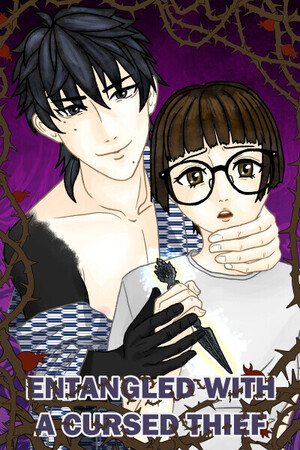
Entangled with a Cursed Thief
Suwa Midoriko paced up and down the rows of the National Museum of Ethnology’s collections storage, practically bouncing as she walked.
The floor-to-ceiling shelves were full of neatly organized and tagged cultural artifacts from all over the world. Today, they would be receiving some new cultural artifacts found buried at a Buddhist temple site on nearby Shikoku Island—generously donated by the temple itself.
Acquiring and cataloguing new items for the museum’s collection was exciting enough for a doctoral student like Midoriko, but what really excited her was the purported curse on one of the objects.
One of Midoriko’s primary research subjects as an anthropology student was the intertwined nature of folklore and the occult. She’d traveled all over Japan during her university career seeking out cursed objects and documenting them. It was part special interest, part pet project.
She felt like she’d seen everything Japan had to offer in terms of cursed objects until she heard about this artifact. Just thinking about it filled Midoriko with excitement that threatened to overflow. As she pranced past a shelf containing West African pottery, a woman’s voice called out.
“Miss Suwa? Are you in here?”
It was her colleague and mentor, Dr. Tanaka—the exact person Midoriko had been expecting.
“I’m right here!” Midoriko exclaimed as she popped out from behind a shelf full of Polynesian wood carvings, startling Dr. Tanaka.
“Ah! Please don’t scare me like that! I’m old!” she said, dramatically clutching her chest.
“Aw, come on! You’re not even a grandma yet!” Midoriko chided as she walked ahead of the middle-aged Dr. Tanaka.
“Sure, sure. But I’m still on edge from transporting that thing here,” Dr. Tanaka said with a sigh.
“You don’t think it’s actually cursed, do you?” Midoriko smirked as she adjusted her glasses.
“You’re the expert here. You tell me,” she replied, gesturing toward the object on the work station in front of them.
To anyone else, the box wrapped in plain cloth may have looked like someone’s misplaced lunch box. But to these scholars, they understood the danger lurking beneath that cloth.
At the Buddhist temple where it was unearthed, every single monk who had come in contact with the artifact had fallen seriously ill. It was believed to be due to the cursed object’s influence.
After donning N95 masks and blue nitrile gloves, Midoriko and Dr. Tanaka unwrapped the cloth to reveal a lacquered box painted with beautiful vajra and lotus designs. It was extremely old—pigments of red, green, and yellow-gold flaked off easily.
“So what do you think?” Dr. Tanaka asked.
“I think I’m glad we put on PPE,” Midoriko replied. She examined a fleck of red paint on her glove and ground it to dust between her fingers. “What were their symptoms again?”
“Severe flu-like symptoms mostly. But they also experienced skin rashes and tremors,” Dr. Tanaka explained in a clinical tone.
Midoriko looked up from the box. Her mask hid the grin she was unable to contain. “Mercury poisoning…”
“One hundred points!” Dr. Tanaka said in a low but excited voice as she softly clapped her hands. “I knew you’d figure it out!”
Looking over the box again, it was no wonder that the monks became ill. They’d probably handled it over and over again. With the cinnabar pigment flaking off, they would have been constantly inhaling it or unknowingly ingesting it if it got on their hands.
“By now, most of them have made a full recovery, but one elderly monk died. That’s what prompted them to offer this thing to us,” Dr. Tanaka explained, her tone a little more somber.
“That’s unfortunate,” Midoriko said, shaking her head. She understood why they believed the thing to be cursed. It was a common conclusion that most people made in situations like this.
Mysterious object is found, everyone who comes in contact with it experiences some kind of misfortune, they get rid of the object, and the misfortune ends. It’s a tale as old as time.
While causation does not equal correlation, a logical explanation can be found for such phenomena. In the case of this box, it was simply toxic pigments—cinnabar, arsenic, and lead. But something didn’t quite make sense to Midoriko.
“I was under the impression that this cursed object was a knife.”
“Correct. It’s inside the box,” Dr. Tanaka said, tapping the lid. “They just happened to find it buried inside this box, so they kept it in there.”
Midoriko let out a soft chuckle at her own foolishness. Of course.
She steadied her shaking hands as she carefully opened the lid to the box. It wasn’t out of concern for curses or even something toxic stored inside (that was what PPE was for). The box was simply extremely old and fragile, estimated to be from around the 9th Century CE.
Midoriko was overflowing with anticipation. She handed the lid to Dr. Tanaka, who gently set it down on the table next to the box. Both women audibly gasped at what they saw.
Nestled inside the silk-lined box was a kīla—a type of ritual dagger most commonly used in Tibetan Buddhism.
“Did this come from an esoteric sect?” Midoriko asked, feeling her glasses slide down her nose as she looked down.
“Yes, it was found on the grounds of a Shingon Temple in Tokushima Prefecture,” confirmed Dr. Tanaka.
“Did anyone there know of its origin?”
“No. They were just as surprised to find it. Evidently, it was unearthed after a strong typhoon a few years back.”
The three-pointed blade had a relief of an intricate knotted design, its handle was a perfectly carved out vajra, and on the pommel was a detailed carving of a three-faced demon-like god. All of this was made infinitely more impressive by the fact that this kīla appeared to be made from stone.
Kīla are most commonly made from metals, though bone and crystals are also sometimes used. But stone? She’d never seen anything like it. Wanting to examine it more closely, Midoriko carefully picked it up with both hands.
“...!”
Midoriko had expected it to be heavy, but this thing was deceptively heavy.
“Dr. Tanaka! Bring me a magnet!” She could hardly contain the excitement in her voice. “It doesn’t have to be a strong one.”
Her mentor understood exactly where Midoriko’s mind was going and rushed over to a file cabinet. Dr. Tanaka snatched a cherry blossom-shaped magnet off the metal drawer and hastily brought it over to Midoriko.
The two women held their breath as Midoriko, with the kīla in one hand and the magnet in the other, brought them close. She touched the magnet to a flat edge of the three-pointed blade and let go.
It stuck.
Squeals of delight echoed through the collections storage.
“Is it a meteorite?!” Dr. Tanaka shouted loud enough to rupture Midoriko’s eardrums.
“It appears so,” Midoriko said, leaning away from her overly excited mentor. She waved the magnet over the entire kīla, feeling the gentle magnetic pull. Midoriko was breathless now. “The entire thing…”
While it isn’t unheard of for ancient blades to be made from meteoric iron, they were just that—iron, something visibly not much different than any other human-forged metallic blade. The fact that this kīla was entirely carved from a meteorite made it exceptionally rare.
“And it’s ours,” Dr. Tanaka said, rubbing her hands together. She began removing her PPE. “I must inform the museum director of this! I’ll leave the rest to you!”
Midoriko fidgeted with the magnet as she watched Dr. Tanaka leave with a pep in her step. When she heard the door to the Collections slam shut, Midoriko turned her attention back to the kīla in her hand.
“She didn’t even ask me if this was cursed,” she murmured to herself.
The “curse” experienced by the monks could be explained away by the box. Toxic pigments and illness—that was very cut-and-dry. What troubled Midoriko, though, was the kīla itself.
It was the real deal.
To Midoriko, a cursed object emits a special aura in the form of a physical sensation—a smell, goosebumps, or even something visible like smoke. Yet it was always something that remained elusive and intangible to her. Whenever she would reach out to touch these objects, the aura would dissipate and never return.
It was her most closely guarded secret. Something that, as an academic, would make her a laughingstock of an anthropologist if she ever admitted it out loud.
As a child, Midoriko didn’t quite understand what these fleeting sensations were. Her mother, who had come from a long line of onmyouji and Shinto priests, once explained to her that she had simply inherited the kind of strong spiritual senses possessed by all her ancestors before her.
Midoriko never really understood how this sixth sense of hers worked. It wasn't like she could see ghosts or monsters, or tell if someone was possessed. She never received any spiritual training either—her mother had no interest in teaching Midoriko those things, nor did she have any family left who could.
Though her mother had been born and raised at a Shinto shrine, Midoriko grew up with the average upbringing that living in the city and having a single mother entailed. Aside from the curse cleansing she would secretly perform when the opportunity presented itself, her life had been normal.
Of all the cursed objects Midoriko had personally researched, a majority of them were fake. Not that people were faking the cursed objects—in fact, most of the people she’d interviewed truly believed in the curses—but that the objects themselves gave off no auras. They were ordinary things.
The kīla, however, was far from ordinary. Midoriko knew instantly when she saw it—it seemed to warp light around it, like looking through a kaleidoscope or a clear gemstone. It was almost hard to look away from it.
Midoriko took off one of her nitrile gloves. She couldn’t resist. The box was the issue, not the kīla, so it would be okay for her to touch it with her bare hands. She simply had to try it.
Her fingers trembled as she brought them close. Midoriko traced the tips of her fingers over the intricate carvings. The meteorite was cool to the touch but surprisingly smooth. She took off the other glove and picked it up again.
The halo distorted around her hands like she was pushing it away. It wasn’t something she could touch or feel, only see. It was mesmerizing.
Midoriko closed her eyes and exhaled, feeling like she had to somehow break free from its spell. She set the kīla back into its silk cradle and kept her eyes closed for a moment longer.
She wanted to savor the sensation, commit the after-image to her memory, because she knew that when she opened her eyes, it would be gone. A fleeting hallucination, like every other time before.
Ready to continue her work of cataloguing this artifact into the Collection, Midoriko exhaled in satisfaction. But when she opened her eyes again, the kīla’s crystalline halo was still there.









Please sign in to leave a comment.