Chapter 3:
Ghost at the Table
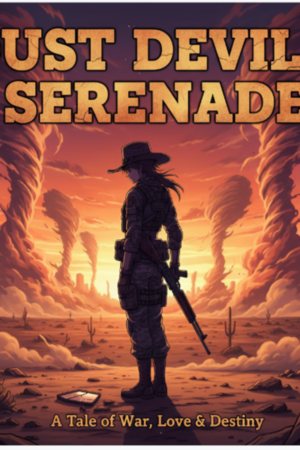
Dust Devil's Serenade
The next two days were a blur of preparation. The plan was simple, which in my experience, meant it was doomed to go wrong in a dozen complicated ways. The two haulers would form the core of the convoy, with the small scout vehicle running ahead to check for immediate threats. I, in the Sand-Viper, would be the outrider. My job was to sweep wide, check the ridges and canyons along the route, and be the hammer that fell on anyone stupid enough to attack us. We were scheduled to leave at dawn on the third day.
I spent most of my time in my hangar, running full diagnostics on the Sand-Viper. Six months of inactivity had not been kind. I had to flush and replace the hydraulic fluids, recalibrate the targeting sensors, and run simulation after simulation on the weapon systems. It was tedious, methodical work, and I lost myself in it. It was easier to focus on pressures and power levels than on the knot of anxiety in my stomach. Every time I sealed the cockpit, I could almost hear the echo of my old squad’s final transmissions. It was a sound I knew I’d never escape.
In the evenings, I would join Elara and her crew at their hangar. They had set up a makeshift kitchen and dining area, and they insisted I eat with them. The first night, I felt like an intruder. They were a tight-knit group, bound by shared hardship and a common purpose. They talked and laughed, sharing stories of their lives before the war, of the families they had lost, and of their hopes for the future. I just sat and listened, a ghost at their table. I hadn’t shared a meal like this, a meal that felt like family, since before Tartarus V.
Elara seemed to understand my discomfort. She didn’t push me to talk. Instead, she’d sit next to me and talk about the convoy, about the mechanics of the haulers, or about the people in the settlements we were trying to help. She spoke about them by name, not as abstract concepts. There was a woman named Anya, a teacher trying to run a school in a bombed-out building. An old man named Ben, who knew how to farm the stubborn Aethel soil. Children who had never seen a world without war. Her words painted a picture of a life that was fragile but resilient.
“Why are you doing this, Elara?” I asked her on the second night, as we sat watching the twin moons rise. The rest of her crew had turned in, leaving us in the relative quiet of the hangar. “This is a huge risk. You could lose everything.”
She was cleaning a hydro-spanner, her movements precise and practiced. She didn’t look at me as she spoke. “My parents were doctors,” she said, her voice soft. “They ran a small clinic in a city called Veridia. When the war came, the Federation said the city was a strategic asset. The Dominion said it was a symbol of oppression. They both shelled it for a week.” She paused, her hands stilling. “I was away, on a school trip. When I got back, there was nothing left. Just rubble and dust.”
She finally looked at me, and in her blue eyes, I saw a pain that mirrored my own. “I found their clinic. The walls were gone. The medical supplies were scattered everywhere, crushed and useless. I remember thinking… if only someone had brought them more. If only they had had enough to treat the wounded, maybe… maybe things would have been different.” She shook her head, a sad smile on her face. “It’s a stupid thought, I know. But it’s the one that stuck. So now, I bring the supplies. It’s all I can do. It’s how I keep them alive, in here.” She tapped her chest, right over her heart.
I didn’t know what to say. Her story was one of a million just like it on this planet, a casualty of a war that had long ago forgotten why it started. But hearing it from her, seeing the quiet strength she drew from her loss, it struck a chord deep inside me. My own loss had turned me into a bitter, hollowed-out man. Hers had turned her into a beacon of hope. I felt a pang of shame.
“I’m sorry,” I said, the words feeling small and inadequate.
“Don’t be,” she said, turning her attention back to the spanner. “Sorrow doesn’t fix anything. Work does.” She finished cleaning the tool and placed it carefully in her kit. “What about you, Jax? Why are you here? And I don’t mean here in this hangar. I mean here, in Rust Creek. Hiding.”
The question was direct, and I had no easy answer. I could lie. I could tell her I was just a merc looking for the next score. But looking at her, with her honest eyes and her open heart, the lie caught in my throat. “I used to be a pilot for the Federation,” I began, the words tasting like ash. “An ace. They called me the Reaper. I flew missions… I did things.” I trailed off, the memories threatening to overwhelm me.
“There was a mission,” I continued, forcing myself to speak. “On a moon called Tartarus V. We were supposed to take out a Dominion command center. High-risk, high-reward. My squad and I were the spearhead. But it was a trap. They knew we were coming. We were pinned down, taking heavy losses.” I could see it all again. The flash of explosions, the red alerts screaming in my cockpit. The panicked voices on the comms.
“Command gave me an order,” I said, my voice barely a whisper. “The objective was still viable, they said. But my squad was in the blast radius. They told me to complete the mission. They told me their sacrifice would be honored.” I closed my eyes. “I followed the order. I fired the missiles. I destroyed the command center… and my team.”
The silence in the hangar was absolute. I could hear the thumping of my own heart. I opened my eyes and looked at Elara. She was watching me, her expression unreadable. I expected to see judgment, disgust. Instead, I saw a profound sadness. “They gave me a medal,” I said, a bitter laugh escaping me. “And then I walked away. From the Federation, from the war, from everything. I came here to forget. But you can’t forget something like that.”
Elara reached out and gently placed her hand on my arm. Her touch was warm, and it sent a jolt through me. “No,” she said softly. “You can’t forget. But you can try to build something new on top of the ruins. You can’t change what you did, Jax. But you can change what you do now.”
Her words were simple, but they hit me with the force of a physical blow. For months, I had been defined by my past, trapped by it. She was offering me a different path. Not forgiveness, not redemption. Just… a chance to do something different. A chance to build instead of destroy. As we sat there in the quiet hangar, under the light of the twin moons, I felt the weight on my soul shift, just a fraction. It was still there, heavy and cold. But for the first time, it felt like something I might be able to carry, instead of something that was crushing me.



Please sign in to leave a comment.