Chapter 1:
Hero of Valor
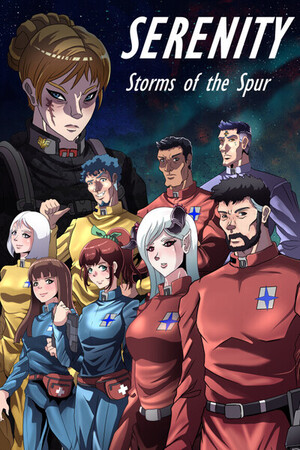
Serenity: Storms of the Spur
After rescuing the Pelagoran colonists from Valor III, the Consortium had invited me personally to be the first member of the Federation to visit their home world.
The invitation alone was unprecedented. The Pelagoran Consortium rarely allowed foreign military officers anywhere near their capital, let alone under the weight of official diplomacy. Commerce, not transparency, defined their relations with the wider Spur. That they had chosen a Federation captain—and not an ambassador, economist, or envoy—was a calculated decision.
I had finished my briefing with Rear Admiral Thorne only hours earlier.
“The Pelagoran Consortium was impressed with your actions at Valor III,” he said. “They’ve invited you to their capital world, Pelagor. This will be the first time a Federation vessel enters their space officially. The mission carries great weight, Captain — learn what you can from the Pelagians. Beyond our encounters, we’ve only known them through commerce. Now we’ll finally see how they live, day to day, beyond the image of a corporate empire. Good luck, Captain. I look forward to your report.”
He dismissed me with a nod, already turning back to his console. For him, the mission was an opportunity. For the Federation, it was leverage. For me, it was a balancing act between ideals and reality — one I suspected would not stay clean.
The Pelagians are an aquatic species, living entirely beneath the waves. Their cities are submerged, their economies anchored to oceanic infrastructure, their politics as fluid and layered as the pressure zones they inhabit. When they need to operate on land, they wear pressurized exosuits — just like they did on Valor III. It’s how they extend their empire beyond the ocean without ever needing to adapt fully to dry worlds.
Now it was my turn to wear one, so I wouldn’t drown in their world. The irony wasn’t lost on me.
“We have arrived, sir,” Dubois informed me.
The viewscreen showed nothing but water.
Not a coastline. Not a continent. Not even scattered atolls.
An unbroken ocean stretched across the entire hemisphere — no continents, no islands, no visible landmass. Just a perfect sphere of liquid blue, hiding whatever passed for a capital beneath kilometers of pressure. The planet radiated order, not abundance—an engineered equilibrium enforced by planetary-scale systems.
“Scans confirm a massive urban complex in the equatorial trench,” Chen reported. “Multi-layered. Artificial structures fused directly into the seabed. Depth increasing… steadily.”
“How deep?” I asked.
Chen glanced at her console. “Already beyond what most Federation habitats are certified for. Their structural tolerances far exceed ours.”
Noble leaned forward slightly.
“No visible planetary defense grid,” he said. “But traffic control is dense. Civilian lanes, cargo movement, internal security patterns. They’re watching us closely.”
That much was obvious.
A channel opened the moment we crossed into Pelagoran space.
A Pelagian filled the screen — sleek scaled skin, yellow eyes, gilled neck flaring as he spoke. No exosuit. No armor. Authority came without protection here.
“FSS Serenity,” he said. “You are cleared for diplomatic descent. Follow the corridor precisely. Deviations incur fees.”
“Fees,” Qamiwat muttered beside me, arms folded.
Some customs transcended species.
I assembled the delegation myself: Qamiwat, Chen, Deon, Noble, Weiss, and me. Luceria and Dubois remained aboard to keep the Serenity ready. If the mission turned sideways, I needed my ship intact and responsive.
Before we boarded the shuttle, Luceria personally inspected each pressure suit — seals tight, oxygen cycling within tolerance, thruster packs responsive. Her usual easy demeanor was absent; this was not her domain, and she knew it.
“These suits are rated conservatively,” she said. “But don’t test them. Don’t bump anything sharp. And don’t let them near your suit joints. If a ring cracks, the ocean wins.”
That wasn’t a metaphor.
Weiss swallowed.
“I hate water,” she said quietly.
No one responded.
The shuttle detached and slipped beneath the waves, gravity replaced by pressure, starlight replaced by filtered blue. Pelagoran escort drones appeared almost immediately, sleek and manta-like, matching our descent perfectly. They did not communicate further. They did not need to.
As we descended, the pressure readings climbed steadily. The suits compensated automatically, internal systems humming faintly as seals adjusted and internal pressure stabilized.
Chen narrated the descent almost unconsciously. “Passing two thousand meters… five… eight… This city was not designed to be evacuated. It was designed to endure.”
Pelagor revealed itself slowly — not built like human cities, but grown like reefs: translucent spires, curved causeways, luminous cargo lanes threading the darkness. Entire districts were suspended between natural formations, anchored by structures that blended seamlessly with geological features.
Then we passed the upper tiers.
Luxury domes hovered like halos above the city core, filled with sculpted coral, ornamental fauna, and vast empty spaces that served no purpose but display. Some were clearly residential. Others looked ceremonial, opulent beyond necessity.
Below them were the lower levels.
Pelagian workers filled the maintenance trenches, hauling resource canisters, repairing filtration walls, scrubbing algae from pressure locks. Their movements were efficient, practiced, unhurried. Family groups worked together in some sectors—larger figures guiding smaller ones, tasks passed down with casual familiarity.
Security drones drifted above them in lazy patrol arcs.
No guards. No visible force.
Just work.
The shuttle passed through a pressure gate and eased into the reception chamber.
The chamber lay open to the sea, its walls transparent, holding back the crushing pressure with elegant ease. Pelagians swam freely through the water-filled space, moving with effortless grace. We stepped down heavily in our suits, boots magnetized to the deck, movement slowed by resistance and bulk.
It was a reminder, subtle and deliberate, of who belonged here.
At the chamber’s center waited Piscium Capitalis.
He was larger than most Pelagians I’d encountered — broad torso, confident posture, his movements slow and controlled. His gills flared gently as he smiled, not wasting energy on unnecessary motion.
“Captain Robert Steele,” he said. “Hero of Valor. Pelagor welcomes you.”
I inclined my head.
“Chief Executive Capitalis. Thank you for receiving us and for allowing the Federation into your world. We understand this access is not granted lightly.”
He accepted that with a slight nod.
“You rescued Pelagian citizens,” Capitalis said. “You ensured their return when their lives were no longer economically viable. That is… unusual.”
“Our duty is to protect life,” I said. “Returning your people home is part of that duty.”
Capitalis studied me closely, his gaze unreadable.
“Then let us proceed as partners,” he said. “Pelagor values reciprocity.”
A holotable shimmered into existence — contracts, equity projections, ownership percentages rendered in crisp alignment. The sheer scale of the numbers was breathtaking, even before their implications became clear.
“Consortium shares,” Capitalis said. “Direct equity. A personal stake.”
I did not answer immediately.
This was expected. Accepting would bind the Federation’s first envoy to Pelagoran profit. Refusing too sharply would insult the Consortium’s governing philosophy and potentially close doors that had only just opened.
I looked again through the transparent floor.
The workers continued their labor with calm precision. They were not monitored constantly, not beaten or hurried. Their pace was steady, communal, deliberate.
“Those workers,” I said evenly. “They aren’t free labor.”
Capitalis followed my gaze.
“No,” he said simply. “They are indentured.”
The word was not spoken defensively — only factually.
“Each carries inherited or contractual debt,” he continued. “Most are born into it. Others assume it willingly in exchange for guaranteed housing, sustenance, medical care, and defined role.”
“For life?” Weiss asked quietly.
“For as long as obligation remains,” Capitalis replied. “Some extinguish it. Many do not.”
Qamiwat’s jaw tightened.
“And if they want to leave?” she asked.
Capitalis turned to her, genuinely puzzled.
“Leave to where?” he asked. “Debt grants belonging. Purpose grants order. Disorder lies beyond obligation.”
Chen watched the workers closely now, eyes tracking patterns instead of individuals.
“They’re… content,” she said, not accusing — observing.
“Yes,” Capitalis said. “They are stable. Stability is peace.”
“The Federation values freedom,” I said. “Choice. The ability to refuse.”
Capitalis inclined his head.
“Pelagor values continuity,” he replied. “Some command. Some maintain. Life is not equal in function — only in necessity.”
There was no anger in his voice.
Only certainty.
“I invited you into Pelagor,” Capitalis said calmly. “I opened my capital to the Federation’s eyes. And the first thing you do is lecture me about your ethics.”
“It’s not a lecture,” I said. “It’s a boundary.”
Capitalis regarded me for a long moment.
Then he lifted a fin.
The chamber hummed — a low vibration passing through the deck. The lights dimmed, not fully, but enough to be felt rather than seen.
Deon’s interface chirped sharply.
“Captain— suit telemetry just registered a comms drop. Serenity is no longer responding.”
I tapped my communicator.
“Serenity, this is Steele. Report.”
Static.
Weiss sucked in a sharp breath.
“My oxygen reserve just recalibrated,” she said. “Consumption rates updated.”
That got my attention.
I pulled up my own suit display.
Life Support: 72 hours (nominal)
Emergency Margin: 18 hours
That was under ideal conditions.
Pressure variance, stress respiration, or system strain could cut that in half.
The deck plates beneath us locked with a metallic clunk, echoed moments later by the muted thud of the outer chamber seals.
Qamiwat’s head snapped toward the exits.
“They’ve locked us in,” she said, voice tight — not angry yet. Dangerous.
Capitalis watched us with clinical interest.
“Your refusal created uncertainty,” he said calmly. “I cannot risk instability within my capital.”
“This is detention,” I said flatly.
“This is containment,” Capitalis replied. “Until alignment is restored.”
My priorities shifted instantly.
Diplomacy was over.
This was survival.
I wasn’t thinking about policy, precedent, or Thorne’s report anymore. I had six people in finite suits, kilometers beneath an ocean, cut off from their ship.
Fear didn’t explode.
It compressed.
Noble checked his weapon reflexively — useless here.
Weiss’s breathing was audible now despite her control.
Chen stared at her suit readout, jaw clenched, already recalculating margins.
Qamiwat rolled her shoulders, eyes bright with something violent and eager.
“If you intend to kill us,” she said lightly, “you’ll regret it.”
Capitalis ignored her.
“In Pelagoran space,” he said, “everything has a price — including time.”
I exhaled slowly, forcing my voice steady.
“Chief Executive,” I said, “whatever offense I’ve caused, my priority is the safety of my crew.”
Capitalis listened.
Good.
“I won’t accept personal equity,” I continued. “But I will restore alignment another way.”
I paused — long enough for him to lean in.
Escalation would trap us. Appeasement would compromise everything the Federation stood for.
Trade, though…
Trade had built bridges where ideology failed throughout human history. It created incentives without surrender.
“Trade,” I said. “A formal framework between Pelagor and the Federation. Government to government. Transparent. Structured.”
Silence.
Interest replaced irritation.
“A state agreement,” Capitalis said.
“Yes,” I replied. “Technology, medicine, resources. Mutual benefit.”
“And in return,” Capitalis said smoothly, “Consortium branches within Federation colonies.”
“We will negotiate limits,” I said. “This won’t be economic annexation.”
Capitalis studied me.
Then the chamber hummed again.
The locks disengaged slightly.
Deon’s interface brightened.
“Captain,” he said, “I’m detecting a narrow comms window opening.”
“Serenity,” Luceria’s voice burst through, strained. “Captain— we lost your signal. Are you alive?”
“For now,” I said. “Prepare a full trade inventory. Non-military. Fast.”
“Aye, sir.”
I met Capitalis’s gaze.
“We will proceed professionally,” I said. “And we will honor our agreement.”
Capitalis smiled.
“You chose correctly,” he said. “Pressure clarifies intent.”
The signal stabilized — barely.
Qamiwat leaned toward me, voice low and fierce.
“You just bought us air,” she said quietly.
“Yes,” I replied.
“For now.”
We were not released immediately.
The doors did not open.
The pressure locks did not disengage all at once.
Pelagor did nothing suddenly.
Piscium Capitalis withdrew with a slight inclination of his head, fins folding neatly against his sides. Other Pelagians took his place — administrators, legal specialists, translators — gliding through the water with practiced precision. They paid us little attention beyond what proximity required, as if our presence had already shifted from threat to transaction.
“We will draft the framework,” Capitalis said before departing. “Until then, you will remain… comfortable.”
Comfortable was a generous word.
The chamber remained sealed, though its systems adjusted subtly. Lighting stabilized. Pressure balanced. Suit telemetry updated again — oxygen consumption returned to nominal. Weiss let out a slow breath, her shoulders dropping a fraction now that she allowed it.
Deon continued to monitor his interface without pause.
“Our status classification has changed,” he said quietly. “We are no longer flagged as an instability.”
“That’s reassuring,” Qamiwat muttered.
Capitalis did not return for several hours.
During that time, Pelagoran officials established controlled dialogue terminals along the chamber’s perimeter. Holographic fields phased into existence — cascading data streams, legal frameworks, economic projections stacking in layered transparency.
Pelagoran contracts were not documents.
They were systems.
Clauses nested inside contingencies. Obligations braided into privileges. Every benefit mapped against long-term return.
Chen studied the displays intently.
“They plan in centuries,” she said under her breath. “These agreements aren’t opportunistic. They’re structural.”
Limited comm windows opened and closed intermittently. Luceria’s voice filtered through in clipped bursts from the Serenity, relaying status updates and inventory confirmations. The trade package was assembled quickly — medical technologies, deep-sea engineering methods, non-military fabrication licensing, agricultural optimization systems. Nothing classified. Nothing overtly strategic.
Everything expensive.
When Capitalis returned, he was accompanied only by data.
“The Consortium accepts your framework,” he said evenly. “With modifications.”
Of course.
Negotiations followed — not heated, not emotional, but relentless.
Pelagian representatives pressed for access corridors, infrastructure partnerships, economic footholds framed in neutral language. I rejected unrestricted expansion into Federation colonies. We countered with regulated trade hubs, inspection protocols, joint arbitration structures. Every concession was weighed not against goodwill, but against precedent.
Qamiwat’s patience wore thin as the hours stretched.
“They’re sanding us down,” she said quietly.
“They’re testing limits,” I replied.
“And you?” she asked.
“I’m making sure we leave.”
Eventually, terms stabilized.
The Pelagoran Consortium would gain limited commercial access within Federation space — regulated, monitored, revocable. In exchange, the Federation would receive preferential access to Pelagian oceanic engineering, resource processing systems, and medical biotechnology adaptable to extreme environments.
No side was satisfied.
That meant it would hold.
Once authorization codes were exchanged, the chamber locks disengaged fully. Pressure gates cycled in sequence. An escort corridor illuminated beyond the chamber — pale, bioluminescent, unmistakably controlled.
“You are free to depart,” Capitalis said. “Our agreement stands.”
“This doesn’t resolve our differences,” I said.
“No,” he agreed. “It merely contains them.”
That, at least, was honest.
The ascent felt longer than the descent.
As the shuttle rose through Pelagor’s layers, the city receded beneath us — luminous, ordered, indifferent. Workers continued their routines. Cargo lanes pulsed at steady intervals. Nothing had changed.
And yet everything had.
We breached the surface and cleared orbit without interference. The Serenity filled the viewscreen — unchanged, intact, waiting.
I did not relax until the shuttle locked into the bay.
Seals engaged.
Pressure equalized.
One by one, we removed our helmets.
Weiss sat heavily on a bench, her hands trembling now that discipline was no longer required.
Deon shut down his interface and stood silently for several seconds before moving.
Chen crossed immediately to Luceria, already speaking in rapid, analytical bursts about Pelagian structural efficiency.
Qamiwat lingered near the hatch, her gaze fixed on the sealed bay doors.
“They didn’t win,” she said at last.
“No,” I replied. “But they didn’t lose either.”
The Serenity set course for the edge of Pelagoran space shortly thereafter. The trade agreement transmitted ahead of us — encrypted, authenticated, already being dissected by analysts light-years away.
As Pelagor diminished into a blue sphere behind us, I remained on the bridge longer than necessary.
Valor III had shown me chaos.
Pelagor had shown me something quieter.
A civilization built on order, continuity, and obligation — and the price it required to maintain them.
The Federation had shaken hands with it.
Whether that would preserve peace, or merely postpone reckoning, remained unresolved.
“Set course for Earth,” I said finally.
The Serenity turned away from Pelagoran space.
Behind us, beneath endless water, the machines continued to work.



Please sign in to leave a comment.