Chapter 1:
The Weight of Nothing
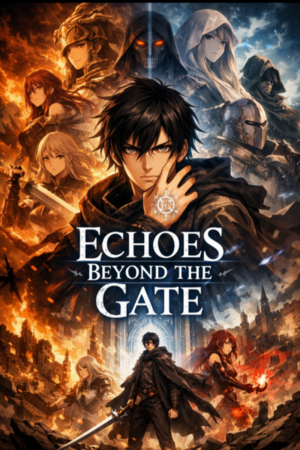
Echoes beyond the Gate
The train smelled like coffee and wet umbrellas.
Akira Kurose pressed his forehead against the cold window, watching Tokyo blur into streaks of neon and shadow. His reflection stared back—dark circles under gray eyes, hair that hadn't been cut in months, the face of someone who'd stopped caring about faces.
His phone buzzed. Another email from Professor Tanaka.
**Subject: Re: Your Thesis Draft**
*Akira,*
*I cannot accept this. You've written thirty pages arguing that meaning itself is a construct we impose on an indifferent universe, then concluded that philosophy as a discipline is therefore pointless. This is intellectual suicide.*
*If you truly believe nothing matters, why are you still here?*
*Please reconsider. You have potential.*
Akira deleted it without finishing.
*Why am I still here?*
Good question.
Twenty-three years old. Philosophy major. No friends who weren't also acquaintances. No passion except the dull ache of knowing that everyone around him was pretending—pretending their jobs mattered, their relationships mattered, that getting out of bed was somehow an achievement worth celebrating.
He'd read Camus, Sartre, Kierkegaard, Nietzsche. All the great minds who'd wrestled with meaninglessness. Some found answers. Some made peace with the questions.
Akira found neither.
He just felt tired.
The train swayed. A woman across from him scrolled through photos of her children, smiling at a screen. An old man read a newspaper with hands that trembled slightly. A student—younger than Akira—listened to music, head bobbing, eyes bright with whatever dream still lived inside him.
*They're all just distracting themselves from the void,* Akira thought. *And maybe that's enough for them.*
But it wasn't enough for him.
The train began to slow. Shibuya Station. His stop.
Akira stood, shouldering his bag. Inside: three library books on existentialism he'd never return, a half-eaten convenience store sandwich, and a notebook filled with questions he couldn't answer.
The doors opened.
He stepped onto the platform.
And then—
—a sound like glass cracking across the sky.
Akira looked up.
The lights flickered. Once. Twice.
Passengers froze, confused. Someone laughed nervously.
Then the train behind him *lurched*—not forward or backward, but *sideways*, as if reality had hiccupped. Metal screamed. People screamed louder.
Akira turned.
The last thing he saw was the train folding in on itself like origami made of steel and physics that no longer applied, and then there was light, and sound, and the sudden understanding that his body was doing things bodies weren't supposed to do.
Falling.
Breaking.
Ending.
His final thought wasn't profound. It wasn't about meaning or existence or any of the philosophy he'd drowned himself in.
It was:
*Oh.*
*So this is it.*
---
**There was no tunnel of light.**
**No life flashing before his eyes.**
**No peaceful darkness.**
There was only falling—*still falling*—through a space that had color but no light, dimension but no distance, time but no progression. Akira couldn't feel his body. Couldn't tell if he was screaming or if screaming had become a concept that no longer applied.
Fragments spiraled past him—memories that weren't his.
A woman in armor, weeping over a sword.
A city of glass towers crumbling into sand.
A child asking, *"Does it hurt to stop existing?"*
And then—
—*impact*.
Not physical. Something worse.
Like his soul had been yanked through a membrane it was never meant to cross.
---
Akira opened his eyes.
Sky.
Not Tokyo's gray haze, but a sky the color of old bruises—purple and deep blue, threaded with clouds that moved too slowly. Three moons hung at different heights, each a different size, casting overlapping shadows that made the ground look fractured.
He tried to sit up.
Pain lanced through his chest—not injury, but *sensation*, as if his body was remembering what it felt like to exist. He gasped, fingers digging into dirt that felt too real, too textured, grainy and damp and *wrong*.
*Where—*
A voice cut through the fog in his mind.
**"Another one."**
Akira's head snapped toward the sound.
A figure stood ten meters away—tall, draped in a cloak that seemed to be made of shadows that didn't quite connect to the ground. Their face was hidden beneath a hood, but Akira could feel eyes on him. Assessing. Measuring.
"You died," the figure said. Not a question. A statement.
Akira's throat worked. "I—what—"
"How you died doesn't matter. *That* you died is all that's relevant." The figure tilted their head. "Tell me, Wanderer—do you believe your life had meaning?"
The question hit harder than the train had.
Akira stared. His mind scrambled for footing, for context, for anything that made sense. "What... what is this?"
"A world shaped by answers to that question." The figure stepped closer. "Astraeon. A realm where belief becomes law, where conviction shapes reality, where the strength of your philosophy determines whether you survive or fade into nothing."
They crouched, and Akira finally saw their face—androgynous, ageless, with eyes like fractured mirrors that reflected too many versions of him at once.
"You've been summoned here because you died without resolution. A soul that cannot accept its end. A consciousness that refuses the void." The figure smiled, but there was no warmth in it. "The question is—what will you *become* here?"
Akira's hands trembled. "I don't... I don't understand."
"You will." The figure rose. "This world is ruled by Seven Sovereigns, each the embodiment of a philosophy. Order. Freedom. Nihilism. Faith. Desire. Despair. Truth. They wage wars not for land, but to prove whose worldview deserves to define existence itself."
The figure turned away, cloak billowing.
"You are a Wanderer now—a soul between worlds. Power here comes from belief. From identity. From the strength of your convictions." They glanced back. "But you, Akira Kurose... you have no convictions, do you?"
The words cut deep because they were true.
"So what happens to you will be... interesting."
Before Akira could respond, the ground beneath him began to glow—not with light, but with symbols, crawling across his skin like living tattoos. They burned cold, etching themselves into his left forearm in a spiral pattern.
He screamed.
The figure watched impassively.
"The Mark of Silence," they murmured. "How rare. A power born from negation itself."
The pain stopped.
Akira collapsed, gasping, staring at his arm. The marks pulsed faintly—geometric shapes that hurt to look at, as if they existed in more dimensions than his eyes could process.
"What... what did you do to me?"
"Nothing. Astraeon chose your Gift based on who you are." The figure's smile widened. "A man who rejects meaning, who negates purpose, who believes in nothing—of course your power would be *silence*. The ability to erase."
"Erase what?"
"Everything." The figure began to fade, dissolving into the bruised sky. "Magic. Belief. Identity. Even yourself, if you're not careful."
"Wait—" Akira struggled to his feet. "Where are you going? You can't just—"
"Survive, Akira Kurose." The voice echoed from nowhere and everywhere. "Or don't. Either way, you'll answer the question eventually."
"What question?!"
The last whisper hung in the air like smoke:
**"What are you willing to become to prove you exist?"**
---
Akira stood alone in the wasteland.
The three moons cast their broken shadows. Distant mountains jutted like teeth against the sky. And somewhere far away, something roared—a sound that made his bones ache with primal fear.
He looked down at his arm. At the Mark of Silence pulsing with cold light.
Then he looked up at the alien sky.
And for the first time in years, Akira Kurose felt something other than numbness.
Terror.
Which meant he was still alive.
Or whatever counted as alive in this place.
He took a breath—the air tasted like metal and old rain—and began walking toward the only landmark he could see: a city in the distance, its towers twisted and wrong, like someone had tried to build Tokyo from memory and failed.
Behind him, the wasteland stretched endless.
Ahead, something that might have been answers.
Or might have been worse.
Either way, he had no choice but to move forward.
*Because standing still*, he realized with grim irony, *would mean accepting this as the end.*
*And if I couldn't accept death in my world...*
*...I definitely can't accept it here.*
---
END OF CHAPTER 1



Please sign in to leave a comment.