Chapter 3:
RULES WITHOUT TRUTH
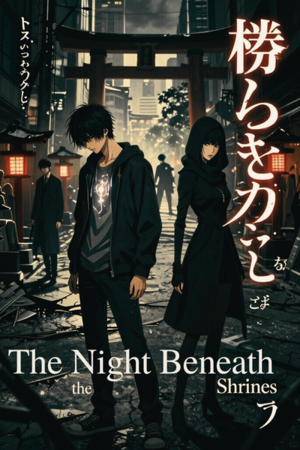
The Night Beneath The Shrines: When the Invisible Becomes Unstoppable
Rin did not take him somewhere safe.
That was the first thing Akiro noticed.
Not immediately—his brain was still catching up with his legs—but somewhere around minute ten, when his lungs stopped burning, and his panic settled into a low, sour ache, the realisation crept in.
Safe places announced themselves. They had fences. Doors. Signs that said authorized personnel only or No Loitering. They had lighting that worked and corners that made sense.
This place did not.
They walked for almost twenty minutes, cutting through streets that felt deliberately unimportant—no landmarks, no crowds, no sense of arrival. The city thinned into something quieter, older. The buildings leaned closer together, as if gossiping about them. Windows grew smaller. Shops closed without explanation.
Akiro kept expecting rain.
It didn’t come.
Instead, the air felt strained, like a held note that never resolved. His ears popped once, then didn’t quite recover.
“So,” he said, silence itching under his skin, “do you always rescue people and then refuse to explain anything?”
Rin didn’t look back. Her pace didn’t change.
“Only the ones who ask questions immediately.”
“Ah,” he said. “So, if I’d waited, like… thirty seconds?”
“You would’ve asked worse ones.”
“That feels unfairly judgmental.”
She glanced over her shoulder briefly. Her expression was neutral, but her eyes were sharp, constantly scanning reflections, alley mouths, the negative space between moving people.
“You’re alive,” she said. “That’s the generous option.”
“Wow,” Akiro muttered. “You should put that on a pamphlet.”
They passed under an overpass where the noise shifted suddenly—traffic above them muting into a dull roar, footsteps echoing too loudly on concrete. A small roadside shrine sat wedged between pillars, half-hidden by shadows and old posters peeling from the walls.
It was old.
Not charming-old. Forgotten-old.
The wood was cracked, the stone chipped, the offering bowl empty except for dust. Someone had left a plastic bottle of tea beside it, half-finished, label peeling.
Rin stopped.
Akiro almost ran into her back.
“—Sorry—”
She crouched without acknowledging him and pressed two fingers to the stone at the shrine’s base.
The world softened.
Not visible. There was no glow, no ripple, no cinematic effect. Just… less noise. Less pressure. Like someone had turned down a frequency Akiro hadn’t known he was hearing, and suddenly he could breathe deeper.
He sucked in air reflexively, surprised by how good it felt.
“This is a suppression zone,” Rin said. “Magic doesn’t behave properly here.”
“Good,” Akiro said immediately. “The less magic the better-- right?”
She shot him a look over her shoulder. “Sit.”
He obeyed, sliding down until his back hit the cool concrete pillar. The chill seeped through his jacket, grounding in a way he hadn’t realised he needed.
The mark under his skin pulsed faintly.
Once.
Then settled, like it was sulking.
Rin leaned against the opposite pillar, arms crossed. Up close, she looked more tired than dangerous. Dark circles under her eyes. A faint crease between her brows, as she frowned more often than she slept. Her coat had been repaired at least twice—careful stitching that suggested she hated wasting things.
“You look like hell,” Akiro said before thinking.
She blinked. “At least I’m not the one living in it.”
“And you smell like it.” He shot back at her.”
A corner of her mouth twitched despite herself. She smoothed it away.
“Listen carefully,” she said. “I’m not here to give you the full truth.”
“You have made that painfully clear.”
“This is what you need to know,” she continued, ignoring him. “Magic doesn’t come from bloodlines. It doesn’t matter who your parents are. It comes from contracts.”
Akiro frowned. “Like… deals?”
“Yes. Spiritual agreements.”
“With what?”
“Doesn’t matter.”
“That feels like it matters.”
“It matters later.”
He sighed. “Okay. Fine. Spiritual agreements.”
“Some are deliberate,” Rin continued. “Most are accidental.”
“Accidental how?”
She tilted her head, considering how much she hated this explanation.
“Fear,” she said finally. “Desperation. Being in the wrong place when a seal fails. You don’t sign anything. You don’t chant. You just… survive something you weren’t meant to.”
Akiro’s stomach tightened.
The alley flashed behind his eyes. The pressure. The way the dark had felt aware of him.
“I didn’t choose this,” he said quietly.
“No,” Rin agreed. “That’s why it’s dangerous.”
He let out a breath he hadn’t realised he was holding. Relief and dread tangled together unpleasantly.
Closing his eyes, Akrio asked. “What does the mark mean?”
“It means magic recognises you now,” she said. “And magic leaves residue.”
He winced. “Residue.”
“You’re visible.”
“To… everyone?”
“To people who know how to look.”
“That’s worse?”
“Yes.”
He dropped his head back against the concrete and stared up at the underside of the overpass. Old chewing gum spots dotted the ceiling like constellations.
“And here I thought being average was a personality flaw.”
Rin didn’t respond immediately.
He peeked at her.
She was watching him—not like prey, not like a threat, but like someone evaluating how much weight a structure could take before it collapsed.
“And the cost?” he asked, softer now.
Rin was quiet.
The city hummed faintly beyond the suppression zone. A train passed overhead, the vibration rolling through the concrete like distant thunder.
“Every use takes something,” she said finally.
Akiro closed his eyes. “Like what?”
“Memories,” Rin said. “Sensation. Emotions. Sometimes flesh.”
He opened his eyes again. “Sometimes flesh.”
She nodded once. No embellishment.
“Overuse causes permanent spiritual damage,” she added. “People become… thin.”
“Thin,” he repeated.
“Hollowed.”
Akiro laughed softly because if he didn’t, something inside his chest might tear. “Is there a refund policy?”
“No.”
Figures.
He stared at the shrine again. The way the stone seemed to drink the light around it, dulling everything nearby.
“What happens if I don’t use it at all?” he asked.
Rin hesitated.
Just a fraction of a second.
That was answer enough.
“That’s not an option, is it?” he said.
“No,” she said quietly. “Not for the marked.”
The words settled between them like dust.
A car horn blared somewhere above. Someone nearby complained loudly about how their phone battery had died overnight.
Akiro wondered how many normal complaints he had left in him.
“Who was the man at my door?” He asked.
“A Warden.”
“The good guys?”
Rin’s mouth twitched. “They’d say yes.”
“And you?”
“I’d say they enforce balance by erasing anything that threatens it.”
“Erasing?” Akiro repeated.
“Yes.”
He swallowed. “So I’m a threat?”
Rin didn’t respond, but that was enough to answer Akrio’s question.
He pictured the polite voice. The calm certainty. The way the lock had clicked open was like it was nothing.
“So they would’ve—”
“Killed you,” Rin said flatly. “Cleanly.”
Akiro exhaled through his teeth. “Ha.”
She studied him closely. “You’re taking this strangely well.”
“I’m not,” he said immediately. “I just… don’t know how to react yet.”
“That will change.”
“I feel like that’s not comforting.”
“It isn’t meant to be.”
Silence stretched again. Not hostile. Just heavy.
Akiro became aware of small things: the roughness of the concrete under his palms, the faint smell of oil and dust, the ache in his calves from running, the way his heartbeat finally slowed to something manageable.
He was still there.
That felt important.
“So,” he asked, “what about the other group?”
Rin stiffened.
“The Unbound.”
“They chased me, too.”
“Yes.”
“What’s their deal?”
“They’re survivors of broken contracts who weren’t contained,” she said. “They believe magic should be public.”
“Free?”
“Yes.”
“And unstable?”
Her jaw tightened. “Yes.”
“Are they wrong?”
Rin didn’t answer immediately.
That scared him more than anything else she’d said so far.
Before he could push, the mark flared.
Akiro gasped, clutching his arm as heat surged through him, sharp and immediate—as if his bones had briefly become wires.
“I—Rin—”
She moved instantly, fingers snapping into a symbol that burned blue against the concrete.
“Stay still.”
“I am still!”
The pain ebbed abruptly, leaving behind a strange emptiness. Not numbness—more like something had been lifted away without his permission.
A word hovered at the edge of his mind.
Then it vanished.
He blinked. “I… what was I saying?”
Rin’s expression darkened.
“You lost a fragment,” she said.
“A fragment of—”
“Doesn’t matter,” she said. “It’s gone.”
He stared at his hands. They looked the same. Felt the same.
Which somehow made it worse.
“…How many fragments do people usually lose?” he asked.
Rin looked away. “Depends on how long they survive.”
The suppression zone hummed quietly around them, holding the worst of the world at bay.
Far beyond it, something restless shifted.
And Akiro understood, for the first time, that ignorance wasn’t safe.
It had just been distance.












Please sign in to leave a comment.