Chapter 8:
Chapter 8: The Disturbance
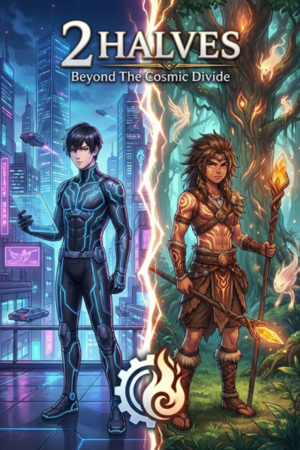
2 Halves: Beyond The Cosmic Divide
The Rose Family compound's intelligence center had been designed for crisis management. Thirty holographic displays, each capable of streaming real-time data from anywhere on the continent. Climate-controlled. Acoustically perfect. A temple to information.
Right now, twenty-seven of those displays were dark.
Zone Rose stood in the center of the room, his gray eyes moving methodically across the three screens that still showed anything useful. Not live feeds—those had died forty-eight hours ago when the Rose Operatives' transmissions cut out. These were recordings. Fragments. Final gasps of data from systems dying in an environment that rejected their existence.
"Sir Roderick," Zone said quietly. "Replay transmission log 47-Delta. Final three seconds. Audio only. Maximum noise filtering."
The AI's voice emanated from hidden speakers, precise and emotionless as always. "Filtering applied, Young Master. Playback commencing."
Static resolved into a woman's voice—Dr. Yuki Tanaka, xenobiologist, one of the Rose Operatives' scientific team. Her words were compressed, frantic, overlapping with background chaos.
"—lattice is destabilizing! The external energy is interfering at a fundamental level—it's like trying to run a circuit underwater! Captain, it's not electromagnetic—our shielding doesn't even recognize it as a threat because it's not in our—"
A man's voice cut through: "Switching to manual hydraulics! Vex, blow the stealth casing!"
"—trying to overwrite our physics!"
An explosion of sound—metal tearing, systems failing, human screaming compressed into a single chaotic burst.
Then something else.
Zone leaned forward, his analytical mind catching what others would miss. Beneath the mechanical death throes, there was a sound that didn't belong. Not the crunch of composite materials or the whine of dying engines.
A resonance. High-pitched, almost musical. Like a violin string stretched beyond its tolerant frequency and vibrating itself to pieces.
Then, silence.
The recording ended.
Zone stood motionless for three full seconds, processing. Then: "Sir Roderick. Isolate the anomalous audio signature from timestamp 47-Delta-12.3 to 12.8. Frequency analysis."
Holographic waveforms appeared, dancing across one of the active displays. Sir Roderick's analysis scrolled alongside them.
"The frequency does not match any known mechanical failure pattern. Spectral analysis suggests... Young Master, this is highly irregular. The signature resembles biological resonance. Large-scale biological resonance."
"Define 'large-scale.'"
"Comparable to cetacean vocalizations. Possibly larger. The amplitude suggests a source with significant mass or, alternatively, multiple synchronized sources."
Zone's expression didn't change, but his pupils dilated slightly—the only outward sign of the excitement firing through his neural pathways. "Something alive made that sound. Something massive, or many somethings coordinated."
"That would be the logical conclusion, though highly improbable given—"
"Improbable isn't impossible." Zone pulled up another display, this one showing the corrupted sensor data the Wraith-1 had managed to burst-transmit in its final moments. To most analysts, the data was garbage—random spikes, incomprehensible fluctuations, digital noise.
Zone saw something else.
He began isolating patterns, filtering out the obvious corruption, looking for structure beneath chaos. After seventeen minutes of manipulation, the image became clear.
The energy readings weren't random. They flowed in patterns—eddies, currents, concentrations. Like atmospheric pressure systems. Like ocean currents. The visualization showed rivers of energy moving across the landscape beyond the Wall, pooling in certain areas, avoiding others.
"They crashed because they flew into a high-concentration zone," Zone murmured, more to himself than to Sir Roderick. "The Anamatic Drive tried to function in an environment saturated with incompatible energy. It's not that the technology failed—it's that the technology was fundamentally unsuited for the medium."
He called up a simulation, overlaying the Wraith-1's flight path with the energy concentration map. The correlation was perfect. The stealth craft had flown directly into what appeared to be a high-density energy current—the visualization showed it like a river of force flowing through the atmosphere, invisible to normal sensors but devastating to Anamatic systems.
"They treated it as interference," Zone said. "Something to overcome through shielding and redundancy. But you can't shield against the medium itself. That's like trying to waterproof a submarine from the inside while diving into the ocean."
"Young Master," Sir Roderick interjected, "your father is approaching. He will arrive at your location in approximately thirty seconds."
Zone didn't move to hide his work. There was no point. Darius Rose knew everything that happened in this compound.
The door opened with a pneumatic hiss.
Part II: The InvestmentDarius Rose entered the intelligence center with the same measured confidence he brought to boardroom negotiations and Continental Congress sessions. At fifty-three, he looked forty, thanks to Dystopian genetic optimization and regular cellular refreshment treatments. His black suit was impeccable. His expression was unreadable.
He surveyed the dark displays, the three active screens showing Zone's analysis, and his son standing in the center of controlled chaos.
"Forty-eight hours of silence," Darius said without preamble. "The operatives are either dead, captured, or in an environment where technology fails completely."
"The third option is most probable," Zone replied, gesturing to his displays. "The energy concentration in the target zone creates what I'm terming 'anamatic rejection.' Our technology doesn't fail because it's damaged—it fails because the fundamental physics that allow Anam-based systems to function are being suppressed by an incompatible energy field."
Darius moved closer, studying the visualizations. His eyes—the same gray as Zone's—tracked across the data with practiced efficiency. "The Continental Congress is aware. They've been conducting tests at the ravine edge for the past three days."
"And their findings?" Zone asked, though he'd already accessed the classified reports through Sir Roderick.
"Atmospheric composition is breathable. Temperature variance within acceptable parameters. No immediate biological hazards detected." Darius pulled up a secondary display, showing test results. "But every device deployed experiences progressive failure. The pattern is consistent: systems with higher anamatic crystal content fail faster. Military-grade plasma weapons fail within minutes. Standard communication arrays last hours. Purely mechanical systems show degradation but remain functional."
Zone nodded. "They've identified the anamatic crystals as the primary vulnerability."
"Correct. The Joint Operation forces are not fools, Zone. They understand the challenge." Darius expanded the display, showing equipment manifests. "They're deploying with minimal anamatic dependence—older weapon systems, redundant mechanical backups, emergency protocols for complete technological failure. Offensive and defensive capabilities will be significantly reduced, but the mission is deemed viable."
"Viable for crossing, perhaps," Zone said. "But inadequate for what comes after."
"Explain."
Zone pulled up his own analysis. "The Congressional approach assumes the energy interference is uniform—a blanket effect that can be planned for. But look at the Rose Operative data. The energy flows in currents, concentrates in specific regions. They could deploy in a low-concentration area and have hours of functionality, then move five kilometers and lose everything instantly. Without the ability to map these energy patterns in real-time, they're navigating blind."
"And you believe you can map them?"
"I believe I can observe them. The operatives had high-tech sensors that failed immediately. I'll have analog instruments that may reveal patterns through indirect measurement—temperature fluctuations, atmospheric pressure, even biological responses in local wildlife if there is any." Zone gestured to his packed equipment. "I won't have the precision of our standard equipment, but I'll have consistency. That's worth more in an unknown environment."
Darius was quiet for a moment, processing probabilities. "The Congressional forces have also prepared for the possibility of hostile contact. Intelligence suggests structures beyond the ravine—possible settlements. If there are inhabitants, they must be evaluated and, if necessary, subdued."
"With reduced offensive capability and failing technology," Zone observed. "Against inhabitants who presumably function normally in that environment."
"Which is why the operation includes significant personnel deployment—three hundred soldiers and specialists. Overwhelming numbers to compensate for technological disadvantage."
"Overwhelming numbers of people who've never fought without technological superiority," Zone corrected. "Soldiers trained on plasma weapons and tactical displays. Scientists dependent on sensors and databases. Diplomats who can't even speak the language because we don't know if there is one." He met his father's gaze. "Father, the Continental forces are intelligent and prepared. But they're prepared for the wrong scenario. They're planning for an expedition. What's coming is first contact."
Darius studied him for a long moment. "And you intend to be on one of those ships."
"Yes."
"Explain your value proposition."
Zone pulled up another display, showing his own calculations—probability matrices, risk assessments, expected outcomes. "The Joint Operation will survive the crossing. Some personnel will adapt. Some technology will function in low-concentration zones. But their objective—to establish peaceful contact and begin diplomatic relations—will fail. Because they're approaching this as superiors encountering primitives, or as explorers charting empty territory."
"You believe there's a developed civilization."
"The data suggests organized structures, possibly cities. The biological resonance in the audio logs suggests coordinated activity. And the energy patterns themselves show signs of... cultivation, perhaps. Or at least, interaction." Zone gestured to his visualization. "If there are people beyond the Wall, they've adapted to this environment. They may even manipulate these energy patterns deliberately. That would make them technologically advanced along an entirely different evolutionary path than ours."
"A concerning possibility."
"An opportunity," Zone corrected. "If we can understand their energy manipulation, learn their techniques, we could adapt our own technology. Or develop entirely new applications. But only if someone approaches them as equals with different knowledge, rather than primitives to be educated."
Darius walked over to Zone's pack, opened it. Inside were items that would look archaic to any Tech Side citizen: a hand-crank flashlight, a mechanical compass, a spring-driven watch, paper notebooks, graphite pencils, and what appeared to be a museum-piece firearm—chemically propelled, no electronics.
"You're going medieval," Darius observed.
"I'm going functional," Zone corrected. "When their plasma rifles fail and their tactical displays go dark, I'll still have light, navigation, and a weapon that works. More importantly, I'll have expected it."
Darius closed the pack, turned to face his son fully. "The Rose family has invested significant resources in your development, Zone. Your genetic optimization alone cost more than most people earn in a lifetime. Your education, your enhancements, your position—all represent capital investment. Explain why I should risk that investment on what you yourself admit will be a failed operation."
Zone had anticipated this question. Darius Rose didn't make decisions based on emotion or family sentiment. Every choice was calculated return on investment.
"Because the information I bring back will be worth more than my education cost," Zone said simply. "The Congressional forces will gather data, yes. But they'll gather it through the lens of Tech Side superiority. They'll see everything as either primitive or threatening. I'll see it as a different solution to the same problem—how do humans survive and thrive? If I can understand their approach, decode their methods, bring back actionable intelligence on an entirely different technological paradigm... that's worth any investment."
"And if you die?"
"Then the investment was high-risk, as all breakthrough research is. But you'll still have Damien. My older brother has always been the safer bet for succession."
Darius studied him for a long moment. "The Continental Congress will not officially recognize your presence. If you're captured, the Rose family cannot acknowledge you without diplomatic incident. You'll be listed as a technical advisor, nothing more."
"I understand."
"And if you die, it will be classified as a training accident. Your brother will inherit your research division and your position in the family hierarchy."
"I wouldn't have it any other way."
Darius moved toward the door, then paused. "The favor you asked for earlier. When you secured my agreement to grant you one request. Is this it? Is joining the Joint Operation what you want?"
Zone considered. The favor was still his trump card, unused, waiting for the right moment. "No. This is what needs to happen. The favor is still mine to claim."
"Then claim it wisely." Darius opened the door. "The Rose family doesn't give second chances, Zone. Come back with something worth the investment, or don't come back at all."
The door closed.
Zone turned back to his displays, already thinking three moves ahead.
Part III: The WarningSix hours before launch, Zone's preparations were interrupted by an unexpected visitor.
"You're actually doing this."
Evelyn Rose stood in the doorway of Zone's quarters, her expression carefully neutral. Unlike her usual boardroom attire, she wore a field suit—sleek, armored, clearly expensive. It made Zone reassess his previous assumptions about her intentions.
"Evelyn," he acknowledged, not looking up from the mechanical compass he was calibrating. "I wasn't aware you were part of the diplomatic envoy."
"I'm not." She stepped inside, letting the door close behind her. "I'm here to talk you out of whatever suicidal impulse convinced you this was a good idea."
"I don't have suicidal impulses. I have calculated risks."
"The Rose Operatives—the best our family has trained—vanished without a trace. You're seventeen, Zone. You've never left the compound without security. You've never even been in a real fight. And you think you can succeed where trained operatives failed?"
Zone set down the compass, turned to face her fully. For the first time in the conversation, he gave her his complete attention. "The operatives failed because they approached the problem incorrectly. They assumed technological superiority would overcome environmental factors. I'm assuming the opposite—that our technology is incompatible and planning accordingly."
Evelyn gestured to his pack. "With museum pieces and paper notebooks? That's your grand strategy?"
"Yes."
"You're insane."
"No. I'm adaptable." Zone picked up one of the notebooks, held it up. "This will function in any environment. It requires no power source, no maintenance, no infrastructure. When everyone else's tactical displays fail, I'll still be able to record observations. That's not insanity—that's preparation."
Evelyn stared at him, her composure cracking slightly. "You really believe you'll survive this."
"I believe my probability of survival is higher than anyone else's on that ship, specifically because I'm not relying on systems I know will fail."
She was quiet for a moment, studying him with an intensity that reminded Zone uncomfortably of how Father looked at board projections—searching for hidden variables, calculating outcomes.
"What are you really looking for out there?" she asked finally. "And don't give me the family benefit speech. I've watched you your entire life, Zone. You don't care about family legacy. You don't care about power or position. So what is it?"
Zone considered lying. Considered giving her the strategic answer, the one that would maintain his position in the family hierarchy.
Instead, he told her the truth.
"Purpose," he said simply. "Everything here is optimized. Predictable. Solved. There's no discovery, no genuine unknowns. Just variables I already know how to calculate." He looked past her, toward the window where the ravine cut across the horizon. "Out there, beyond the Wall, there's something I don't understand. Something that defies every model I've built. And I need to know what it is."
Evelyn's expression softened—barely perceptibly, but Zone caught it. "You're chasing meaning."
"I'm chasing understanding. If that leads to meaning, that's acceptable."
She moved to leave, then hesitated at the door. "If you die out there, Zone, the succession passes to Damien by default, but your research division and personal assets will be absorbed into the family holdings. I won't mourn you. I'll liquidate what I can and consolidate the rest."
"I would expect nothing less."
"But if you succeed..." She looked back at him. "Make sure you're ready for what comes after. The Continental Congress won't let this knowledge stay contained. Whatever you find, whatever you learn—it will reshape everything. And not everyone will be happy about that."
"I'm aware of the political ramifications."
"Are you?" Evelyn's eyes were sharp. "Because once you prove there's a viable civilization beyond the Wall, every family, every faction, every power structure will want to exploit it. You'll have started something that can't be stopped, Zone. Maybe not a war immediately, but eventually. Are you prepared for that?"
Zone considered. "If contact is inevitable—and the Wall's collapse makes it so—then I'd rather it happen with information than ignorance. Decisions made in darkness cause more casualties than decisions made in light."
"That's very philosophical for someone who claims to only care about data."
"Data is philosophy's foundation."
Evelyn almost smiled. "You really are Father's son." She opened the door. "Good luck, little brother. Try not to get yourself killed. It would be inconvenient."
"I'll keep that in mind."
The door closed.
Zone returned to his preparations, but Evelyn's words lingered. You'll have started something that can't be stopped.
Probably, he thought. But events happen whether you want them to or not. At least this way, someone will understand what's happening.
Part IV: The Staging GroundThirty-six hours after the Rose Operatives' final transmission, Zone stood in the massive staging hangar, watching organized chaos transform into military precision.
The DSS Horizon dominated the space—a Titan-class transport cruiser, three hundred meters of white durasteel and chrome, designed to carry 150 personnel plus equipment across any terrain. Beside it, the DSS Vanguard (Dystopian military) and DSS Unity (mixed diplomatic mission) underwent final preparations.
Zone observed the loading procedures with clinical detachment. The equipment being loaded was noticeably different from standard military deployments. Older weapon designs—kinetic projectile systems, chemical propellants, mechanically operated artillery. Communication equipment that relied on radio frequencies rather than quantum entanglement. Medical supplies that were pharmaceutical rather than nano-technological.
The Continental Congress had adapted their approach based on the ravine tests. But adaptation and optimization were different things.
"Impressive, isn't it?"
Zone turned. General Alaric Draeven stood beside him, hands clasped behind his back, watching the same loading process with evident pride. The Utopian commander was in his fifties, with the bearing of someone who'd never encountered a problem he couldn't solve through superior firepower and moral authority.
"Impressive engineering," Zone agreed neutrally.
"These ships represent the pinnacle of human achievement," Draeven continued. "We've adapted them based on the ravine tests—reduced anamatic dependence, mechanical redundancies, multiple backup systems. We'll cross that ravine, establish contact with whatever—whoever—is on the other side, and begin the next chapter of human civilization."
Zone said nothing.
Draeven noticed his silence, studied him more carefully. "You're Darius Rose's son. The one they call 'the Calculator.'"
"I prefer 'analyst.'"
"I've read your file. Seventeen years old. IQ tested beyond our standard measurement ranges. Completed university-level coursework by fourteen. Accepted into six doctoral programs before you were sixteen." Draeven's tone was curious rather than judgmental. "Why would someone with your capabilities want to walk into unknown danger?"
"Because 'unknown' is the operative word," Zone replied. "Everything else is just calculation of knowns. This represents the first genuine unknown in my lifetime."
"You sound like you're looking forward to it."
"I'm looking forward to understanding it."
Draeven smiled—genuinely, which was rare in Zone's experience. "You remind me of someone. There was a scientist, years ago, who approached problems the same way. Pure logic, no emotion, just analysis. Brilliant woman. Do you know what happened to her?"
"No."
"She discovered that some variables can't be quantified. Human courage. Sacrifice. Love. She spent so long trying to measure them that she forgot to experience them. Died alone in her lab, surrounded by equations that couldn't explain why she felt empty."
Zone met the General's gaze steadily. "Then she was measuring the wrong variables. Emotion is just neurochemistry. Courage is calculated risk-taking. Love is investment in genetic propagation plus social bonding. They're all quantifiable if you use the right metrics."
Draeven laughed—not mockingly, but with genuine amusement. "I hope you're right, son. For all our sakes, I hope you're right. Because if you're wrong, you're going to have a very difficult time where we're going."
The boarding call sounded—a clear, synthetic tone that echoed through the hangar.
"That's us," Draeven said. "Time to make history."
Zone picked up his pack—so much lighter than the tactical gear everyone else carried—and headed toward the Horizon's boarding ramp.
As he climbed aboard, he looked back once at the staging ground. At the gleaming city beyond. At the world of optimized efficiency and calculated existence he'd lived in for seventeen years.
Goodbye, he thought, feeling nothing. I wonder if I'll miss you.
He didn't think he would.
Part V: LaunchZone's quarters aboard the DSS Horizon were small but functional. A bunk. A desk. A porthole showing the city receding as the massive ship lifted off.
He set his pack on the bunk, pulled out the mechanical watch, wound it carefully. The ticking was immediate, precise, comforting in its physicality.
Tick. Tick. Tick.
"Attention all personnel," General Draeven's voice came through the intercom. "This is your commander speaking. We launch in T-minus ten minutes. We embark on a mission of peace, discovery, and expansion of human knowledge. We carry with us the hopes of our civilization and the legacy of our achievements. The eyes of history are upon us. Let us prove worthy of that responsibility."
Zone opened his notebook—paper, bound with actual thread, primitive and reliable. He uncapped his graphite pencil.
At the top of the first page, he wrote:
HYPOTHESIS: Reality is locally variable. What we call "laws of physics" may be conditional rather than universal.
COROLLARY: If technology is environment-dependent, then so is civilization. The society beyond the Wall has adapted to different conditions. Understanding their adaptations will require abandoning our assumptions about technological development.
PREDICTION: First contact will be catastrophic for both sides. We expect primitives or empty territory. They expect... unknown. Both sides will be unprepared for the reality. Both will react based on incomplete information.
He paused, then added one more line:
PERSONAL NOTE: If I die, at least I'll die having felt curious.
The floor shuddered. The deep hum of the Anamatic drives rose to a whine, then stabilized into a steady pulse. Zone felt the artificial gravity shift as the ship accelerated.
He didn't look out the porthole at the city disappearing behind them. He kept his eyes on the notebook, on the blank pages waiting to be filled with observations.
"Sir Roderick," he said quietly. "Initiate passive recording. Audio only. Store locally on mechanical drive. This is research log one."
"Recording commenced, Young Master," the AI replied. "Launch sequence proceeding nominally. Estimated time to ravine crossing: four hours, seventeen minutes."
Zone set down the pencil, leaned back against the bunk. He closed his eyes, not sleeping, just... waiting.
For the first time in his life, he was moving toward something instead of away from it. Toward understanding instead of stagnation. Toward genuine unknowns instead of predictable variables.
His heart rate remained steady at 62 beats per minute. His breathing was controlled, rhythmic. Physiologically, he was calm.
But somewhere in the part of his mind he usually kept isolated and unused, something stirred. Not quite excitement. Not quite fear.
Anticipation.
Zone Rose was chasing the only thing he'd ever wanted: a problem he couldn't solve.
And in four hours, he would find it.
End of Chapter 8




Please sign in to leave a comment.