Chapter 3:
The Maiden of Maerachi
Yuna
It was a quiet night at Hakushindō Shrine. The moon hung low like a patient eye, silver mist curling around the eaves of the old rooftops. Inside, the Tsukimori children gathered around the irori hearth, warmed not only by the fire, but by the voice of their mother—Airi—who sat cross-legged with her hair braided like silk threads, a cup of barley tea steaming beside her.
"Tonight," she said, smoothing her kimono sleeves, "I will tell you the story of Yoruhime no Maerachi—the Strong Maiden of the Midnight Blood."
Yuna’s eyes widened. She knew this one. The tale her mother only told when the snow crept too close to the doors and the wind felt like it carried old memories.
Long ago, before the shrines were carved and the mountains given names, the land was not ruled by humans—but by hunger. Spirits roamed freely, some kind and some cruel, and among the humans, very few were born with power enough to resist them.
But one maiden was different.
She was called Ayaka no Yoruhime—a name so soft it meant Night Princess of the Petal Wind. Born under the rare eclipse of two moons, she was as beautiful as falling sakura and as strong as coiled steel.
Her eyes were the pale gold of dawn. Her hair long and white, like moonlight stitched into silk. Yet what made her feared—and revered—was her blood.
Maerachi.
A rare, crimson essence said to burn like coals when spilled. It could fuel demons, giving them power beyond their form… but it could also bind them, sealing their wickedness into whatever vessel the blood touched.
Many wanted her blood. Some offered gold. Others offered war. But Yoruhime wanted neither power nor wealth.
She wanted peace.
She wanted protection.
So she began to craft dolls—not toys, but vessels. She would carve wood and bone, wrap silk and thread, and drip her sacred blood into the hearts of the dolls. Then she would whisper names to the wind—names of demons once feared—and seal them inside, binding them to her will.
She did not use them to conquer.
She used them to guard.
Her home, her people, her shrine.
Within ten years, she was invincible. The wolves of the forest howled at her passing. Bandits wept if they approached her gates. Even lesser yokai knelt in fear.
But power calls to power.
One night, beneath a black wind and a shuddering sky, a terrible demon awoke. He was called Kuragen—a name that meant the Hollow Thread, for he could stretch himself across shadows and weave despair like silk. He had consumed priests, broken barriers, and turned entire villages into empty shells.
And now, he wanted Yoruhime’s blood.
Not to consume, but to replace her. To weave himself into the Maerachi lineage. To live forever.
He attacked the shrine with his true form—his body a thousand arms of coiling silk, each tipped with laughing mouths. His face a porcelain mask with no eyes, and his voice… like wind through bones.
Yoruhime’s dolls fought. They screamed with old magic. They burned and shattered one by one. Her walls crumbled. The forest was torn open. Her own blood screamed for release. And still, she stood.
When her last doll shattered at her feet, Yoruhime knew:
This was her final night.
But she smiled.
She walked into the heart of the battle, hair blowing like snow, bleeding from the mouth. And with her last breath, she embraced Kuragen, pressing her palm to his hollow chest.
And she spoke the words—an ancient incantation that split the evil realm and cursed the future:
“Ochi yami no wa, ware no chi ni naru.
Sokoshirenu mono yo, sono na o keshite—
Utsushiyo ni aranu mono to nari,
Chishio no sugata to tomo ni nemure.
Kizuna to nare. Sugata to nare.
Ware to naru.
Fall, circle of darkness.
Become my blood.
You, who have no depth—erase your name.
Become that which does not belong in this world.
Sleep, bound to my flesh and blood.
Be bond. Be shape.
Be me.”
Kuragen screamed. But it was too late.
Yoruhime sealed him into herself. She became the prison. She gave up everything—life, body, soul—turning her dying form into a vessel of eternal punishment.
But as she collapsed, eyes glowing with Maerachi fire, she did something no one expected.
She reached into her blood, into her gift, and she cursed another girl. A peasant child, hiding beneath the shrine, trembling in fear.
The girl was called Nadeshiko—a wild-haired child with a crooked tooth and the courage to steal prayer candles for warmth. She had no lineage. No power. No destiny.
Until Yoruhime's blood entered her.
A single droplet splashed onto her cheek, and the world turned red. Nadeshiko screamed, and light poured from her chest. In that moment, she became the first of the carriers—marked by the dying breath of a hero. The Maerachi blood was passed.
But not just passed.
Multiplied. Twisted. Bound to fate.
From that day forward, Yoruhime's blood would find new vessels. Sometimes in warriors. Sometimes in beggars. Sometimes in children who hadn’t even learned to walk.
Each carrier would feel the pull—protection or destruction. Each would live with the echo of a demon sealed in ancient agony.
And Kuragen, though trapped, would whisper still.
He could not escape.
But he could… wait.
Airi’s voice softened as she finished. The fire crackled. Her children were silent.
Haru had gone pale.
Ren stared into the flame like it had insulted him in poetry.
Kaede crossed her arms tightly.
And Yuna?
Yuna touched her cheek without thinking. There was no mark. No wound. But something about the name Yoruhime made her chest ache.
She whispered, “Do you think her blood’s still alive?”
Airi nodded slowly. “The Maerachi flows still. Through hidden clans. Through forgotten names. But always… watching. The blood chooses. It protects. And when danger rises, it acts.”
“And Kuragen?” Kaede asked.
“Sealed,” Airi said, her voice flat. “Forever.”
Yuna wasn’t sure why, but her gaze drifted to the corner of the shrine where the shadows pooled deepest. Something about that night felt colder than usual. Something… waiting.
But she shook it off, pulled her blanket tighter, and said,
“Well, if I ever meet Kuragen, I’ll feed him spoiled tofu and poke him with a mop.”
The room exhaled laughter.
Even if somewhere, far below the shrine, something stirred.
And remembered a name:
Yuna.
The morning sky stretched wide and quiet, like someone had spilled blue ink across rice paper. Mist curled through the trees, and the shrine bells rang softly with the wind. Yuna stood barefoot at the steps, her white hair pulled back in a messy braid, watching her father tighten the last strap on his travel bag.
“Will you come back with scars and dramatic stories?” she asked, pretending not to look sad.
Daijirō knelt beside her, brushing a lock of hair from her face. “Only dramatic scars,” he promised. “And stories about the time I taught a samurai to cry properly.”
She smirked. “Make sure they don’t break your knee again.”
“I’ll tell them my daughter will break theirs if they try.”
Kaede came down the steps carrying a jar of pickled plums, her way of saying “come back alive or I’ll track you down.” Haru followed with an exaggerated sob, clinging to Daijirō’s leg. “Take me with you! I can hold the swords! Or make tea! Or distract the enemies with interpretive dance!”
Ren simply handed him a fresh blade in a cloth wrap and bowed. “For defense. Or dramatic effect.”
Daijirō looked at his family—half feral, half legendary—and smiled like a man stepping into battle not with soldiers, but with the gods themselves.
He ruffled Yuna’s head one last time. “Take care of the shrine while I’m gone.”
“I always do,” she replied. “Just don’t teach any of your new students to cook.”
“One time I burned rice slightly—”
“You set the kettle on fire, Otōsan. You created smoke demons.”
He gave her a wink, and with one last glance at his wife—Airi, waiting silently at the gate, arms crossed and eyes soft—he turned and disappeared down the old stone path, swallowed by mist and memory.
The house felt quieter after that. Not sad, just... thinner. Like the walls were listening more closely.
Kaede ran the house with even more terrifying efficiency. Haru tried and failed to start his own morning sword drills (“Why can’t we train with kitchen knives?!”). Ren retreated into silent meditation, writing increasingly cryptic haiku like “The rice cooks alone / shadows gather by the gate / I sharpen my spoon.”
And Yuna?
Yuna began going to the shrine every single day. Alone.
She said it was for meditation. Reflection. “Spiritual stuff,” she’d shrug when Kaede asked. “You wouldn’t get it.”
She would sit on the cold wooden floor, surrounded by incense smoke and the distant sound of wind chimes, eyes closed and breath steady. She didn’t pray. She didn’t chant. She just listened.
And that’s when the dreams began.
In the dream, she was always barefoot, standing in a vast stone chamber that breathed like a living thing. The walls were old. Not built—but grown, like bones of the earth.
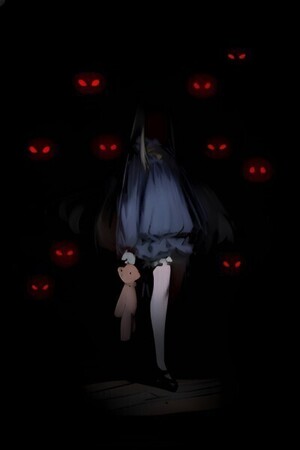
And surrounding her were demons.
But they didn’t move. They didn’t attack.
They watched her.
A dozen of them. Maybe more. Each one different. A horned beast with wings like blades. A woman with hollow eyes and a fan of burning paper. A boy with silver chains for skin. A giant with no mouth.
They stood in a circle around her. Silent. Still. As if guarding something.
And at the center of it all...
her.
Yuna. Standing calmly, white hair floating as if underwater, eyes closed.
When she opened them in the dream, they weren’t brown. They glowed red.
The same red her mother had described.
Maerachi.
Each time she woke up, heart pounding and clothes soaked in sweat, she would stare at her hands. They were still small. Still hers. Still very human.
She never told anyone. Not Kaede, who would panic-clean the entire shrine. Not Haru, who’d start setting booby traps made of wasabi and string. Not even Ren, who would silently leave protective talismans in her sock drawer.
And not her mother.
Because part of Yuna wasn’t scared.
She felt... watched. Yes. But also safe. Protected by something older than prayer. Older than the shrine. Older than her.
One evening, she stayed in the shrine a little longer than usual. The sun had already dipped below the trees, and the paper lanterns cast warm orange halos on the walls.
She knelt in the center of the shrine, eyes closed.
Breathing.
Listening.
Something stirred. A whisper behind her ear that wasn’t wind.
“Yuna...”
She opened her eyes.
No one was there.
But her fingers tingled. Her chest burned faintly. And somewhere—far, far below the floorboards—she felt a thrum. Like a heartbeat. But not hers.
Not human.
And in her head, just before the dream could break:
“Soon.”
Later that night, Airi watched her daughter from the doorway. Yuna was curled in bed, twitching gently in her sleep, murmuring words Airi couldn’t hear. The moonlight painted her white hair in silver, and for just a moment... she saw a flicker of someone else.
Someone older.
Someone familiar.
Airi’s breath caught. Her hand tightened around the wooden beam of the door.
"...Ayaka no Yoruhime," she whispered to herself. "Is it you again?"
The wind outside howled—not loudly. But like laughter muffled in a dream.


Please sign in to leave a comment.