Chapter 35:
Chapter 34: Trial by public voice
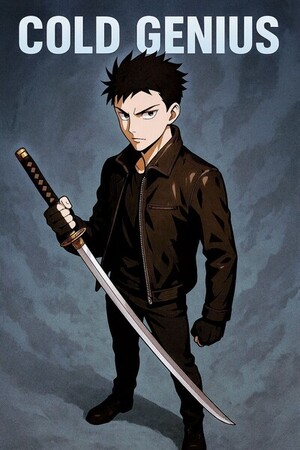
Cold geinus: The frozen mind
The city didn’t sleep anymore.
It argued.
Every screen, every radio, every late-night livestream hummed with the same question, whispered like a wound that refused to close: What is the Cold Genius?
The rain-soaked skyline flickered on a hundred different podcast thumbnails as Derek walked past a closed electronics store, his hood pulled low. Inside the dark glass, reflections of neon headlines floated like ghosts:
HERO OR MENACE?
VIGILANTE OR SAVIOR?
THE COLD GENIUS PROBLEM
He stopped walking.
Not because of the cold. Not because of exhaustion.
But because he heard his name spoken with certainty by people who had never seen the blood on his hands—or the faces he couldn’t forget.
The most watched stream that night belonged to “Civic Crossfire”, a high-profile debate channel known for tearing open social wounds and refusing to let them heal quietly.
The studio was wide and sharp-edged, designed to feel confrontational. Black marble floors reflected the white overhead lights, and a massive LED wall behind the speakers displayed looping footage: collapsed buildings, emergency responders, blurred silhouettes of the Cold Genius vanishing into smoke.
At the center sat Evan Cross, the host—mid-forties, clean beard, calm smile that never quite reached his eyes. He wasn’t shouting. He didn’t need to. His power came from sounding reasonable.
“To be clear,” Evan said smoothly into the mic, “tonight isn’t about hate. It’s about accountability.”
To his right sat Maya Lin, investigative journalist and vocal defender of vigilante justice. Her posture was tight, jaw set, fingers clasped like she was holding herself together.
On Evan’s left was Richard Vale, a political analyst with a reputation for scorched-earth takes. He leaned back comfortably, arms crossed, already smirking.
And between them—projected remotely on a tall vertical screen—was the evening’s most influential voice.
Professor Nolan Graves.
Former ethics advisor to federal agencies. Author of Power Without Permission. The man whose words could turn public sympathy into public fear overnight.
Graves’ face filled the screen, pale and composed, glasses reflecting the studio lights.
Evan nodded toward him. “Professor Graves, you’ve reviewed the incidents tied to the Cold Genius. In your professional opinion—what are we dealing with?”
Graves didn’t hesitate.
“We are dealing with an individual who has decided that his judgment outweighs the rule of law.”
Maya leaned forward immediately. “That’s a gross oversimplification. He stopped bombings. He exposed corruption. He—”
“He also caused mass panic,” Graves interrupted calmly. “And in several cases, mass casualties.”
The footage behind them shifted—emergency sirens, bodies covered with white sheets, a building mid-collapse.
Richard chuckled under his breath. “Funny how defenders always skip that part.”
Maya snapped her head toward him. “Funny how critics never ask why people were in danger to begin with.”
Evan raised a hand. “Let’s keep this focused. Maya, do you believe the Cold Genius is a hero?”
She swallowed. “I believe he’s a traumatized kid who did what institutions refused to do.”
The word kid rippled through the studio.
Richard leaned forward now. “Oh, come on. That excuse again? Tragedy doesn’t grant a license to terrorize a city.”
Maya shot back, “Neither does comfort grant moral clarity.”
Graves adjusted his glasses. “Intent does not erase consequence.”
The screen behind them froze on an image—blurry, distant, unmistakable.
The Cold Genius standing amid smoke, head lowered, shoulders heavy.
Derek watched from the alleyway across the street, the audio streaming through a cracked earbud.
Every word felt heavier than the last.
They weren’t wrong.
That was the worst part.
“Let’s talk scale,” Evan continued. “Professor Graves, some argue that without the Cold Genius, casualties would’ve been far worse.”
Graves nodded once. “That argument assumes only two options: chaos or vigilantism. That’s a false dilemma.”
Maya slammed her palm lightly on the desk. “Then where were the authorities? Where was anyone when those people were trapped?”
Silence followed—thick, uncomfortable.
Richard broke it with a shrug. “Still doesn’t make him a saint.”
“I never said saint,” Maya replied quietly. “I said necessary.”
The word hung there.
Graves’ voice softened—not kinder, but more dangerous. “History is full of men who believed they were necessary.”
Evan leaned back, lacing his fingers. “So what do we call him, then?”
Graves looked straight into the camera.
“A warning.”
The livestream chat exploded.
LOCK HIM UP
HE SAVED MY SISTER
MENACE
HERO
HE’S JUST A KID
Derek pulled the earbud out.
The city didn’t see him.
They saw an idea.
Later that night, another voice rose.
This one quieter. Smaller. More intimate.
The channel was “Late Static”, a late-night audio podcast run out of a cramped apartment, grainy camera, mismatched microphones. No sponsors. No polish.
The host, Jonah Reed, spoke softly. “I’m not here to debate legality. I’m here to ask a human question.”
Beside him sat Rhea Alvarez, community counselor, eyes tired but earnest.
Jonah continued, “If the Cold Genius stopped someone from killing your family… would you care how he did it?”
Rhea didn’t answer immediately.
When she did, her voice trembled. “I’d care about why no one else did.”
Jonah nodded slowly. “That’s what haunts me. Not what he broke—but what was already broken.”
They played an audio clip: a survivor’s voice, shaky, grateful, crying.
Derek closed his eyes.
He remembered her.
Across the city, a more hostile stream gained traction.
“Iron Verdict.”
The host, Caleb Stroud, didn’t pretend neutrality.
“The Cold Genius is a criminal,” he barked into the mic. “And anyone defending him is complicit.”
His guest, Sandra Pike, a former prosecutor, nodded sharply. “We don’t need vigilantes. We need order.”
Caleb smirked. “Finally, someone sane.”
Sandra added, “He wants to be judged by results? Fine. Then judge the bodies.”
The clip went viral within minutes.
Derek sat on the edge of a rooftop, knees pulled to his chest, city lights blurring below.
He thought of Marcus.
Not the name on a screen. Not a talking head.
The man who taught him how to tie a tie.
Who stayed up late waiting for him.
Who believed in him before anyone else dared.
If they knew who raised me, Derek thought, they’d tear him apart too.
He pressed his palms to his eyes.
The noise wouldn’t stop.
By morning, the debate had spilled into classrooms, subways, dinner tables.
Some people wore homemade symbols in support.
Others crossed the street when they heard his name.
A city divided by a boy who never wanted to be a symbol at all.
And somewhere, watching all of it unfold—
Red Rose smiled.
To be continued…




Please sign in to leave a comment.