Chapter 8:
Awakening of Memory
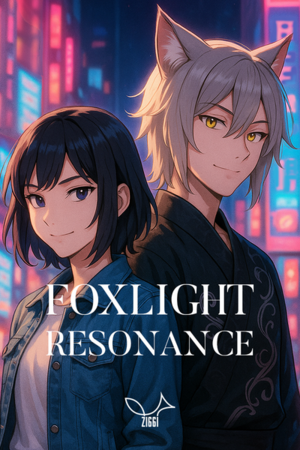
Foxlight Resonance
A young girl sings on a tiny stage, lit by cheap spotlights. Her black hair catches the light like living ink, and her voice — her voice is something fragile, desperately beautiful.
The setting changes. A rooftop. The girl returns for an encore. She cries under the rain, and a familiar silhouette stands before her. Rei? Helpless, hand outstretched toward something he cannot save.
Aoi jolted awake.
Light filtered through rice-paper shoji, casting golden rectangles across an old wooden floor. The air smelled of cold incense, wood worn smooth by centuries, and something indefinable.
This wasn’t her apartment.
She sat up slowly, grimacing. Every muscle in her body protested. Her head throbbed with a dull ache, and somewhere in her chest, she could still feel the echo of the Resonance — the invisible thread connecting her to Rei.
He was here. Somewhere in this house. She felt him the way one senses the warmth of a fire in the next room.
She looked around. The room was minimalist — a futon, a low dresser, a calligraphy scroll on the wall. But the details told a more complex story. Modern talismans were hidden in the corners, some engraved with printed circuits intertwined with ancient kanji. Digital seals flickered faintly on the doorframe, almost invisible unless one knew what to look for.
Aoi rose unsteadily and slid the shoji open.
The hallway opened onto a small garden — a few stones, moss, a maple whose leaves were just beginning to redden. Beyond it, she glimpsed the silhouettes of temples and stupas.
Yanaka, she realized.
The old district of cemeteries and shrines — one of the last places in Tokyo that still felt like the Japan of old.
She followed the smell of coffee.
Rei stood in a surprisingly modern kitchen wedged between centuries-old plaster walls. He wore a simple black T-shirt and jeans, his ash-blond hair tied back in a low ponytail. Without stage makeup, without costume, without the aura of a superstar, he looked… ordinary. Almost human.
He was hand-grinding coffee, the motion steady and meditative. On the counter, a slow-drip coffee maker waited.
She knew he could feel her through their bond.
“You slept for twenty-four hours,” he said without turning around.
Aoi sat on a wobbly stool, taking in the room. Books were stacked on a shelf — French novels, manga, treatises on Buddhist philosophy. A collection of vinyl records occupied a corner beside a vintage turntable. And in a pot on the windowsill, a green plant fought bravely against neglect, its leaves half yellowed.
“This is where you live?”
Rei poured hot water over the ground coffee with practiced precision.
“It’s the only part of Tokyo that still looks like the place where I was born.”
A comfortable silence settled between them. The aroma of coffee filled the air.
“Why did you bring me here?” Aoi asked at last. “My apartment…”
“Isn’t protected.” Rei handed her a cup. “Kageyama knows where you live. He knows everything about you. Here, at least, you’re safe.”
She took the coffee, her fingers brushing his. A familiar spark ran through the contact — the Resonance pulsing, recognizing the other half of itself.
Rei withdrew his hand, his expression neutral.
He sat across from her, holding his own cup without drinking.
“Our essences are blending. I’m starting to feel your emotions as if they were my own. And you…”
“I’m starting to feel yours,” Aoi said, staring into the dark liquid.
The silence that followed was heavy with unspoken things.
“How do you do it?”
He raised an eyebrow.
“You’re Rei Kagami. Your face is plastered across half the screens in Tokyo. But yesterday — at the hospital, at the studio, in the taxi — no one recognized you. Even the journalists covering Yuki’s case walked right past you without blinking.”
Rei smiled — not the calculated perfection of his public appearances, but something older. Sharper. More cunning.
“An old habit.” He took a sip of coffee.
“When you live for centuries feeding on human emotions, you learn quickly that attention is a double-edged sword.”
“An illusion?”
“More like… a filter.” He searched for the words.
“I don’t change my appearance. I change how people perceive it. I become just another face in the crowd. That way, I avoid siphoning human energy constantly — even when I don’t want to.”
He drank again, his expression turning serious.
“While you were asleep, I contacted an informant,” Rei continued. “A yōkai who lives as a human. He works regularly with Kageyama.”
He paused, golden eyes darkening.
“Kageyama has spent months cultivating hatred, creating perfect conditions to generate powerful yurei.” Rei set his cup down. “Yuki was just a test.”
“My informant gave me three more names scheduled as headliners for the Tokyo Idol Festival. Human artists who, like Yuki, have been targeted by suspicious hate campaigns in recent weeks.
Akane — a young singer-songwriter whose debut album just exploded.
Tsubasa — an underground rapper starting to break into the mainstream.
And Ren — an actor-seiyuu making waves in otaku circles.”
Rei swirled the now-cold coffee in his cup without drinking.
“The four most anticipated artists at the event. Millions of fans. Millions of haters.”
“The perfect breeding ground,” Aoi murmured, suddenly grasping the scale of the plan.
“Exactly. These four aren’t random victims — they’re the pillars of Kageyama’s ritual. Their massive popularity, combined with the hatred cultivated against them…” He shook his head.
“It’s nourishment for his gestating ōyurei. And the Festival will be the convergence point. Fifty thousand people in the Dome, millions more streaming — all those emotions concentrated in one place, at the same time.”
A shiver ran through Aoi. She thought of the unconscious girl — her glassy eyes, her broken smile, that voice layered over her own, not truly hers.
“The VTuber,” she whispered. “Nekomata_Hikari.”
Rei didn’t answer immediately. But something flickered in his gaze — tension, an unpleasant memory — that Aoi caught through their bond before he could mask it.
“You know her.”
It wasn’t a question.
Rei stood, turning his back to look out the window.
“It’s complicated.”
The silence stretched. Aoi sensed she was touching something raw — a wound that had never fully healed. Through the Resonance, fragments leaked through: guilt, regret, an ancient pain that refused to die.
She chose not to press. Not yet.
“Why do you do this?” she asked instead.
“Protecting humans. Fighting Kageyama. You could just…”
“Run?” Rei turned back, a bitter smile on his lips.
“I’ve thought about it. More than once. Leaving Tokyo, starting over somewhere else, letting humans deal with their own demons.”
“But you didn’t.”
“No.” He sat down again, closer this time — close enough for Aoi to feel the warmth radiating from him. Not physical heat, but spiritual.
“You want to know why I protect humans even though I feed on them?”
She nodded.
“Because I’ve lived long enough to understand one thing.” His golden eyes locked onto hers with unsettling intensity.
“Consuming something until it’s destroyed is condemning yourself to starve. But it’s more than that.”
He paused, choosing his words.
“Humans are fleeting. Fragile. They live a hundred years if they’re lucky, then they’re gone. But they’re never alone. Even in suffering, they find each other. They create. They love. They fight.”
His voice softened.
“I feed on them, yes. But they remind me what it means to be alive. And that… I don’t want to lose.”
Aoi’s phone vibrated on the counter.
She picked it up, frowning at the unknown number. A message appeared:
“Yuki is awake. She’s asking to see you. Nya~ 😺”
Aoi stared at the screen, puzzled.
Rei leaned over her shoulder to read it. His expression froze.
“It’s a trap.”
“Probably.” Aoi slipped the phone into her pocket.
“But it might also be our only chance to understand how to break the link between the ōyurei and its victims.”
She looked at him, resolute.
“We’re going.”
“I’ll be ready to intervene if something goes wrong.”
And somewhere in the infinite network of the internet, a presence with violet eyes smiled.










Please sign in to leave a comment.