Chapter 1:
Inconvenient Questions
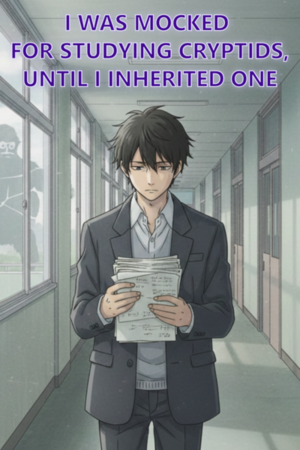
I Was Mocked for Studying Cryptids, Until I Inherited One. Cryptids Aren’t Pseudoscience. They’re Damage Control
Ono Renji learned early that silence could sound like laughter.
It happened in small ways. A pause after he spoke. A glance exchanged between classmates. The way a lecturer would clear his throat and continue as if Renji had not raised his hand at all. By his final year as a biology major, the rhythm was familiar enough that he could anticipate it, brace for it, and still feel it land.
“Cryptozoology,” Professor Nishida said, reading from the proposal sheet as if the word itself required care. “You understand that this department evaluates empirical research.”
Renji stood at the podium, hands folded, shoulders straight. He had practiced this defense in front of his bathroom mirror until his reflection looked tired of hearing it.
“I am not attempting to prove the existence of cryptids,” Renji said. “I am studying the environmental conditions and cultural patterns that produce consistent cryptid reports across unrelated regions.”
A few students shifted in their seats. Someone in the back snorted before catching themselves.
Professor Nishida peered over his glasses. “So folklore.”
“No,” Renji replied, more quickly than he should have. He inhaled, slowed himself. “Folklore responds to something. Even when it is inaccurate, it reflects pressure. Ecological stress. Resource collapse. Human encroachment. Legends appear where data collection fails.”
“And you believe,” Nishida said, “that a creature which has evaded all physical evidence is the best lens for this.”
Renji nodded. “Because the absence is the data.”
The silence this time was heavier. Not mocking. Uncomfortable.
“That is poetic,” Nishida said at last. “But science does not reward poetry.”
Renji returned to his seat with the familiar warmth creeping up his neck. Around him, laptops resumed typing. The seminar moved on to gene flow modeling and wetland degradation metrics. Real science.
Afterward, in the hallway, two of his classmates passed him without slowing.
“Orang what was it,” one whispered.
“Pendek,” the other replied. “The forest gnome thing.”
Renji did not correct them. He had learned that corrections only sharpened the jokes.
He retreated to the university library, where the anthropology shelves sat neglected beneath flickering lights. His bag thudded onto the table. He pulled out his notebook, its pages dense with maps, rainfall charts, and clipped translations of oral histories from Sumatra, the Pacific Northwest, rural Japan.
Orang Pendek was only one case. A bipedal forest hominin reported in Sumatra for generations. Short. Fast. Avoidant. Always near logging frontiers. Always vanishing as roads advanced.
Sasquatch. Mothman. Kappa. Different myths. Similar margins.
Renji did not believe they were real creatures in the way animals were real. No bones. No bodies. No DNA. But he believed the patterns were.
When forests were fragmented too quickly, stories appeared of something watching from the gaps. When rivers were rerouted, something drowned children who strayed too close. When skies filled with unfamiliar light, wings followed in rumor.
Myths were not lies. They were compression.
His phone buzzed. An email notification.
Funding approval: Conditional.
He opened it with a pulse of cautious hope.
The project would receive limited ecological anthropology funding under one condition. He would be accompanied by a senior researcher. The study would be framed as cultural documentation, not biological investigation.
Renji read the name twice.
Professor Kawashima Akio.
The skeptic.
Kawashima was famous in the department for dismantling fringe theories with surgical calm. He had published extensively on river ecology and invasive species dynamics. He was also known for publicly stating that cryptozoology was “a failure of imagination masquerading as curiosity.”
Renji stared at the screen. Relief and dread tangled in his chest.
At least it was approval.
That evening, he met Kawashima in his office. The room smelled faintly of old paper and disinfectant. Specimen jars lined one shelf, their labels faded.
“I want to be clear,” Kawashima said without preamble. “This trip is not a hunt.”
“I understand,” Renji said.
“We are documenting cultural narratives surrounding environmental change,” Kawashima continued. “Your Orang Pendek will remain a narrative construct.”
Renji hesitated. “May I still collect ecological data near reported sites?”
Kawashima studied him for a long moment. His eyes were sharp, unreadable.
“As long as you do not interfere with ongoing operations,” he said. “There is extensive logging in Sumatra. Dangerous terrain. You will follow my instructions.”
“Yes, Professor.”
Kawashima nodded once. “Good. And Renji.”
“Yes.”
“Curiosity is not a shield,” Kawashima said. “Do not let it convince you that skepticism is cruelty. Skepticism is containment.”
Renji did not fully understand what he meant, but he bowed politely.
In the weeks before departure, the mockery intensified.
“Going monster hunting,” someone joked during lab cleanup.
“Bring back a selfie,” another said. “If it doesn’t eat you.”
Renji smiled thinly and kept washing glassware. He had stopped trying to explain. The more he defended himself, the more he sounded like the caricature they expected.
At night, he pored over satellite images of Sumatra. Illegal logging scars crept outward like infections. Roads where none should exist. Clearings that reappeared after official shutdowns.
He noticed something strange. Areas with repeated Orang Pendek sightings showed a pattern of interrupted development. Logging attempts abandoned. Equipment losses. Worker disappearances explained away as accidents.
Not protection. Resistance.
He added a note in the margin. Environmental feedback via myth escalation.
The night before departure, Renji packed lightly. Field clothes. Recorder. Notebooks. A folded copy of his proposal, creased from revision.
He paused over his bookshelf. Texts on ecology. Anthropology. One slim volume on comparative mythology.
He left the mythology book behind.
On the plane, Kawashima slept with practiced ease. Renji stared out the window at the dark ocean below, thinking about forests he had never seen and stories he was not supposed to believe.
He wondered, not for the first time, whether science failed not because it lacked rigor, but because it lacked patience for what did not fit neatly.
When they landed in Sumatra, heat wrapped around them like a living thing. The air smelled of damp earth and fuel. Renji felt a strange pressure behind his eyes, as if the world were slightly louder than it should be.
Kawashima paused at the edge of the tarmac, scanning the tree line beyond the buildings. His posture shifted, subtle but alert.
Renji noticed.
“Professor,” he said carefully, “have you been here before?”
Kawashima did not look at him. “Enough.”
As they drove toward their field site, the road narrowed. Forest pressed close. Renji watched shadows move between trunks, dismissed the thought as fatigue.
Still, a sentence from his rejected proposal echoed in his mind.
When the environment cannot speak through data, it speaks through stories.
He did not yet know how literal that would become.










Please sign in to leave a comment.