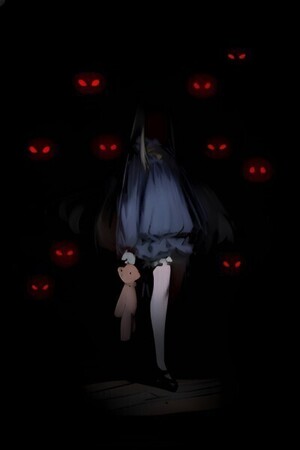
By the time her cousins left, Yuna had developed the uncanny habit of vanishing. Not dramatically. Not with storms and flickering lights. But like the quiet fading of breath on a windowpane.
At breakfast, she’d sit quietly, still clutching Sayomi, eating little. By mid-morning, she was gone—not missing, but always in the same place:
The shrine.
The air was cooler there. Older. Wrapped in incense and secrets.
Here, Yuna found the whispers didn’t echo—they answered.
She began to pour through the ancient scrolls and crumbling ledgers tucked behind the offering cabinets. Some were sealed in thin linen wrappings, others half-eaten by time and insects. But she read them, brushing each kanji with her fingers like it was sacred.
The family registry. Blood charts. Names she didn’t recognize. Symbols… and references to something over and over again:
"Maerachi."
And then: “The Nameless Vow.”
One particular volume was bound in black hemp, its contents scrawled by a hand that looked like it trembled. Inside was a sketch of a woman with cascading white hair, like her own, her arms open in surrender—or ritual. Her eyes were drawn completely black. Around her, circles of kanji bound in ropes of brushwork. Below her feet, a crawling demon with gaping jaws.
“She is the first. She is the vault. She is the curse.”
—Kazue of the East Branch
On the fifth day of her self-imposed shrine stay, a caw echoed overhead.
Not just any crow.
This one had silver-tipped feathers, and its eyes glowed faintly red under the sun.
Yuna stepped out from the archway, narrowing her gaze.
“I know you,” she whispered.
The crow tilted its head. With precise timing, it flapped its wings once and dropped a scroll at her feet before landing on a nearby statue of Kannon, the bodhisattva of mercy.
She unrolled the letter carefully, her heart thudding.
The wax seal was unmistakable—her father's clan emblem: the Three Blades of Tsukimori.
To my dearest blossom, Yuna,
If this finds you, then the crow has remembered the way home. His name is Tsubasa—treat him kindly, for he is older than me and wiser than most humans.
You may be sensing things. Dreams — to be precise. Pieces of memory that are not yours. Don’t ignore them. They are not curses.Your mother and I have always known you were different—not because of your hair, but because of your Maerachi. That blood runs wild and red and rare, and it calls to both demon and god alike.
I cannot say much in writing, but there are three keepers at the shrine. You may not have seen them yet, but they are always there, always watching. When you are ready, they will show themselves.
Seek them. Listen.
And remember this: You are not what haunts you. You are what endures it.
—Father (Tsukimori Daijirō)
Yuna read it three times, her fingers trembling slightly on the parchment. Tsubasa gave a soft, croaking grunt, then fluffed his feathers like a sigh.
“…I’m not sure if I’m ready,” she said aloud.
The crow stared at her a long time, then hopped once to the side. As if to say, But you will go anyway, won’t you?
That night, the shrine shifted.
She walked to the back hall, guided by a strange hum in her ears—low, like a prayer without words.
There, beneath the withering peach tree behind the shrine walls, sat three figures.
Not quite monks. Not quite hermits.
They were robed in faded indigo, patched with countless handsewn repairs. All of them sat cross-legged on the cold stone, unmoving, eyes closed.
And then… the tallest opened one eye and smirked.
“Took you long enough,” he said.
The second waved lazily. “Tea’s cold. Too bad.”
The third simply inclined his head. “You’ve come, bearer of the blood.”
Yuna hesitated. “You’re… the keepers?”
The smirking one nodded. “Depending on who's asking. I’m Genbo. That sleepy one is Mokuren. And the serious stick over there is Jinsei.”
Jinsei gave a nod. “We’ve been here since before your grandfather’s grandfather offered plum wine at this shrine.”
Mokuren yawned. “Longer, maybe. Time’s weird when you eat too many shrine berries.”
Genbo clapped his hands once. “Enough riddles. She’s here because it’s waking in her. The blood. The chain. The dream.”
Yuna felt a chill at that.
“I don’t… understand it. There’s a girl in my dreams. A demon girl. She tries to kill me. Tells me I’m nothing.”
Genbo’s smile vanished. Mokuren sat up straighter.
“You met her?” Mokuren asked. “Already?”
“She calls me pathetic. Says I’m unworthy.”
“She is not real,” Jinsei said.
“She is very real,” Genbo corrected. “But not… whole.”
Mokuren rubbed his temples. “She is the echo of the curse. The spirit of conflict within your blood. She is your opposite, born from Maerachi’s wound.”
Yuna frowned. “Maerachi… isn’t just blood, is it?”
“No,” Jinsei said gravely. “It is memory. It is war. It is the hunger of demons and the silence of gods. It lives, even now.”
Yuna's voice came quiet: “Am I dangerous?”
They were silent for a moment.
Then Genbo smiled again. “Of course. You’re a Tsukimori. Dangerous is our family crest.”
As the moon hung high, the keepers taught her old chants, whispered names she shouldn’t yet know, and told her of the woman in white—the first bearer of Maerachi.
“She sealed the first demon inside herself,” Mokuren said. “Then passed the blood to another before death. The line has never been broken.”
“You are the thirteenth,” Jinsei added. “And the last, perhaps. If the demon returns.”
Yuna stood as the wind carried the scent of plum blossoms across the shrine.
Tsubasa flew above, circling once before landing on her shoulder. His claws were careful, his gaze knowing.
She did not tremble this time.
She looked out at the darkness, at the old mountain range where her dreams echoed.
“I’ll face her again,” she whispered.
“You will,” Genbo said. “But next time, you’ll speak back.”
The first time Yuna jabbed her thumb with a needle, she didn’t cry.
She grinned.
“Good,” Airi said, narrowing her eyes approvingly. “You didn’t flinch. That means you’re ready.”
Yuna raised an eyebrow. “You literally didn’t tell me I’d be pricking myself today.”
Airi smirked, her own fingers flying over the fine stitching in her lap. “Lesson one in doll-making, sweetheart: Something always bleeds.”
The craft room was a tucked-away chamber in the east wing, where sunlight poured through the rice-paper screens like melted gold. The air always smelled of pressed cotton, cedar, and that faint perfume of old things waiting to be touched again.
Spools of silk and hemp thread lined the walls. Straw bundles stood like awkward sentinels in the corner. Glass eyes blinked from velvet-lined boxes. Yuna found them unsettling.
“Mother…” Yuna’s tone was suspicious. “You never let any of us come in here alone. Not even Haru. Why me now?”
“Because,” Airi said with a calm, breezy air as she tied her hair into a tight bun, “you’re the only one of my children with nimble fingers and enough rage management issues to stab things with care.”
“Wow. That’s the most elegant insult I’ve ever received.”
“You’ll earn worse before we’re through.”
The Fluffy Dolls came first. Airi called them “practice friends.”
They were made of cotton and felt, button-eyed and uneven-limbed, stuffed with dried lavender and laughter.
Yuna named her first one Mochimaru. Its head was way too big. Its legs looked like soggy radishes. But it smelled like safety.
“You’re not bad at this,” Airi said one evening, peeking over her daughter’s shoulder. “That rabbit has less trauma in its eyes than mine ever did.”
“That’s because mine hasn’t lived in a haunted storage box for ten years,” Yuna retorted, holding up Mochimaru triumphantly.
Porcelain dolls were next. They were delicate. The kind of beauty that threatens to shatter just by being seen too long.
Airi handed her a brush and a bowl of soft pink paint. “Don’t blink too long, or you’ll paint her eyebrows into next week.”
Yuna leaned in, her hand steady. “Mother… why porcelain?”
Airi’s tone turned quieter, almost distant. “Because they’re the most like people. Hollow inside. Painted to look alive. And if you’re not careful…”
She lifted one by the neck.
Crack.
It was gone.
“…they don’t survive the drop.”
Yuna stared at the broken shards.
“...Did you just dramatically smash that for the metaphor?”
Airi smiled darkly. “I absolutely did.”
Then came the straw. Rough. Ancient. Stiff like bones and sharp like secrets. These dolls weren’t made for hugs—they were made for rituals.
“They were used in warding spells,” Airi explained, her hands weaving with lightning speed. “And sometimes, if we’re being honest… for curses.”
“Curses?” Yuna perked up.
“Don’t sound excited.”
“I’m not! …I’m just respectfully interested in weaponized agriculture.”
Airi smirked. “You’re absolutely my daughter.”
They soaked the straw in salted water and dried herbs. Twisted the limbs. Tied knots with sacred thread.
When Yuna finished her first, it looked vaguely human and vaguely murderous. She decided to call it Miss Thistle.
That night, mother and daughter sat in the dim candlelight of the crafting room, surrounded by a growing army of faces—stitched, painted, woven.
Airi sipped her tea. “Do you know why I teach you this now?”
Yuna, running her fingers across the forehead of Miss Thistle, shook her head.
Airi leaned forward, her voice hushed.
“Because a girl who knows how to make dolls… learns how to build herself back, even after the world tries to unmake her.”
Yuna met her gaze. Something sparked behind her tired eyes—fear, yes, but wonder too.
And somewhere in the house, the silence held.
The dolls watched.
And Yuna whispered to herself:
“I wonder how many of me I’ll have to make.”
Please sign in to leave a comment.