Chapter 14:
EMOTIONAL BLEED
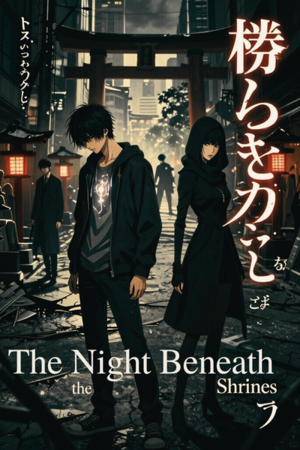
The Night Beneath The Shrines: When the Invisible Becomes Unstoppable
Akiro cried over laundry.
It took him a full minute to realize what was happening.
He was standing in the cramped communal laundry room of his apartment building, fluorescent lights buzzing faintly overhead, the air thick with the smell of detergent and damp fabric. A single sock, lonely and stubborn, had disappeared into the black maw of a washing machine. Not lost forever, probably. But, for now, it has vanished.
His chest tightened. His throat burned. And then, despite himself, tears welled up, sliding down his face in a steady, unrelenting stream.
“…What?” he whispered, voice small, almost embarrassed in the cavernous silence of the laundry room.
He sank into a plastic chair, head in his hands, shaking.
It wasn’t the sock.
Of course, it wasn’t the sock.
It was everything else finally slipping past whatever emotional dam had been eroding inside him for months.
Loose threads surged through his mind like a violent tide—memories he hadn’t realized he’d lost, images he’d assumed were gone. A childhood bedroom painted pale green. The smell of his mother’s cooking on weekends. Her voice calling him for dinner. The warmth of sunlight through a cracked window. The quiet safety of being small and unseen, unburdened, unmarked.
He gasped, shivering. The dam had broken. Everything slipping past him like smoke.
This wasn’t loss.
This was return.
When Rin arrived, her footsteps echoing softly against the concrete floor, she found him still there, hunched in the chair, eyes red, looking like someone who had nothing more to lose.
“You didn’t answer your phone,” she said, voice cautious, observing him without rushing.
“I was busy,” he replied hoarsely, still staring at the floor, trying to process the sudden flood of sensation.
“With?” she asked. Her tone carried a mix of curiosity, concern, and a hint of awkwardness—because, in truth, no one had ever explained how to handle this level of human vulnerability.
“Breaking down over household appliances,” he admitted, and the humor was bitter, a thin veil over the rawness underneath.
She hesitated, glancing at him sideways. “…That bad?”
“Everything went distant for a moment,” he said quietly. “But now it’s wearing off.”
Rin’s shoulders slumped slightly, a subtle sigh escaping her lips. “That shouldn’t happen. Not like this. Not after everything.”
“Well,” he said, wiping at his face with the edge of his sleeve. “…It did.”
Silence stretched between them, the kind of human silence that isn’t uncomfortable but is fragile and weighted with unspoken understanding.
“…Ilya was right,” Akiro said eventually, his voice barely above a whisper. “Something’s wrong with how this… system works. Or maybe the rules themselves. Or maybe me.” He laughed bitterly. “…Or all three.”
Rin stared at the floor. The lines around her eyes were sharper, her hands clenched in her lap, silent acknowledgment of what she knew. “I know,” she admitted.
That admission landed harder than any argument, sharper than any lesson Rin had taught him.
“You know?” he echoed, incredulous. “You knew this could happen?”
“I’ve known for a while,” she said quietly, finally meeting his gaze. Her eyes softened, something vulnerable slipping past the professional mask she always wore. “…I just didn’t think it would break this fast.”
He laughed again, dry and bitter, running a hand through his damp hair. “Story of my life lately.”
She looked at him then—not as an asset, not as a responsibility, but as a person. Not a mark, not a repository of magical fragments, not an Anchor or a tool. Just… him.
“I’m sorry,” she said finally. The words felt unfamiliar on her tongue, but weighty in their sincerity.
He blinked at her. “…For what?”
“For not being able to protect you from this,” she admitted. “For letting you… hurt like this, for so long. For not being honest about how fast it could spiral.”
He shook his head slowly, unsure whether to feel relief or despair.
“It’s not like anyone could have warned me in a way that makes sense,” he muttered. “I don’t even know if I understand it myself. It’s… chaos in fragments. Memory in pieces. Emotions diluted to nothing.”
Rin nodded. “I know.” Her hand hovered, then she let it rest lightly on his shoulder. Gentle, steady—real. “And I can’t fix it. But… I can be here. You’re not alone.”
Akiro exhaled shakily, eyes watering again. “Alone is… exactly what I’ve been feeling. Until now, I didn’t even notice. I didn’t feel anything. Just… floating.”
Rin’s gaze softened, a rare vulnerability flashing across her features. “Floating can feel like drowning, too,” she said quietly.
“…I think I’m drowning then,” he said, voice cracking. “And it’s weird because I feel… everything at once. All the fragments, the memories, the guilt, the anger. And then… emptiness. And now this.” He gestured vaguely at the washing machines, the small, absurd epicenter of his unraveling.
Rin let out a small sigh, half exasperated, half tender. “Laundry has that effect on people sometimes. I didn’t think it would be… quite this literal for you.”
He laughed, bitterly, at a dry, ragged sound. “Literal. That’s exactly it. I’ve been numb for months, walking through this… this fractured existence, and now a sock triggers a cascade of everything I’ve been suppressing. How uncool.”
“You’ve been carrying more than you realize,” Rin said softly. “Numbness was survival. You survived the fractures, the magic, the pressure… but the cost didn’t stop. It waited. It waited until something mundane cracked the dam.”
He buried his face in his hands again, shuddering. “So, it’s not just magic. It’s… me. Everything I’ve ignored.”
Rin leaned forward, speaking carefully. “You’re still… you. Fragments lost, reactions dulled, memories gone—yes. But the core? That’s still there. The part of you that feels. That questions. That… resists. That’s alive.”
Akiro peeked at her, eyes red and raw. “Alive feels… expensive right now.”
“It is,” she admitted. “You pay in fragments, in emotions, in exhaustion, in numbness sometimes—but what you get back… what you choose to reclaim, is worth it. Even if it’s messy. Even if it hits at the wrong time. Even if it’s over a sock.”
He let out a dry laugh, a mixture of disbelief and tiny relief. “Over a sock, huh? The very pinnacle of tragedy. Maybe I’ll write a book someday.”
“I’ll read it,” Rin said, almost smiling.
They sat together in silence, the machines humming, the air warm with steam and detergent, the faint scent of fabric softener mingling with the metallic tang in his nose. Akiro’s breathing slowly steadied. The flood of emotion ebbed just enough for him to feel his own pulse beneath his fingers.
“…I’m scared,” he admitted finally, voice low. “…I don’t want to feel like this. But I also don’t want to stop feeling.”
Rin’s hand squeezed his shoulder, grounding him. “Good then. That’s human. That’s right. This is what being alive costs sometimes. Not just magic, not just contracts or fragments. Life itself has a cost. And the more you let yourself feel… the more you anchor yourself, even in chaos.”
He exhaled slowly, letting the tension in his shoulders ease fractionally. “…I forgot what it felt like to be scared. To be… connected to the world.”
“That’s coming back,” Rin said softly. “…One at a time.”
Akiro stared at her, searching for her expression. “…Do you think it’s too late?”
“For what?” she asked.
“To feel like… like me again.”
Rin’s lips pressed into a thin line. “…It’s never too late. Not unless you stop trying. Fragments fade, memories slip, emotions erode—but the core… you that resists, that struggles, that feels… that part never goes away. You must want to catch it. That’s all.”
He let her settle. “So… all this—” He gestured vaguely at himself, at the crumbling city, at the magic that had shredded his life into pieces. “…It’s not permanent. Not completely?”
“No, it doesn’t have to be,” she said firmly. “It’s a struggle. Every day. But it’s not permanent. Not unless you let it.”
He exhaled again, letting the tension slide out in a mixture of sobs and laughter. “…I guess this is growing up, huh?”
“In a way,” Rin replied quietly. “Except…. getting emotionally catastrophic over a sock.”
He laughed despite himself, letting the sound carry through the small room. Small, human, unheroic, but real.
Rin leaned back, letting a moment pass. “…You’re not alone, Akiro,” she said again. “And you’ll get through this. One splinter at a time.”
He nodded slowly, letting the warmth of her presence anchor him. “…One splinter at a time.”
Outside, the city pulsed, ignorant of the small human moments of triumph and despair happening in a cramped laundry room. But inside, in that brief, stolen moment, Akiro felt something he hadn’t done in months: the faintest hint of hope.
And maybe that was enough.






Please sign in to leave a comment.