Chapter 3:
What Survives the Report
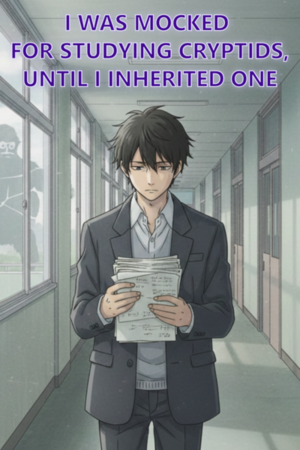
I Was Mocked for Studying Cryptids, Until I Inherited One. Cryptids Aren’t Pseudoscience. They’re Damage Control
Renji woke to the sound of paperwork.
Not pages turning, but voices reciting language so dry it scraped against the inside of his skull. Dates. Causes. Official phrasing that reduced screams into syllables that fit neatly on forms.
“…industrial accident involving unauthorized logging operations,” someone said. “Multiple casualties. Cause of death consistent with wildlife panic and secondary trauma.”
Renji opened his eyes.
A canvas ceiling sagged above him, stained with humidity. The air smelled of antiseptic layered over damp soil, as if someone had tried to disinfect a forest and failed. His body felt heavy in an unfamiliar way. Not sore exactly, but weighted, like his center of balance had shifted while he slept.
He turned his head slowly.
Professor Kawashima stood at a folding table near the entrance of the medical tent. Two men flanked him; both dressed in uniforms that carried no clear insignia. Their posture was formal but not military. Government-adjacent, Renji thought dimly. The kind that existed to be overlooked.
“There were no survivors among the workers closest to the equipment,” one of the men continued. “Several bodies were unrecoverable. Presumed lost to terrain collapse.”
“And the equipment itself?” Kawashima asked.
“Removed for investigation,” the man replied smoothly. “Foreign contractors will be questioned. Cooperation is expected.”
Renji swallowed. His throat burned, dry as sand.
The second man noticed his movement. “He is awake.”
The conversation stopped as if cut with a blade.
Kawashima turned, his expression unreadable. He excused himself with a nod and approached the cot.
“You should not move yet,” he said quietly.
Renji ignored the instruction and pushed himself upright. The motion sent a wave of dizziness through him, sharper than expected. His hands trembled as he steadied himself on the cot’s edge. The tent seemed too small, its boundaries pressing inward.
“What did you tell them?” Renji asked.
Kawashima studied his face with clinical focus. “Enough to close the incident.”
“And the rest?”
Kawashima glanced toward the tent entrance, then back to Renji. “The rest has been contained.”
Renji let out a short, involuntary laugh. It sounded wrong to his own ears. “Contained,” he repeated. “Is that what you call it?”
“It is the term used,” Kawashima replied. “Not the truth.”
The men outside resumed their low conversation. Footsteps passed. Orders were given. The machinery of explanation moved on.
Renji closed his eyes. The memory surged immediately, uninvited.
The forest tearing open. The thing that had come through, screaming without language or intent. The Orang Pendek emerging from the trees, not shouting, not posturing, only acting. And the elder, already wounded, pressing his hand into Renji’s chest with desperate finality.
Renji gasped, his fingers digging into the cot.
“You are safe,” Kawashima said, though his voice lacked conviction.
Renji opened his eyes again. “What happened to them?”
“The Orang Pendek?” Kawashima asked.
Renji nodded.
“They withdrew once the anomaly collapsed,” Kawashima said. “They do not linger. Proximity invites attention.”
“And the elder.”
A pause.
“He did not survive the transfer,” Kawashima said at last. “It was not intended.”
Renji stared at the canvas wall. “Then why did it happen?”
Kawashima did not answer.
Later that afternoon, Renji was escorted outside.
The logging site looked smaller in daylight. Less monstrous. Bright tape cordoned off the clearing, fluttering uselessly in the still air. Soldiers stood at intervals, their boots sinking slightly into disturbed soil.
The machine was gone.
Not dismantled. Not covered. Simply removed, leaving behind only deep ruts and scorched ground. Renji felt it immediately. A hollow absence, like a tooth pulled from the land without anesthesia.
His chest tightened.
“You feel it,” Kawashima said beside him.
Renji nodded. “Something is missing.”
“Yes,” Kawashima said. “And something remains.”
Renji looked toward the forest edge. The trees stood quietly, but the silence felt intentional now. Watchful.
“That thing,” Renji said. “The creature. Was it summoned?”
“Yes.”
“On purpose?”
Kawashima hesitated. “The operators did not know what they were doing.”
“But someone did.”
“Yes.”
Renji clenched his hands. “And this happens often?”
“The creature summoning rarely happens,” Kawashima said. “But it has happened before. Across centuries. Across continents. ”
“And the cryptids,” Renji said slowly. “They respond.”
“They endure,” Kawashima corrected.
Renji turned to him. “You knew.”
“I suspected,” Kawashima said. “There are patterns. Veil thinning. Environmental resistance. Certain myths repeating in specific conditions.”
“Then why bring me here?” Renji asked, the question sharp with accusation. “Why approve the project?”
Kawashima met his gaze. “Because denial does not prevent curiosity. Because institutional skepticism does not erase the world’s fractures. And because you were already looking in the right direction.”
“That does not justify it.”
“No,” Kawashima agreed. “It does not.”
That night, Renji could not sleep.
Every sound pressed into him with uncomfortable clarity. The chirring of insects outside the tent arrived in layered detail. He could feel the uneven ground beneath the cot, the compacted soil resisting rest. Even his own heartbeat felt too loud.
When he closed his eyes, images surfaced. Not memories exactly, but impressions. Forests retreating before roads. Clearings appearing and vanishing. Humans advancing with tools and certainty. And always, resistance.
Not organized. Not coordinated. Just persistent.
Renji realized then that what he had inherited was not strength. It was obligation.
By morning, evacuation orders were issued.
The official report was finalized in less than twelve hours. Illegal logging accident. Environmental damage. No further investigation required.
Renji signed where he was told. His signature looked wrong on the page, as if written by someone else.
At the airstrip, Kawashima handed him a sealed envelope.
“Your thesis materials,” he said. “Edited for safety.”
Renji took it, then hesitated. “Did the elder choose me?”
Kawashima’s expression tightened. “Compatibility is not choice. It is circumstance.”
“That sounds like something you tell yourself,” Renji said.
Kawashima did not deny it.
On the flight back to Japan, Renji drifted in and out of uneasy sleep. His dreams were crowded with sensation. Soil compacting underfoot. Branches bending. A body that was not entirely his, moving through space with different priorities.
When the plane descended, the feeling returned. Pressure. Constraint. The land below was dense with human presence, layered with old modifications and older compromises.
Japan felt tired.
Campus life resumed as if nothing had happened.
Renji’s classmates joked about his “adventure.” Professors skimmed his revised proposal with visible relief. No cryptids. No anomalies. Just cultural narratives and deforestation statistics.
“What did you find?” someone asked in the hallway.
Renji considered lying. Considered repeating the sanitized language of the report.
Instead, he said, “Patterns.”
That night, alone in his apartment, the pressure returned. Stronger this time. A pull toward the edge of the city, where concrete gave way to neglected green.
Renji sat on his bed, heart racing, and understood with unsettling clarity that Sumatra had not been an exception.
It had been the first time he noticed.
And whatever now lived alongside him was listening, waiting for the next fracture to appear.








Please sign in to leave a comment.