Chapter 5:
Damage Control
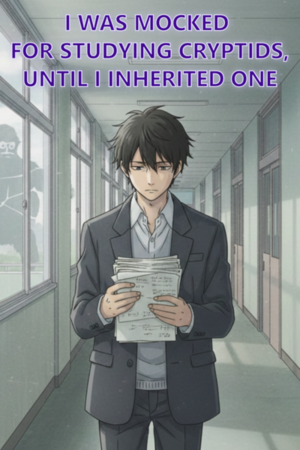
I Was Mocked for Studying Cryptids, Until I Inherited One. Cryptids Aren’t Pseudoscience. They’re Damage Control
They did not speak on the way back.
Kawashima drove with both hands on the wheel, eyes fixed ahead. The road cut through low hills and unfinished suburbs, places that had once been fields and now existed in a state of permanent hesitation. Renji sat in the passenger seat, his body aching in ways he could not explain.
Every bump in the asphalt sent a ripple through him. Not pain. Feedback.
“You felt it because you were close,” Kawashima said at last. “But also because you are no longer insulated.”
Renji looked at him. “You mean human.”
Kawashima did not answer immediately. He turned off the main road and guided the car onto a narrow path lined with reeds and stagnant water. At the end stood an old water treatment facility, long decommissioned. Rust ate through its fences. Warning signs hung crooked, ignored by everyone except those who already knew.
They parked.
“You should not repeat what you saw tonight,” Kawashima said. “Not to your university. Not to the police.”
Renji laughed weakly. “You say that like I could explain it.”
Kawashima stepped out of the car. “I can.”
They entered the facility through a side door. Inside, the air was damp and cool. Water dripped somewhere in the dark, slow and rhythmic. Kawashima led Renji down a narrow corridor until they reached a circular chamber. A shallow pool occupied its center, its surface perfectly still.
“Sit,” Kawashima said.
Renji did.
For a moment, nothing happened. Then the pressure returned. Stronger than before.
Kawashima removed his glasses and placed them carefully on the floor. He loosened his tie, rolled up his sleeves, and stepped toward the pool.
“You have questions,” he said. “I will answer what I can.”
The water stirred.
Kawashima’s reflection warped, his outline blurring. The change was not sudden. It was deliberate. His skin darkened, taking on a faint green sheen. His fingers lengthened, webbing forming between them. His eyes widened, pupils flattening.
A kappa stood where Kawashima had been.
Renji did not scream. He could not. The pressure in his chest locked his breath in place.
“This is not a disguise,” Kawashima said, his voice unchanged. “It is inheritance.”
He stepped back, and the water rose slightly, responding to him. Then, just as carefully, he shifted again. Skin returned to normal. The webbing receded. In moments, Kawashima Akio stood before Renji once more, tired and human.
Renji exhaled shakily. “You said cryptids do not exist.”
“I said they were not what people thought,” Kawashima replied. “That is still true.”
Renji rubbed his face. “You have known this whole time.”
“Yes.”
“And you let them mock me.”
Kawashima inclined his head. “Yes.”
Anger flared. “Why.”
“Because attention is dangerous,” Kawashima said. “Because curiosity without context invites catastrophe. Because the more seriously cryptids are treated as real, the more people look for ways to use them.”
Renji thought of the machine. The humming panels. The men who had not known what they were doing.
“They are not studying us,” Renji said slowly. “They are studying the veil.”
Kawashima nodded. “Or rather, the absence of it.”
He sat opposite Renji. “The world you know operates on thin magic. Residual. Diffuse. Enough for inheritance to function. Not enough to sustain intrusion.”
“And the other world,” Renji said.
“Abundant,” Kawashima replied. “When the boundary thins, power leaks. Creatures follow.”
“And they go berserk,” Renji said. “Every time.”
“Yes.”
Renji clenched his fists. “Then why not stop the machines.”
“We try,” Kawashima said. “But the research is layered. Field operators do not know the purpose. Contractors do not know the implications. Shut one site down, another opens elsewhere.”
“And you,” Renji said. “You watch.”
“I contain,” Kawashima corrected. “That is the agreement.”
Renji stood abruptly. “An agreement with who.”
Kawashima hesitated. “With people who prefer damage control to panic.”
“That is not an answer.”
“It is the only one that exists,” Kawashima said. “Governments have known about shifters for centuries. They learned quickly that secrecy caused fewer deaths than revelation.”
Renji paced the room. The air felt thick, resistant to his movement.
“Ethan said I am carrying the wrong myth,” Renji said. “What does that mean.”
Kawashima studied him. “Inheritance has territory. Context. Orang Pendek power responds to forests under pressure. You are using it in concrete and steel.”
“That does not make the monster less dangerous,” Renji said.
“No,” Kawashima agreed. “It makes you more unstable.”
Renji stopped pacing. “Then teach me how to stabilize.”
Kawashima shook his head. “That is not how this works. There is no training. No mastery. You inherited because there was no one else.”
“And if I refuse,” Renji said.
“Then the power will seek another compatible host,” Kawashima replied. “Or it will degrade. Or it will die.”
Renji swallowed. “People could be hurt.”
“Yes.”
“So I cannot refuse.”
“You can,” Kawashima said quietly. “You would just have to live with the consequences.”
Sirens echoed faintly in the distance. Not from the site this time. Somewhere else.
Renji felt it again. The pressure. The pull.
“It is happening again,” he said.
Kawashima stood. “Yes.”
They returned to the car and drove without headlights, guided by sensation rather than sight. This site was smaller. A temporary installation in a half-abandoned industrial park. The machine was already active when they arrived.
Ethan was there.
He stood near the perimeter, arms crossed, watching workers scramble in confusion as the air warped above the device.
“You are late,” he said when he saw them.
Kawashima stepped forward. “Stand down.”
Ethan laughed. “You brought the kid.”
Renji ignored him and focused on the machine. The veil was thinning, not torn. The land strained, resisting.
“They are pushing output,” Renji said. “They think the readings are noise.”
“Then end it,” Ethan said. “Before it escalates.”
“That will kill everyone nearby,” Renji said.
Ethan’s jaw tightened. “That is not my problem.”
“It is mine,” Renji said.
The creature began to form. Smaller. Flickering. Unstable.
Kawashima placed a hand on Renji’s shoulder. “If you intervene, you will expose yourself.”
Renji nodded. “I know.”
Ethan scoffed. “This is not heroism. This is hesitation.”
Renji stepped forward anyway.
He did not attack the creature. He did not attack the machine.
He reached out to the land.
The inheritance answered reluctantly. His body twisted, partially, painfully. His senses expanded until he could feel the machine grinding against reality, feel the forest fragments buried beneath asphalt screaming in confusion.
He did not close the tear.
He eased it.
Reduced the friction. Slowed the feedback loop. Allowed the strain to dissipate rather than snap.
The creature collapsed in on itself, not destroyed but unable to sustain form. It faded like mist under sunlight.
The machine sputtered and shut down as alarms blared.
Silence followed.
Renji collapsed to his knees, gasping. Kawashima caught him before he hit the ground.
Ethan stared at the empty air where the creature had been. “You let it go.”
“No,” Renji said weakly. “I let it stop.”
Ethan turned away. “Next time, your restraint will get someone killed.”
“Next time,” Renji replied, “your certainty might.”
Authorities arrived. Explanations formed. The site was sealed.
As they left, Ethan paused beside Renji. “You are not wrong,” he said grudgingly. “You are just fragile.”
Renji managed a tired smile. “So is the world.”
That night, as Renji lay awake, pain blooming through him in waves, he understood something with unsettling clarity.
This was not a war.
It was maintenance.
And he had just volunteered to be part of it.






Please sign in to leave a comment.