Chapter 14:
4:00 AM
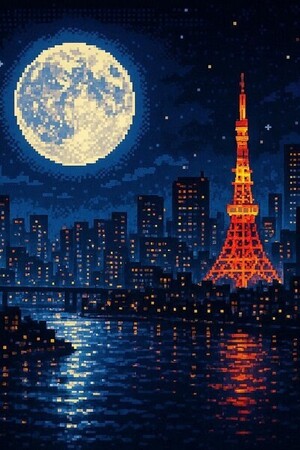
Moonlightning in Tokyo
Surrounded by a yellow glow, the taxi began its journey. The driver, Suzuki, sat behind the wheel, with the Traveler in the passenger seat beside him. In the back seat, Robert, Asagi, Mr. Harada, and Kaguya were pressed together. Kaguya stared intensely through the window, carefully observing the surroundings. Her hands were clenched into fists—clearly tense, yet ready for whatever was about to happen.
Out of the boundless darkness, individual points began to appear—first stars. Soon the Sun, the Earth, and the full Moon emerged, hanging motionless in the sky, as if the time travelers were permanently bound to it. Robert felt a wave of relief when he saw that the Moon was whole. A moment later, meteor craters appeared on its surface, which frightened him briefly.
Rocks appeared. Water. Vegetation. Animals.
“We’ll be there any moment now!” the Traveler announced cheerfully. “Remember—people of this era cannot see or hear us, and we cannot interact with them. Unless we run into other time travelers, of course!” he added brightly. “This setting works much like the one used by the bandits—by which I mean the collectors of time-travel devices. You’ve already encountered them in Edo!”
The speed at which things appeared around them visibly slowed. Although it was night, they could see reasonably clearly. Fishing huts came into view, wooden racks for harpoons, and the sleeping places of domesticated dogs. A large bonfire burned some distance from the village, casting long shadows over the huts of people from the distant past.
Suddenly, Kaguya gasped sharply.
They saw a small girl carefully looking around, clearly trying not to be noticed by anyone.
“Lead the way, young lady!” the Traveler said cheerfully to Kaguya.
“So be it…” she sighed. “Let’s get out and follow her.”
“What child is that?” Robert still didn’t understand. “Is she someone important?”
“To my story—very much so,” Kaguya replied. “She’s me.”
They all followed the sneaking child, who could not see them and believed herself to be completely unnoticed.
“What is she doing…?” Asagi watched the girl’s movements closely.
The slight child struggled to push aside a heavy stone covering a pot near the fire and scooped out a large handful of something from inside. She placed it on a flat stone nearby and began kneading it like dough.
“It’s clay,” Kaguya explained. “I always loved doing this, ever since my mother taught me the basics.”
They watched the deft movements of little Kaguya’s hands from thousands of years ago. First, she shaped a small clay bowl. Then she rolled the clay on the stone until it formed thin coils, which she wound into spirals and attached to the rim of the bowl, building up the vessel’s walls. Asagi examined the clay closely: it contained other materials, some of which the exorcist recognized as crushed shells. The child then smoothed the inside of the vessel, leaving fanciful patterns on the outside. Everyone watched, mesmerized.
Next, the little girl took a string and wrapped it around the clay vessel, imprinting its pattern into the soft surface. Kaguya watched, deeply moved.
“You know, I still do this to this day.”
“You mean…?”
“Ceramics is still my profession. Not continuously—certainly not for all those thousands of years—but for most of the time. These days, Jōmon-period vessels are popular again. They sell well at online auctions…”
“What was your name back then?” Mr. Harada asked. “Surely not ‘Kaguya’?”
“No. I’ve only been using that name for a little over a thousand years. Back then, names were… simpler. Like ‘Sun’ or ‘River.’ Mine was ‘Moon,’ and it stayed that way. Later I began using the name ‘Kaguya’ when The Tale of the Bamboo Cutter became popular…” She drifted into her memories.
“Now watch,” the Traveler interrupted.
A luminous shape appeared in front of the child—a silhouette only slightly taller than little Kaguya. The girl tried to scramble to her feet but instead clumsily fell onto her back.
The glowing form staggered, its light seeming to dim. The figure extended a small hand toward the child. At first frightened, the girl stood up and reached out her hand in return.
“Is that…?!” Asagi whispered.
“Watch carefully,” the Traveler urged.
The short, glowing figure leaned down and whispered something into little Kaguya’s ear, still holding her hand. The child nodded in understanding. After a moment, the child began to cry softly, and the luminous being stroked her head in a comforting gesture, which seemed to help. But the effort must have exhausted the glowing visitor completely, because suddenly it began to tremble and… shattered into hundreds of fragments. They swirled through the air and then vanished, as if shot off toward different points.
In the terrified child’s hand remained only a glowing palm.
The hand of a kami.
Little Kaguya knelt by the fire, staring in horror at the radiant hand.
“Yes. That was our Aya,” present-day Kaguya explained. “It’s a shame I only understood it now.”
“And you, all this time…”
“Yes. I avoided answering that question because I didn’t even know how to begin. Sure, we’ve seen many incredible things lately, but… this is a long and complicated story.”
“Take your time,” the Traveler reassured her. “I know I’ve said it before, but we have plenty of it. Let’s sit down and listen. This is the right moment for your story.”
“These are very distant, dust-covered memories from thousands of years ago… That glowing being—our Aya—told me to keep her hand and never give it away to anyone. I was terrified and didn’t understand anything, but what else could I do? Unfortunately, it turned out to be a curse…”
They all sat down by the fire, unnoticed by anyone. Kaguya told them how she hid the hand in a clay vessel and carried it everywhere with her, never revealing what it truly was. Sadly, the hand of the kami—who was in reality Aya scattered throughout the fabric of time after Murata’s lightning struck the anti-magic beads—had one effect on her: she stopped aging. While her peers grew twice her height, she remained a small child. She understood more and more, but her body did not mature or age. Eventually, the villagers could no longer ignore it and decided the child was cursed. Little Kaguya had to flee, fearing for her life.
She wandered for decades and centuries from village to village. Kind people took her in, and she fled as soon as she noticed suspicion or fear in their eyes. Every few years she moved on, never forming attachments, always carrying the clay vessel with the kami’s hand. She often spoke with village shamans, learning from them and accumulating mystical knowledge now long forgotten. This growing knowledge allowed her to create magical powder and helpful spells that made survival in changing times easier—communication with yōkai, becoming invisible, flying—everything necessary to survive. She could also feel the power of the kami’s hand growing, accumulating greater strength within the extraordinary artifact as time passed.
Meanwhile, decades and centuries went by. There were more and more people, new groups arrived, fought, and killed one another—or, conversely, built ever larger cities, more effective weapons, and lived in ever greater numbers. The small child often went unnoticed, and Kaguya learned to live quite skillfully in these changing times. Thanks to the artifact’s growing power, she needed little food and could hide efficiently from danger. Over thousands of years, she witnessed much joy and countless tragedies, always on the sidelines, outside the main events. She saw many wars she could do nothing about, people dying of hunger whom she had to leave behind. That was why she never formed attachments, learning only what was necessary to survive.
The passing centuries brought profound changes. After periods of war came an era of relative order and the harsh rule of the shogunate. Then armed foreigners arrived, and the emperor restored and modernized the country—the greatest change Kaguya had ever experienced. More wars followed, now involving metal vehicles of death. Flying machines appeared. Radio broadcasts. Kaguya survived these turbulent, tragic times by hiding in the most remote regions of Japan—called Yamato or Zipang before foreigners gave it its current name.
Eventually, the country modernized and people changed once again. For the first time in hundreds—perhaps thousands—of years, Kaguya felt safer. She moved to the great city now called Tokyo. She found a corner where no one paid her any attention and watched gigantic glass buildings rise, people rushing everywhere by subway and train. She found modern clothes that fit her. The only people she had to avoid were officials who tried to register her—into records, orphanages, schools. For the first time, her childlike appearance became a problem. She decided it would be better to be someone more grown-up—but that required parting with the kami’s hand for several or perhaps several dozen years, to temporarily free herself from its influence.
It took Kaguya a long time to convince herself to part with the clay vessel, but eventually she decided it would be better for both of them. She found a place she believed to be distant and safe enough and buried the vessel. Then she made her way back to Tokyo by bus and train. She remembered the date exactly.
March 10, 2011.
The next day, the largest earthquake ever recorded in Japan struck—San Ten Ichi-Ichi. The resulting tsunami caused countless tragedies and the deaths of tens of thousands. Kaguya did not know whether this was the wrath of a goddess or whether the power of the kami’s hand, no longer controlled by her presence after so many thousands of years, had simply gone wild. As soon as she could, Kaguya returned to where she had hidden the artifact—but neither the sandy hill nor a large portion of the surrounding area existed anymore. It had been swallowed by the tsunami.
Lost, Kaguya survived as she always had: creating beautiful ceramics, learning to use modern inventions like the internet, and living through magic and magical powder. Her body also began to mature, resulting in her current appearance. She sold her work at online auctions, which—by chance or through the artifact’s influence—eventually drew her attention to an auction where someone had listed the artifact she had parted with fifteen years earlier and regretted ever since.
“That’s the whole story,” she finished. “You already know the rest.”
The group sat in silence for a while.
“Well,” the Traveler’s warm voice pulled them from their thoughts, “that leaves us with only one mystery to solve.” He turned his gaze to Robert.
“You mean…?”
“Your ability to use the power of the kami—and Murata himself.”
“They’re… connected?”
“Unfortunately, yes!” the Traveler laughed. “Murata can control the power of the kami as well—though fortunately, the hand itself never fell into his possession!”
“But I don’t remember anything like that,” Kaguya interjected. “So much has happened, and the older times blur together, but I would remember if the kami’s hand had affected anyone other than me…”
“Then we’ll have to travel to a time a little closer,” the Traveler said with a grin. “Closer to our own time—and to us personally!” He laughed and pointed at Robert.
“What do you mean?”
“The year 1600. April. Bungo. Present-day Usuki.”
Everyone climbed back into the taxi and prepared for the journey.





Please sign in to leave a comment.