Chapter 6:
Football
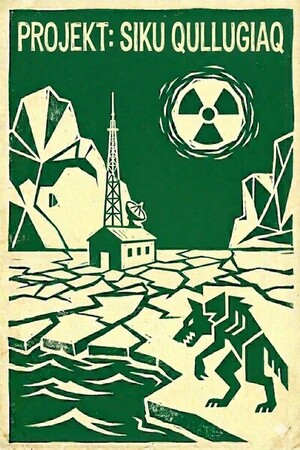
Projekt: Siku Qullugiaq
They got to the space base before noon. It was approaching the end of the polar sun, and in a few days there’d be the first sunset in months. The base was preparing for the launch but at this point the rocket blasts had been going on for at least a decade and they’d gotten it down to a routine.
Pituffik Space Base was the oldest U.S. military installation in Greenland. It opened as Thule Air Base in 1951, part of a secret Cold War Arctic project. The Danish government moved the entire village across the bay so that the Americans could build. In fact, during the Cold War the Danes gave the U.S. permission to open up military installations anywhere they wanted and at any time. The permission was never revoked. The base had been renamed Pituffik Space Base sometime in the twenties, when things started really going wrong, but it took some years for the space force to actually launch rockets from there. The whole space force thing was the carnival barker’s idea, but it didn’t take off until he was gone for good. Like the push for statehood for Greenland. Despite his saber-rattling, he never opened any new bases in Greenland and the idea went into remission. But eventually the Americans did open up new bases. None of them were as far north as the space base.
The open-door policy was intended for the larger bases built closer to the larger settlements, Nuuk and Sisimiut and Ilulissat, but the obligation of the policy impressed upon the armed forces in Greenland by Washington led the brass at the space base to contract out boats for anyone who wanted to take advantage of the open-door policy with them. It was part of the inherent paradox of the current American president’s embrace of militarism and self-determination. For the U.S. military, as always, money was no object.
Sid knew all the guardians at the base, but not the Lieutenant General who came to greet Wally and him. He wondered if the man was a Mets fan. There were three or four on the base, depending on how the team was doing. There were fewer baseball fans in general. Football had totally eclipsed it as an American sport, a war with offense and defense and tackles, especially after the players union agreed to roll back a lot of the safety measures in exchange for more money and ownership stake.
Wally liked football. He was a big fan of the merger of the football leagues of the two countries a few years ago, and didn’t like the claim that the whole thing was just a political ploy. It was true that the experience had made the idea of the Canadian provinces and territories joining the U.S. as states a bit more palpable. Killing the fourth down was supposed to kill football. Instead it brought back a physical game that solidified football in television ratings and viral short clips.
There was a big debate about whether to expand the playoffs from seven teams since the merger created a forty team league. The four western teams joined the junior conference of the American league, and the four eastern teams joined the senior conference. That kept those teams from being in the same conference as their competitors for the television market in Buffalo and New England. A new North division was created in each conference and the Canadian teams were placed there. The old North divisions became new Central divisions. Americans ignored that and called them the Canada divisions, another lesson in the uncertain path toward Canada’s accession into the U.S. Political columnists loved to use it as a metaphor and Wally hated that. He did like when Prince Archie became a first-round draft pick and brought the trophy to Canada for the first time in history. He’d bring the UK into the future too, Wally knew. And they won it without an expanded playoff. Everyone expected a playoff expansion because everyone sells out, and more playoff games meant a lot more money. It was a good sign, the political columnists opined.
-We’ve been expecting you, the Lieutenant General said to Wally. I’m Lieutenant General L.T. Gladstone, Deputy Chief of Space Operations, Operations, Cyber, Nuclear, and Xenobiology. SOCNuX, he explained.
-You’ve been expecting us? Wally asked, confused. I wasn’t sure I’d even be able to make it here. The guy from Ottawa told me to find someone to go with through the open door policy and hope for the best.
Gladstone looked him up and down. He was old enough to remember when cryptozoology was pseudoscience. He was also old enough to remember when xenobiology was theory, but here they were. He was old enough to remember a lot of things.
-I was hoping to take a look through some of your archives, Wally said, noticing he was being sized up and feeling again like a dog. What do you know about the B-52 crash?
-Oh that was what, eighty, ninety years ago, Gladstone asked, caught by surprise by the question. It’s been twenty-some years since we tried looking, when the ice first really started melting.
-How far did you look?
-I’d say it was probably about a hundred kilometer radius.
-That’s more than I expected, Wally said with a whistle. But still not enough. Do you know how far wolves can travel?
-A wolf couldn’t carry a nuclear bomb from the 60s hundreds of kilometers. What are we talking about here Professor Woodbine?
-Oh, I’m not a professor sir, Wally said. Now please tell me about the tunnels.







Please sign in to leave a comment.