Chapter 19:
Chapter 17: The Boy the World Finally Saw
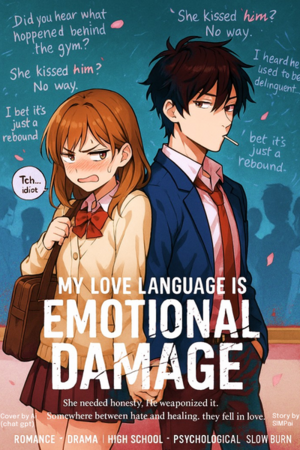
My Love Language Is Emotional Damage (Volume 1)
Chapter 17: The Boy the World Finally Saw
“I didn’t step forward to be seen. I stepped forward because someone was there.” – Adam
Sunday arrived.
Adam woke late, not because he was tired, but because nothing demanded him out of bed. The light filtering through the curtains was pale and lazy, dust floating through it like the day itself hadn’t decided what it wanted to be yet.
He lay there for a while, one arm tucked behind his head, staring at the ceiling. Quiet. Not the heavy kind. Just empty. Eventually, he sat up and swung his legs over the side of the bed. The floor was cool under his feet. He stretched once, slow and deliberate, then moved through the apartment with the same calm rhythm he always did. Dishes were done first. Laundry were folded. Counter was wiped. He did things thoroughly. Not obsessively. Just enough that when he finished, there was nothing left nagging at him.
His phone buzzed on the table.
Akane:
Sorry 😣 shoot ran longer than expected
I’ll call you later, okay?
He smiled faintly and typed back.
Adam:
Don’t rush. Do your thing.
A few seconds passed.
Akane:
Miss you though.
His thumb hovered, then typed.
Adam:
I know.
Simple. Honest. He set the phone down and headed for the kitchen, opening the fridge out of habit more than hunger. He reached for his matcha drink, then paused. Empty. He stared at the carton like it had personally betrayed him.
“…Of course,” he muttered.
He checked the cabinet. Nothing. No backups. No emergency stash. He exhaled through his nose, almost amused.
“Alright,” he said to the empty room. “I’ll go.”
He grabbed his jacket and wallet, slipping his phone into his pocket before heading out. The building hallway smelled faintly of cleaning solution and old concrete. Outside, the neighborhood felt different on Sundays. Softer. Less urgent.
Kids played farther down the street. A couple argued quietly over groceries. Somewhere, a radio played a song too cheerful for the gray sky.
Adam walked toward the convenience store, hands in his pockets, mind drifting.
He thought about Akane. About how busy she’d been lately. About how proud he was, and how strange it felt to miss someone while being genuinely happy for them at the same time.
At the store, the clerk greeted him with a nod.
“Matcha again?” the man asked.
“Yeah.”
“Popular these days.”
Adam shrugged. “Guess so.”
He paid, tucked the drinks into the bag, and stepped back outside.
That was when he smelled it.
Smoke.
At first, he thought it was someone burning trash. Then he heard shouting. Not loud, not panicked yet. Just wrong.
Adam stopped.
Across the street, a few buildings down, gray smoke curled up from behind a low fence. It thickened fast, darker now. Someone ran past him, phone pressed to their ear.
“Fire department’s on the way!” the man shouted to no one in particular.
Adam’s gaze locked onto the source.
An old building. Small. Painted pale yellow.
He recognized it.
The orphanage.
Before he realized he was moving, he was already crossing the street, bag still in his hand.
Someone screamed.
“Kids are still inside!”
Adam dropped the bag.
The matcha rolled onto the pavement, forgotten.
And without another thought, he ran.
Heat hit him first.
Not flames. Not pain. Just the sudden, suffocating weight of hot air pressing against his chest as Adam reached the gate. Smoke poured out of the windows in uneven breaths, thick and gray, carrying the sharp bite of burning plastic and old wood.
People stood frozen on the sidewalk. Someone was crying. Someone else kept shouting that help was coming.
Adam didn’t wait to hear it again.
“Where?” he asked the nearest adult, already moving.
A woman grabbed his sleeve, panicked. “The back rooms. Two of them. They were napping. I–I couldn’t–”
That was enough.
Adam pulled free and ran.
Inside, the world collapsed into noise and blur. Smoke crawled along the ceiling, rolling downward in heavy waves. The floor was littered with toys, small shoes, a picture book half-burned at the edges. Somewhere deeper in the building, something cracked and fell, the sound sharp and final.
“Hey,” Adam called out, voice low but steady. “If you can hear me, answer.”
No response.
He dropped to a crouch immediately. The air was clearer near the floor, cooler. His eyes burned. He pulled his sleeve over his mouth and moved forward on instinct, counting steps, memorizing turns.
A cough. Small. Ragged. Adam’s heart kicked.
“Stay there,” he said, louder now. “I’m coming to you.”
He followed the sound to a side room. The door was half-open, warped from heat. He shoved it wider and saw them.
Two kids.
One older, maybe eight or nine, standing in front of the other like a shield. The younger one was on the floor, knees pulled to their chest, eyes wide and glassy with fear. Smoke clung to their hair and clothes.
They didn’t scream when they saw him.
They just stared.
“Okay,” Adam said, keeping his voice calm, like this was the most normal thing in the world. “We’re going out now.”
The older child shook their head violently. “It’s hot.”
“I know,” he said. “I’ll carry you.”
He moved fast. Scooped the younger one up first, cradling them close to his chest. They clutched his shirt instantly, fingers digging in like anchors.
“It hurts,” the child whispered.
“I know,” Adam said again. “You’re doing great.”
He reached back with his free arm. “You too. Grab on.”
The older kid hesitated for half a second, then grabbed his shoulder. Adam shifted his stance, bracing himself, then moved.
The hallway was worse now. Smoke thicker. Visibility down to nothing. His lungs screamed with every breath. He focused on one thing only.
Forward.
Something crashed behind them. The sound was close. Too close. The older child whimpered, grip tightening.
“Don’t let go,” Adam said. “No matter what.”
They didn’t.
When they burst back through the entrance, fresh air hit like a slap. Adam staggered, coughing hard as hands reached out, voices overlapping in shock and relief.
“They’re out!”
“Call an ambulance!”
“Hey–hey, you okay?”
Adam lowered the kids carefully, kneeling with them until he was sure they were steady. The younger one didn’t let go of his sleeve right away.
“You came back,” the older one said, voice shaking.
Adam nodded once. “Yeah.”
Sirens grew louder in the distance. Only then did his hands start to shake. The children were still holding onto him.
Even after the danger had passed, even after the open air cooled their skin and soot streaked down their faces, they stayed close, small hands fisted in the fabric of Adam’s jacket like it was the only solid thing left in the world.
He didn’t pull away.
The younger one clung to his chest, breathing in short, uneven gasps. Their head fit just under his chin, and Adam adjusted his grip automatically, shielding them from the noise as best he could.
The older child stood pressed against his side, shoulders shaking. “I thought,” they whispered, swallowing hard, “I thought we were going to die.”
Adam crouched so they were closer to eye level. His voice was quiet, steady. “You didn’t. You’re safe now.”
Fire engines screeched to a stop in front of the building. Doors slammed. Boots hit pavement. Firefighters surged past, hoses uncoiling in practiced motions, faces already smeared with ash before they’d even entered.
A paramedic knelt beside them. “Hey there,” she said gently to the kids. “Can I check you out?”
The younger one shook their head violently and pressed closer to Adam.
“It’s okay,” Adam murmured. “She’s just making sure you’re alright.”
The paramedic glanced at him, surprised by how calm he was despite the soot smeared across his face and hands. “Are you their guardian?”
“No,” Adam said. “Just… here.”
The woman nodded, understanding more than the word implied.
Slowly, carefully, the children let go as they were guided onto a blanket. The older one kept looking back, eyes searching.
Adam stayed where he was.
A firefighter approached him, helmet tucked under his arm. “You went in?”
Adam nodded once.
“With no gear?”
Another nod.
The firefighter let out a breath, somewhere between admiration and disbelief. “You saved them both.”
Adam shrugged, gaze drifting back to the kids. “Anyone would’ve.”
The firefighter didn’t argue.
Behind them, the crowd had grown. Phones were out now. Whispers rippled through the gathered neighbors.
“Was that him?”
“He ran straight in.”
“He’s just a kid.”
A police officer stepped up, notebook in hand. “Sir, we’re going to need a statement. Just routine.”
Adam nodded again. “Okay.”
As he spoke, the kids watched him. The younger one gave a small, uncertain wave.
Adam lifted two fingers in return.
One of the caretakers from the orphanage finally broke down, crying openly as she thanked him over and over. Adam listened, awkward, hands shoved into his pockets like he didn’t know where to put himself.
And across the street, unnoticed by him, a familiar face lowered a camera just long enough to smile.
The story had found its beginning.
The crowd thinned as the fire came under control.
Flames were no longer visible, only smoke rising in slow, tired curls as firefighters worked through the building. The worst had passed. The children sat wrapped in blankets now, sipping water, their faces streaked with ash and tears, but alive.
Adam stood a short distance away, answering questions when asked, silent when not.
He didn’t see the man at first.
The reporter lingered near the edge of the scene, not pushing, not speaking loudly. He wasn’t dressed like the others with cameras raised high, elbows sharp. He watched instead. Let the moment breathe.
His lens found Adam.
Soot-streaked. Hair damp with sweat. Jacket half-burned at the sleeve.
The reporter didn’t rush the shot. He waited for Adam to turn slightly, to glance back at the children, to exhale as if his body was only just now realizing it had survived something.
Click.
The sound was small. Almost polite. Adam turned his head, sensing movement rather than hearing it. Their eyes met for a brief second. Recognition flickered. Not Adam’s. The reporter’s.
He lowered the camera slightly, brows knitting together. He had seen this boy before. On the track. In the volleyball court. Standing beside a girl whose face had started appearing on screens and billboards.
The thought settled quietly.
Interesting.
He took another photo. Not dramatic. Not heroic. Just real.
Adam looked away again, attention already drifting back to the kids and the responders. He didn’t ask questions. Didn’t pose. Didn’t perform.
The reporter watched him for a while longer.
Then he slipped his phone from his pocket, typing a few short notes.
Heroic student. Orphanage fire. Connected to rising model. He didn’t smile. He didn’t frown. He just observed. Some stories announce themselves with noise. Others wait for the right person to notice. The fire trucks left one by one. Their sirens faded into the distance, taking the urgency with them, leaving behind a street that felt strangely hollow. The orphanage stood scarred but standing. Smoke clung to the air like a memory that refused to disperse.
Adam sat on the curb.
Someone had handed him a bottle of water. He held it loosely, knuckles still dark with soot, palms scraped raw. Only now did the shaking return, subtle but real, running through his fingers like a delayed echo.
A police officer finished taking notes. “We might need to contact you again,” he said. “But for now, you’re free to go.”
Adam nodded. “Okay.”
He stood, slung his jacket over one arm, and took a few steps away from the crowd. That was when his phone buzzed. Unknown number. He frowned slightly, then answered.
“Hello?”
The voice on the other end was sharp, breathless. “Adam Tsuda?”
“Yes.”
“This is Akane’s manager. She’s on a shoot right now, but–” The woman paused, choosing her words. “There’s been an incident. A fire. Someone mentioned your name.”
Adam closed his eyes briefly. “I’m fine,” he said. “I helped a bit. That’s all.”
There was silence. Then hurried movement, muffled voices overlapping.
“She’s leaving,” the manager said. “She heard your name and wouldn’t stay.”
Adam’s chest tightened. “You didn’t have to–”
The call ended. Across the city, the shoot ground to a halt. Akane had been standing under bright lights, surrounded by people adjusting her hair, her makeup, her posture. She was mid-laugh when someone whispered urgently into her ear. Fire. Orphanage. Kids. Adam. The world narrowed instantly.
“What?” Her voice came out too sharp.
Before anyone could stop her, she was pulling off the accessory they’d just pinned to her collar. “I need my phone. Now.”
“Akane, wait–”
She didn’t.
She grabbed her bag, hands trembling, fingers already dialing as she moved. The set dissolved into noise behind her. She barely heard her manager calling after her, barely registered the surprised looks.
The phone rang. Once. Twice. Adam answered just as she reached the street.
“Akane–”
“Where are you?” Her voice cracked on the second word. “Are you hurt?”
“I’m okay,” he said immediately. “I swear.”
“Don’t lie to me.”
“I’m not.” He hesitated, then added, softer, “I’m still here. Near the orphanage.”
She didn’t respond. She was already flagging down a taxi.
“I’m coming,” she said. “Don’t move.”
“Akane, you don’t–”
“I’m coming,” she repeated, firmer this time. “Just stay.”
The call ended.
Adam stared at his phone for a moment, then slipped it back into his pocket. He leaned against a streetlamp, exhaustion settling into his bones now that the adrenaline had burned out. Fifteen minutes later, a taxi screeched to a stop. Akane was out the door before it fully halted. She ran. Didn’t care who saw her. Didn’t care about the smoke or the cameras or the people still lingering around. She crossed the street in a straight line and stopped only when she was directly in front of him.
Her eyes moved fast. Face. Hands. Arms. Chest.
“You’re bleeding,” she said, breathless.
“It’s nothing.”
She didn’t argue. She reached out instead, fingers hovering for half a second before gripping his jacket like she needed proof he was real.
“You scared me,” she whispered.
Adam swallowed. “I didn’t mean to.”
“I know.” Her voice softened, but her grip didn’t. “That’s the problem.”
Sirens echoed faintly in the distance. Somewhere, a camera clicked again. Neither of them noticed. For a brief moment, the world shrank to the space between them. Smoke. Relief. The quiet aftermath of something that could have ended very differently. Akane rested her forehead against his chest, breathing him in like she needed to recalibrate.
“You’re not allowed to disappear on me,” she said quietly.
He rested his chin against her hair. “I didn’t.”
She nodded, eyes closing. “Good.”
Around them, people whispered. Someone raised a phone. And without either of them realizing it, the story changed shape. Not just a hero. A pair. By evening, the smoke had cleared. The orphanage sat quiet under the watch of temporary floodlights, its windows dark, its walls blackened but standing. Adam and Akane had already left by then, slipping away before anyone thought to stop them. No statements. No interviews. Just two people walking side by side toward the nearest train station, shoulders brushing, silence heavy but steady. They thought that was the end of it.
It wasn’t.
In a cramped newsroom across the city, the reporter sat in front of his screen, sleeves rolled up, hair still damp from sweat and summer heat. He scrolled through the photos slowly, methodically.
Adam kneeling beside the children. Adam standing in smoke, jaw set, eyes distant. Akane running toward him, panic written openly across her face. Akane clutching his jacket like she would fall apart if she let go. The reporter didn’t need to exaggerate. The story wrote itself.
He leaned back in his chair, fingers steepled, thinking not about lies but about angles.
Heroic student saves orphans. Rising model rushes from work to his side. Young couple at the center of it all. He opened a draft.
“A quiet Sunday turned dramatic when a local orphanage caught fire earlier today. Witnesses report that a teenage boy rushed inside without hesitation, saving two children trapped by smoke. Moments later, popular model Akane Hayasaka was seen arriving at the scene, visibly shaken, confirming the two share a close relationship…”
He paused, reread it, then adjusted a sentence. Not too sensational. Not too soft. Just enough. By the time the article went live, the sun had fully set. Phones across the city buzzed.
Screens lit up with the same image:
A boy in soot-streaked clothes.
A girl holding onto him like an anchor.
At home, Akane’s phone buzzed while she was still sitting on the edge of her bed, replaying the day in her head. She glanced down, expecting a message from her manager.
Instead, she saw the headline. Her breath caught. Across town, Adam lay back on his couch, staring at the ceiling, replaying the sound of coughing children and breaking wood. His phone buzzed too. Message after message after message. He picked one at random.
“Is this you?”
He closed his eyes.
Somewhere between saving two lives and walking home with the girl he loved, the world had made up its mind.
Adam hadn’t asked for the spotlight.
But it had found him anyway.
And once it does, it never really lets go.













Please sign in to leave a comment.