Chapter 26:
Vignettes III: Water
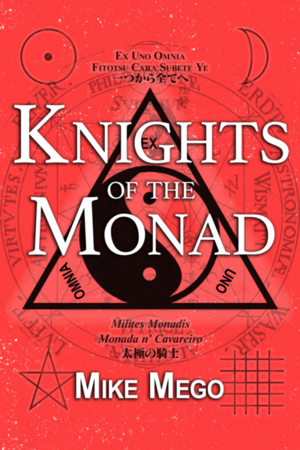
Knights of the Monad
A latter-day testimony from Patricio “Paco” Numasaki on his encounter with Niiro in 2008 was gathered shortly before the publication of this work. Numasaki, a construction manager living in Seikyo, was working on a public project in Hiroshima at the time; Niiro, then a Captain in the Japanese People’s Army (JPA), was also active in the city.
This would’ve been about 2008, or so. Twenty-two years ago. Vivi and I were married at that point, and not long after I came home we’d have our first—and only—child. I probably don’t need to spell her name out at this point, do I?
It was rough, working in Hiroshima, and I imagine that’s part of what pushed Vivi further and further down the slope. I didn’t have a single opportunity to leave or even call back home, but I took the money where the money was; maybe that relationship was partially my fault in the end. Anyways, it was this big program—part of Satsuma’s deal with the UN after the armistice was signed. They’d send a thousand workers to help out with reconstruction projects in the Chugoku region, mostly laborers. I thought I was going to be a laborer, too, but it turns out they were a little short on supervisors. Having had a lot of experience compared to most of the men who went, I ended up filling in as a foreman. That was a big step up for me at the time.
I was still on the graveyard shift, though. And the project we were assigned to was, of course, a row of homes for Japanese diplomats to Satsuma. God knows why they wouldn’t want them in Osaka or something, where the environment might be a little less hostile. On top of being harassed by townies who’d lost a brother or an uncle or something in the war nearly every other night (though they were mostly harmless), we had to deal with the pickiest designers ever—and they were, of course, also prejudiced against us. After a few months or so, I already felt like trashing the office, buying a one-way ticket back to Nagasaki, and never looking back. That is, until I met “Don Army Brass”, as I call him even now.
We owed a lot to the Japanese troops who acted as security for us. Did their job, no questions asked, and not a word spoken to us. Our last line of defense against the aforementioned townies. One night, I get word their commanding officer is coming around, to check out the progress. I’m stressed as all hell, expecting an earful from some bulldog-faced crew-cut about “AWOL” or “candyassing” or whatever the hell the military folks call it, which I’d then have to pass on to my team. I whip them into shape and get their asses moving, the whole eight hours. Finally, 8 o’clock comes. My guys leave without saying a word to me; not only were they tired, but they were pissed. I linger a bit longer, then finally decide to make my way home too. Only once I step out the office door do I finally see Army Brass.
He’s got skin that’s light but well-tanned at the same time, hair that’s long enough to go over his ears with that specific swoop, and big eyes that stare a hole into me. Still wearing camo, though he and I aren’t in an active combat zone as far as I know, and a red beret and matching checkered scarf. His presence is commanding, and manly.
Hell, I think, this guy looks pretty Satsuman to me.
Then he speaks. And, wouldn’t you know it, the first word out his mouth is Konnitta. This man is a Satsuman. And he probably knows I’m a Satsuman too.
Army Brass introduces himself: Captain Jotaro Niiro of the such-and-such company of the such-and-such battalion of the JPA. And I am?
“Paco,” I answer, because I think Paco’s good enough.
“No, your full name.”
“…Patricio Numasaki.”
“Pleased to meet you, Patricio.” To my surprise, he offers me a beer, which I gladly accept. He has some of his own as well. We both take a sip.
Now, hold on, I suddenly think. I’d done my fair share of research on Satsuman history at that time, and I remembered the name “Niiro” coming up a lot. A lot. This was one of the closest families to the old Imperador. A noble name. I press him on it. He laughs, that kind of obnoxious, forced laugh that all rich folks have.
“It’s true,” he says, “my father was a noble in Satsuma. But he left the family a long time ago. My mother was Japanese, and I…well, I’m not sure what I am anymore.” His aura doesn’t crack one bit.
“If you want my opinion, Captain,” I shoot back, “I think you’re Japanese.”
What other reason would he have to be fighting for Japan, after all?
“…Do you hate me for that? For being responsible for starting the war?”
“Hell no,” I say, and once he mentions the war I just can’t stop. I tell him everything I think about the war: that the bombing of the capitol building in Fukuoka was an obvious false flag; that if anyone had to be and could have been behind it, it was the Americans and their CIA; and that the reason they started it was to save their trade routes with China.
I brought up a plan to him I read about, that after the Second World War the Yankees wanted to have Japan clear out Kokura and Shimonoseki and widen up the Kanmon Strait. Same thing with Shikoku. That was thwarted, of course, when the Communists took over Japan and Korea and they had to switch sides to Satsuma. I told him I think they were hoping we could pull another WWII: restart the invasion of Chugoku, Shikoku, and Korea, and the Yankee-Celestial cavalry would follow us in and clean house. Except, once public opinion turned ever-so-slightly against us, they ditched us in a heartbeat and bombed the shit out of us until we gave in.
In the end, I guess they got part of what they wanted. Japan sure isn’t communist anymore, and if luck is on their side Korea will fall soon too.
Army Brass’ next question is if I’m a communist. Again I give him the hell-no. I’m just sick of the elites. The people who get away with making everyone else’s lives on earth miserable while they laugh their way straight to hell.
Now I think it might be time to get a little scriptural, test this man to see how Satsuman he really is. I mention the story from the Gospels, where the Devil tempts Jesus out in the desert. Specifically, the Devil’s final temptation: to give Jesus total political authority over all the kingdoms of the Earth. They have been made over to me, he says, and I may give them to whomsoever I please. Now, of course, the Devil is a liar, but even St. Paul said we do battle with principalities, and equates these with the evil spirits in the heavens. So I give it to him straight: I think war is the Devil’s pastime.
He nods and nods and nods, and once I’m finally done he answers with, “But what about war waged for mankind’s sake?”
“What?”
“The New Testament must be viewed in light of the Old,” he says. Okay, so he is a Christian. Or was at some point, at least. He continues.
“After the Exodus, God leads the Hebrews into the Promised Land. But the land is full of Canaanites. So, what does God do?” He’s waiting for me to answer.
“…Tells them to fight ‘em?”
“Precisely,” he says. Hate that word.
“The Hebrews wage war against the Canaanites. Judah wages war against Israel. Babylon, Persia, and Greece wage war against Judah. Judah wages war against Greece. We like to think that when these nations fight, one is wiped out, or captured and moved into some enclave to rot away. But we ought to know better than that. When two nations fight, a new nation is born. Tribes intermix. The strong survive, while the weak perish.
“When God commanded the Jews to make war against the Gentiles, or commanded the Gentiles to make war against the Jews, each time the Jews were radically transformed—culminating in the time of Christ. It is almost like alchemy; the hand of God guides the mortal’s transformation into the divine, from the low to the high.”
At this point I’m completely lost, and he’s off on his own. I genuinely don’t know how I’ve been able to recall these words after all these years.
“I myself am the product of such alchemy. I am gold and silver, Mars and Venus, light and dark, microcosm and macrocosm, the two forming the one. Birth and death. War, you see, is the miracle of birth and death; the snake biting its tail. And like that snake, it forms a loop, repeating ad infinitum; that is war’s only shortcoming. But I know of a way to break that cycle, so that death shall be no more: by recalling the first war.”
He stops as if prompting me to ask him to clarify. Again, I’m lost and just thinking about going home by now. So I repeat the last couple words I heard back to him and hope he’ll wrap it up soon.
“The first war?”
“Yes. The first war waged between the sons of God and the sons of man. The sons of God come down from the heavens, mate with human women, and spawn the race of the giants—a new man. But this new man does not know God; he commits all manner of atrocity on the earth, and thus God sends the flood.”
Not hearing where the war is in all this.
“However, there is a side to that story, the one we know from our Bibles, that has been left out for most of our history. In some of the other ancient texts recovered from the Jews, it is related that when the fathers of the giants come down from heaven, they also make many arts known to men: smithing, jewelry, cosmetics…but chief among them spells and divination. That is their sin. And for that, the rest of the sons of god—the angels—wage war against them, chain them up in hell, and wipe the giants out.
“What you may not know is that those arts, spells and divination, still survive today.”
My interest is piqued a little. So the military man believes in magic, huh?
“They are rare, but more numerous than one might expect. Some today are called mages, fortune-tellers, exorcists, alchemists—”
“Wait, wait, wait,” I cut him off. “Exorcists? Exorcists ain’t magic, and I’ll stand by that.”
“Not so,” Army Brass answers. “They too commune with spirits, after all. But their methods are secret—passed down only to those they deem worthy. And there are some like them even here in Japan, though they are known by a different name. Why, just a few months ago, there was a gathering of exorcists, alchemists, mages, and shamans in this very city—more than a hundred of them in number, called here by the Army, from both here and your country.
“But I’ve said too much.” He clears his throat. “My point being, there are people alive today who still know the secrets of the sons of God. They are the ones in this world who must be eliminated; all men must rise up and destroy them, just as the sons of God destroyed the giants. Then, and only then, will the New Man finally be born!”
He’s getting awfully emotional. I sidestep his whole rant about magic, but keep the classified info he just leaked in the back of my mind.
“So you’re a man of God too, huh?” I say. “You must’ve been baptized, then.”
“Yes,” he answers. “I rarely use the name now, but my father…named me Melchior.”
I give an empathetic chuckle. “Like the Magus, huh? No wonder you’re so damn obsessed with magic.” He chuckles too, and I slide on past Melchior, give him some courtesy about my long trek home, and thank him for the beer.
He showed up to the site a few more times after that, but never brought up anything about magic or conspiracies again, even though I was sort of hoping he would.
And come to think of it, he never said a word about the project that day.




Please sign in to leave a comment.