Chapter 11:
EPISODE - 11 - The Radiance Before the Fall
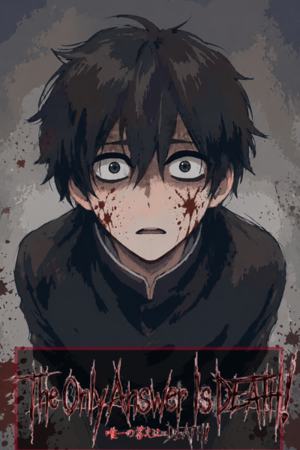
The Only Answer Is DEATH! (唯一の答えは...DEATH!)
[MA 18+ - Contains extreme graphic violence, death and gore, suicide, and severe psychological trauma]
There once lived a kid—and that kid was me. All I wanted was to laugh beside friends on sunny days that felt like they would never end.
Seven years old. That's when it started—not the loops, not the tragedy, but the understanding that he was different. Wrong. Cursed by genetics that had painted his hair the color of arterial spray, of emergency lights, of all the things people associated with danger and death.
The first day of school, his mother had kissed his forehead and told him to be brave. His father had said nothing, just looked at him with an expression that mixed pride and worry in equal measure. Neither of them knew what waited for their red-haired son beyond the school gates.
The laughter started immediately. "Look at his hair!" "Is it dyed? Did his parents do that?" "It's so weird—"
They pointed. Whispered. Giggled behind hands that didn't quite muffle their mockery. And Gekidō—young, naive, still believing the world could be kind—had tried to smile through it.
I dreamed of kindness, of never being cruel, of never wearing the smirk of those who hurt others.
But kindness wasn't offered. The mockery escalated. By the end of the first week, he had nicknames: Devil Child. Fire Head. The Red Curse. Teachers did nothing—or worse, joined in with gentle suggestions that maybe his parents should consider "normalizing his appearance" to help him "fit in better."
By the second week, the physical torment began.
Older students—cornered him after school. Held him down while one of them produced scissors. The blades were dull, meant for construction paper, but they worked well enough on hair. The cutting was rough, uneven, leaving looks visible through the butchered remains of his red hair to be even more messed up than before.
"There," one of them said, satisfied. "Now you look less like a freak."
Gekidō had gone home in tears, his mother's expression crumbling when she saw what they'd done. She'd tried to even it out, but the damage was too extensive. They'd had to cut it all off, leaving him completely bald for months while it grew back.
And when it grew back red—as it inevitably would—the cycle began again.
But years later, I became something else entirely: a villain in the flesh, a devil ripped straight out of a storybook, leaving only suffering in my wake. The memory shifted, pulled forward by the current of retrospection.
Eight years old now. Hair grown back, red as ever, proclaiming his difference to anyone with eyes. But something had changed in Gekidō. The crying had stopped. The pleading had ended. When they cornered him now, he fought back—small fists swinging wild, connecting more through desperation than skill.
It didn't help. Just made them angrier.
They started framing him for things he didn't do. A broken desk—blamed on Gekidō, though he'd been in another classroom when it happened. A stolen lunch box—found in his bag, though he had no memory of taking it. Test papers vandalized with crude drawings—his handwriting forged well enough that teachers believed he'd done it.
His parents were called in repeatedly. At first, they defended him. But as the accusations mounted, as the evidence piled up, doubt crept into their voices. Their expressions. Until finally, his father had grabbed him by the shoulders and demanded: "Why are you doing this? Why are you making us look like failures?"
"I'm not—I didn't—" Gekidō had tried to explain, but the words tangled in his throat, choked by the realization that even his own parents were beginning to believe he was the monster everyone claimed.
All those innocent dreams shattered the moment I began my first days of school. It was then I learned the truth: dreams are nothing but disgust.
The beatings at home started shortly after. Not severe—never severe enough to leave marks visible to others for more of getting made fun of—more consistent. His father's hand across his face when grades weren't perfect. His mother's silence when he begged her to make it stop. The slow understanding that he'd been abandoned by the very people who used to protect him. All because they saw him as a devil in human flesh not long after as well.
He learned to hide. To make himself small. To avoid eye contact and speak only when spoken to and never, ever draw attention to the red hair that branded him as other.
But hiding only worked until it didn't. Nine years old. The basement.
His parents had decided that the red hair was the problem—the root of all their troubles, the source of the shame their son brought upon them. If they could just make it go away, everything would be fine. He'd be normal. Acceptable.
They'd tried cutting it again, but it grew back. Tried dying it black, but his hair rejected the color within days, the red bleeding through like a wound refusing to heal. So they'd tried something more drastic.
Bleach. But that only caused him to have burn marks on his fourhead, for weeks. Until they finally healed. From the very start, I was different. Too different. Every classroom I entered, every playground I stood on... I was the joke. The monster. The cursed child. The devil in human flesh.
They went further than just words. They framed me—time after time—for things I never did to.
The isolation was total. No friends—who would befriend the devil child? No allies among teachers—they'd already decided he was trouble. No escape from parents who'd convinced themselves they were helping, that the punishment was correction, that breaking him down would somehow build him back up into something acceptable.
He stopped going to school. Stopped leaving his room except when summoned. Stopped speaking unless absolutely necessary. Became a ghost in his own home, a shadow that moved through spaces without leaving impression.
And in that isolation, something fundamental shifted. I thought I'd rot there, in that pit of hatred. I thought that would be my life: a walking curse.
The suicide attempt came at age seven and a half. Simple. Efficient. A rope fashioned from bedsheets, the bedroom light as a beam in the ceiling that could support his weight. He'd researched how to tie the knot properly—information freely available in books his parents never monitored—and practiced until his small hands could execute the hanging noose with precision.
The moment came on a Tuesday. Unremarkable day. His parents were upstairs arguing about bills, their voices filtering down through the floor, and Gekidō had simply... decided. Enough was enough. The curse would end. They'd be free of him. Everyone would be better off.
He'd climbed onto the stool. Adjusted the noose around his neck. Felt the rope's rough texture against his skin—uncomfortable but tolerable, a small price for permanent peace. His hands gripped the knot one final time, checking its security.
But then... at seven years old... I met Mahitaro.
The rope had closed around his neck. He'd kicked the stool. Felt the drop sound of the chair falling down in his ears—brief, terrifying—and then pressure. Immediate and absolute. His hands flew to his throat on instinct, clawing at the rope, but the knot held. His vision started to tunnel, darkness creeping in from the edges as oxygen deprivation began its work.
And then—nothing. Darkness complete. The peace he'd been seeking. Until he woke up.
Same bedroom. Same rope. Same Tuesday morning before school. His neck bore no marks. The stool stood upright. Everything reset, as if his suicide had been erased from existence.
The loop.
He didn't understand it then. Didn't have vocabulary for temporal displacement or causality violation. Just knew—with certainty beyond logic—that he'd died and been returned to life against his will.
The second attempt came the next day. Same method, same result. Death and resurrection in endless cycle.
The third attempt, he'd tried something different. Stolen a knife from the kitchen, opened his wrists in a slice. Woke up the same Tuesday morning. Wrists unblemished. Blood vanished.
After the tenth attempt, he'd stopped counting. After the fiftieth, he'd stopped feeling fear. After the hundredth, he'd started experimenting—testing the loop's boundaries, determining what triggered resets and what didn't.
And then, on one iteration, he'd gone to school instead of attempting suicide. You were the first hand that reached out to me. The first one who didn't laugh.
Mahitaro Yasachiru. Eight years old, small for his age, quiet in a way that suggested shyness rather than malice. Their desks had been assigned adjacent by alphabetical accident—Gekidō and Mahitaro, sitting side by side in a classroom that had otherwise isolated the red-haired kid completely.
During lunch, when Gekidō sat alone as always, Mahitaro had simply... walked over. Sat down beside him. Opened his lunch box and started eating without comment on the red hair, without mockery or disgust.
"Want some?" Mahitaro had offered, holding out half his sandwich with an expression of genuine friendliness.
Gekidō had stared at the offered food like it was a trap. Waited for the punchline—the moment Mahitaro would snatch it back and laugh, would reveal this was just another elaborate cruelty.
But the punchline never came. Mahitaro just waited, patient, until Gekidō's trembling hand reached out and accepted the sandwich half. They'd eaten in silence. But it was comfortable silence. The kind that existed between people who didn't need words to communicate basic decency.
You stood beside me when others wouldn't. You smiled at me... and suddenly, I wasn't a monster anymore.
The friendship grew slowly. Mahitaro invited Gekidō to study together. Defended him when other students mocked his hair. Insisted the teachers were wrong when they blamed Gekidō for things he didn't do. For the first time in his life, Gekidō had someone who believed him. Who saw him as human rather than curse. All because he decided to go to school, instead of doing suicide on the day he was used to doing it on.
His grades improved—he studied harder, wanting to impress Mahitaro, wanting to be worthy of the friendship offered so freely. Other students noticed. Started treating him marginally better, as if Mahitaro's acceptance had granted permission for basic civility.
His parents noticed too. The beatings slowed, then stopped. They seemed confused by their son's sudden social success, but pleased enough to suspend punishment.
You made me... someone. Someone who mattered. And then came Yasuke.
Mahitaro's older brother—thirteen years old, athletic, popular, everything Gekidō wasn't and never could be. When Mahitaro brought Gekidō home for the first time, Yasuke had looked at the red hair with an expression Gekidō had braced himself for: disgust, mockery, rejection. Always the same.
Instead, Yasuke had grinned and said: "Cool hair. Bet you never lose anyone in a crowd, huh?"
The comment was so unexpected, so genuinely friendly, that Gekidō had nearly cried. Nearly broke down right there in the Yasachiru family home, overwhelmed by kindness from yet another source.
When I met Yasuke, I thought, 'It can't be real. There's no way life could give me two people like this.'
But it was real. The Yasachiru family—Mahitaro, Yasuke, their parents who welcomed him with warmth that felt alien after years of abuse—became his refuge. His sanctuary. The place where red hair didn't matter, where he could laugh without fear of punishment, where he could simply... exist.
He spent more time at their house than his own. His parents didn't object—seemed relieved, actually, to have him gone. The bedroom gathered dust, its implements of correction left unused.
We became the trio, didn't we? The three shadows always together.
School became bearable, then enjoyable. Teachers knew them—Mahitaro, Yasuke, and Gekidō—as the inseparable unit. Neighbors waved when they walked past. Other students invited them to groups, to games, to social events that had once been closed to the red-haired outcast.
For the first time in my cursed little life... I believed it too. I believed I had escaped the darkness.
The happiness lasted three years. Three years of normalcy. Of belonging. Of believing that maybe—just maybe—the loop had been a gift instead of the curse, a second chance to find what he'd been denied in the original timeline.
Until February 22, 2007.
That was the beginning. That was the radiance. The life I thought I'd always wanted. But Mahitaro... you don't know what it's like to have paradise in your hands... and then feel it ripped away loop after loop after loop.
The memory of that day was crystalline in its horror.
Yasuke snapping under pressure Gekidō had noticed building but didn't know how to address. The pencil through the teacher's throat. The blood. The screaming. Yasuke's arrest.
And then—days later—Yasuke's suicide attempt in detention. The brain damage. The permanent vegetative state. Mahitaro's complete psychological collapse.
Gekidō had tried to help. Tried to be there for his friend through the tragedy. But Mahitaro was unreachable, drowning in grief too profound for his child mind to process. Losing all memories of them both.
And then Mahitaro's parents—broken by losing one son to brain death—had made their choice. They would protect their remaining child the only way they knew how: by erasing the trauma. By suppressing Mahitaro's memories of Yasuke, of the incident, of everything associated with that February day.
Including Gekidō. Your parents... they blamed me. Said my cursed hair had brought darkness to their family. Said I was the reason both their sons were destroyed. And like the cowards they were. They eventually forgot about the eldest song trapped in prison. And all memory of him in the world, was lost for good.
They'd come to his house. Pounded on the door. Screamed accusations through the windows. His own parents—already convinced he was trouble—had believed them immediately. The beatings resumed, worse than before. The bedroom became prison again, isolation chamber designed to break whatever remained of his spirit.
And when he finally escaped—when he'd tied the rope for the thousandth time and kicked the stool—The loop reset him to February 22, 2007. The day paradise died.
Over and over. Thousands of iterations. Watching Yasuke snap. Watching the teacher bleed. Watching Mahitaro shatter. Trying desperately to change it, to prevent it, to save them.
But the loop was rigid. Fate demanded its sacrifice. No matter what Gekidō did—no matter how he intervened—the tragedy occurred. The only variables were timing and details. The outcome remained constant.
I tried everything. Stopped Yasuke before the classroom. He snapped at home instead. Prevented the pencil attack. He used something else. Saved him from detention. He found another way to attempt suicide.
After loop five hundred, Gekidō stopped trying to prevent it. Started just... watching. Documenting. Learning the pattern so thoroughly that he could predict every word, every action, every consequence before they occurred.
After loop one thousand, I forgot what it felt like to hope.
After loop two thousand, he forgot what Yasuke's smile had looked like when it wasn't followed by violence. Forgot the sound of Mahitaro's laughter when it wasn't prelude to grief.
After loop three thousand, he forgot his own name for seventeen iterations. Had to relearn it, force it back into his consciousness through repetition.
The loops made me inhuman. Stripped away everything except purpose. Everything except the desperate need to save you both, even if I'd forgotten why it mattered.
And then—after failing for the thousandth time to change the core tragedy—he'd realized: he couldn't save them from within the loop. He wasn't strong enough. Wasn't smart enough. Wasn't human enough anymore.
But maybe someone else could be. That was when I understood. Maybe I couldn't save Yasuke. Maybe I couldn't save myself. But I could save you.
The plan formed across hundreds of loops. Intricate. Cruel by necessity. Requiring him to become the villain, to orchestrate suffering, to damn Mahitaro in order to save him.
He would transfer the loop power through Mahitaro, passing the curse to someone who still had humanity to burn. Would craft a teenage version of himself—armed with specific memories and cruel personality—to torment adult Mahitaro into strength. All from the remaining factors of the loop abilities last pieces still inside of him.
Would send Mahitaro back to witness this original tragedy, to remember what he'd forgotten, to forge resolve from inherited suffering, and then if he was strong enough. Mahitaro would see the message he left behind to boost that resolve even more, as he had planned.
The calculations were cold. Mathematical. Pattern recognition across thousands of failures, determining which sequence of suffering would most likely produce the resolve needed to reject fate itself.
And Mahitaro—my greatest friend, my last remaining connection to humanity—was the only variable strong enough to gamble on. I needed you to carry it. The weight. The truth. Even if that meant cursing you with the same despair that destroyed me.
So I created an incident—something new, something irreversible. I made you suffer through a fabricated tragedy, a framed murder in high school, because suffering is what forces evolution. I needed you broken, reshaped by it, hardened into a complete vessel of despair.
No matter what age you reached—no matter when you finally chose to end it—the Loops would have activated all the same. They were keyed not to time, but to despair. To the moment you decided there was no future left to endure.
I knew that even if you survived into adulthood, that weight would still find you. Something like that is enough to break anyone. Especially someone like you.
I've always been able to read you, my dear friend. Like a book I've already finished. That was when the loops began. Not as punishment, but as refinement.
Every reset, every failure, every corner you turned trying to prevent my younger self from becoming what he did—I made sure it only deepened the change. I fed him knowledge drawn from suffering across timelines. I sharpened what was already dissolving inside his devilish heart.
And all by creating a clone of myself.
A version whose sole purpose was your suffering. One empowered by full awareness of the Loop, enhanced even physically—athletic advantages, heightened endurance—small gifts, all carefully added to ensure the plan progressed.
I worked tirelessly to make it succeed. Every moment of pain you endured was deliberate. Every hope you chased was accounted for. Not because I hated you.
But because I needed this to work. Because your suffering was the key to you winning that resolve. A resolve created from that very suffering.
And anything that might have interfered with the plan later on—I made sure it was altered. Removed. Kept out of the way. Consider it a final kindness. From the one person who truly looked up to you.
I told myself I didn't feel guilty. That my suffering had burned guilt out of me long ago. That it was justified. That it was worth it. And it seems I was correct. After all, I seemed to have felt nothing while making this whole plan right from the beggining.
But deep inside.
It had hurt. Even hollowed as he was and even though he could no not see what would happen, stripped of humanity by thousands of deaths, it had hurt to torture the one person he'd ever loved.
I don't even know if that makes me your friend... or your executioner.
The memory began to dissolve. Gekidō's consciousness—such as it was, stretched across time through the last dregs of power—felt itself fragmenting. The message had been sent. The revelations delivered. The purpose fulfilled.
All that remained was the hope—faint, fragile, born from calculations rather than faith—that Mahitaro would prove strong enough. Would reject the fate Gekidō couldn't. Would save them all.
You were always special. My greatest friend. My last hope. The final thought carried weight of thousands of loops, thousands of deaths, thousands of failures compressed into one desperate gamble. Don't prove me wrong.
And then—nothing. Just echo fading into temporal static, a ghost finally allowed to disperse, leaving behind only the suffering he'd inflicted and the faint possibility it might somehow, impossibly, mean something.
And in this episode, his plan—his story—was finally explained. A truth long buried, now understood at last. The story of the red-haired devil who trampled time beneath his feet. Who bent suffering into a weapon. Who defied fate itself… no matter the cost. Or was he gone?
TO BE CONTINUED...





Please sign in to leave a comment.