Chapter 14:
Chapter 14 The swamp Takes but Sometimes it Gives Back
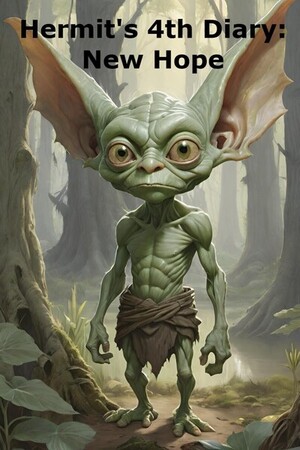
Hermit's 4th Diary: New Hope
We dragged everything into our stump. A pile formed: a heap of strong, straight sticks, a mound of giant, drooping leaves, a tangle of tough, sinewy vines.
We worked on instinct. Grub and Grill became the pillars, standing on either side of the stump’s hollow, holding the longest, thickest sticks horizontally across the gap above our heads.
“Tie them strong or wind rip them apart!” Grub shouted over the drumming rain.
Snag and Fort took the vines. They lashed the cross-beam sticks to the inner walls of the stump, wrapping the vines in frantic, tight loops, pulling knots with their teeth.
“Leaves next! We layer them like scales!”
Trog and me began slapping the huge, waxy lily leaves over the lattice of sticks. We overlapped them like shingles, the curled edges shedding the cascading water away from the center.
The rain became a waterfall pouring off the edges of our stump. Inside, it became a frantic cave of dripping green light and moving shadows. We worked in a wet, muddy, pained frenzy. The roof was lopsided, but it was better than no roof at all.
Finally, panting, soaked to the bone and shivering, we were done. We stood in the center of our hollow, looking up at our crude, sloppy, magnificent roof. A few persistent drips found their way through. One landed right on Grub’s nose, but the rain was blocked and we were under cover.
We collapsed onto rotten wood of the floor, a heap of exhausted, trembling goblins. The storm raged outside. But inside the stump, under a roof we had built with our own bruised hands, the sound was muffled.
The cold from the rain had seeped deep into our bones, reigniting every ache the medicine had soothed. We crawled into the driest corner, under the sturdiest part of our lopsided roof, and formed a pile. We were a knot of green limbs.
Lying there, nestled in the living pile, I turned my head. In the wall of the great stump, where a knot had fallen out, there was a hole the size of my finger. A little window to the outside.
I peered through it.
The world outside was grey. Rain fell in solid, shimmering sheets, hammering the swamp with a force that flattened reeds and churned the standing water into a froth. Each drop hit the thick, black mud with a sound like a tiny slap, and I watched, hypnotized and horrified, as the water began to rise.
It wasn't a flood. Not yet. The little islands of firm ground were shrinking, their edges melting into the soupy water. The narrow, safe path Snag had found to our stump was vanishing, submerged under deceptive pane. The mud was turning into a hungry, liquid slurry.
I remembered the desperate, gasping fight in the cave, the water at our necks. The memory was a physical jolt. My breath hitched.
"How high would the water climb? Would the roots hold? Or would we wake in the night to cold, black water seeping over the floor, soaking our pile, turning our fortress into another drowning-pot?"
Grub, feeling the tremor run through our pile, grunted.
"Hermit? What wrong?"
"Water. It is eating the ground. Rising." I whispered, my eye still glued to the hole.
A ripple of tension went through our goblin pile. We were all thinking it now.
"We are high," Snag murmured, "Roots are strong. This stump has stood for many rains. We good here. It will hold."
"But this rain is strong," Fort said, "Stronger than many. We should be careful."
-----------------
For a few hours, we did the only thing we could: we rested in our pile, letting the shared warmth and the rhythmic hammering above lull us into a shallow, watchful sleep.
Then, as suddenly as it began, the drumming on the leaves faded to a patter, then to the occasional plink of a heavy drop, then to nothing. Steam began to rise almost instantly from the sodden ground; air became thick and wet. The sauna heat was back, heavier than before.
We untangled ourselves and crept to the entrance of our stump. Peering out, we saw the water had already begun to retreat. The liquid soup was pulling back, draining into hidden channels, leaving behind a slick landscape of black mud studded with debris.
Muddy pushed to the front.
"Big water comes, big water goes. When it sleeps again… it leaves presents. Fish that swim too close to the new edge, get stuck. Logs from deep places, thrown up on the mud. Sometimes… good roots, washed clean. The swamp takes, but sometimes… it gives back."
Without another word, we scuttled out of our stump. The ground was a different creature now. Not firm, not liquid, but a relentless, sucking glue. Our small feet sank into the warm, black ooze up to our knees with every step. Walking was a loud, squelching, laborious pull. We sounded like a herd of feeding frogs.
But we didn't mind. Our eyes were on the glittering junk-line the flood had deposited at the high-water mark. We fanned out, a slow, muddy search party.
Almost immediately, Trog let out a wet, gurgling cry of triumph. He was tugging at something half-buried, a large fish.
I waded near a clump of reeds and saw a clay pot. A human thing, discarded long ago and now gifted to us by the flood. It was a treasure; it could hold water, or grubs, or paste.
Muddy was right. The angry water had left a messy dinner table behind. Our little legs churned through the warm mud, our hands grabbing, our hearts lifting with a simple, savage joy. The swamp had tried to drown us, and now, it was feeding us. It was a confusing, beautiful, muddy kind of mercy.
----------------------
We searched until the sun dipped behind the tangled tree line, and the steam began to cool into a clinging, mosquito-whining dusk. Our arms were full; our legs caked in drying mud that cracked with every step.
One by one, we squelched back up the hidden path and dumped our findings in the center of the great stump. We stood around it, panting, mud dripping from our chins, and stared.
It was a loot-pile from a confused world.
On one side, the swamp's bounty: a pile of glossy, stunned fish, their gills still fluttering weakly; a heap of muddy, starchy tubers; a clutch of oversized frogs, tied together by their legs with a strip of vine.
On the other side, the past's debris, spat up by the floodwaters: a jumble of pale, splintered wood that had once been a chair or a small table; a few cracked, ceramic plates, a dented metal pot; and most mystifying of all, a small, rusty toolbox.
Snag, with his clever fingers, had pried it open. Inside, nestled in flakes of orange rust, were tools: a handful of nails, a screwdriver with a worn wooden handle, a small hammer.
We crouched around the pile, not touching, just looking. The fish we understood. The frogs were food. The sticks from the furniture were fuel.
But the plates… we looked at each other.
"Food… goes on? These are plates. We never had plates before. We eat from the ground."
Trog ventured, picking one up and licking the mud off. It tasted of clay and old water.
"Pot has a hole," Grill observed, poking a finger through it.
"But it can hold other things. Berries. Grubs. Not soup, but… things."
Then, all eyes turned to the toolbox. Grub reached out cautious hand and picked up the small hammer. He turned it over, squeezed the handles.
"Human tools," Muddy whispered, half in awe, half in fear, "Tools. For fixing. For… hammering things tight. The nail-thing… it pierces. Makes wood bite wood."
We were no longer just creatures hiding in rot. We had a pot, even with a hole. We had plates. We had mysterious, rusty metal that spoke of a world that built things.
-----------------
A week in the stump was a lifetime of small, hard victories.
The first victory was our bodies. The throbbing bruises faded back to our normal muted green. We healed. Our crushed and burst ball sacks between our legs began to change. In its place, new tissue formed. Small, soft, wrinkled pouches of skin slowly grew back, delicate and tender. They were tiny yet, hanging loose where there had been only ruin.
They were empty now. But they were a promise. They meant the life inside us, brutally stamped down, was stubbornly rebuilding itself. The possibility of future eggs, of a future beyond mere survival, had physically returned to us. We were whole, in our new, slightly crooked way.
The roof came next. Our first leafy canopy sagged pitifully after the rain stopped. We took it apart. Using rusty screwdriver as a crude awl, we drilled holes into the inner walls of the stump, just below the rim. Into these holes, we wedged the straightest, strongest poles, creating a sturdy, horizontal frame.
Then we found grey, sticky clay in a pocket near a bend in the slow-moving river. We carried it back in the dented pot and the cracked plates. We mixed it with water and mashed-in reeds for strength. Snag, with his clever hands, showed us how to press and smooth the clay over a tight weave of thin cattail stalks we laid across the new frame. We built the roof in sections, letting each dry in the searing sun before adding the next.
It wasn't pretty. It was lumpy and thick in some places. But when the next rain came, it held. The water beaded and ran off the sloped clay surface. Inside, our home was dark, cool, and, for the first time, truly dry.
By the end of the week, we were not just camping. We were living. The stump was no longer a hiding place; it was home. It smelled of drying clay, crushed herbs, and the smoky residue of our small, carefully guarded cook-fire. We had routines. We had full bellies more often than not. The raw, screaming hole of grief for the hatchlings was still there, but a scar was forming over it, tough, sensitive, but capable of bearing weight.




Please sign in to leave a comment.