Chapter 3:
Chapter 3 — The Hidden Past
Dead Signal
The car tore through the shattered streets of Shimamoto.
Behind them, the infected spilled out of side alleys like starving animals, slamming into wrecked vehicles and each other as they chased sound and movement. Bodies littered the asphalt—some motionless, some twitching, some dragging themselves upright again. Survivors ran past burning storefronts, swinging pipes, chairs, anything they could grab, only to be dragged down moments later.
Flames climbed apartment walls. Smoke swallowed the sky.
“The town…” Riku muttered from the passenger seat. “It’s completely gone…”
The girls clung to one another in the back, flinching at every shadow, every impact, certain something would smash through the windows and drag them out at any second.
Gunfire cracked ahead—sharp, controlled.
Military trucks rolled into view. Soldiers dismounted in tight formation. Orders were barked. Rifles snapped up. Zombies dropped with brutal efficiency.
“It’s the army!” Takeru shouted, relief flooding his voice. “We’re saved!”
One of the girls let out a shaky laugh through tears.
“Thank God… we still have hope…”
Arata didn’t slow.
As the car neared the roadblock, his eyes locked with a soldier standing near the barricade.
The man froze.
Recognition flashed across his face.
Arata swerved hard.
Tires screamed as he cut into a narrow alley.
“WAIT—HEY!” Takeru yelled. “Where are you going!? The army’s right there!”
“Dude!” Riku shouted. “What’s wrong with you!?”
Arata didn’t answer.
He drove straight to his old apartment building, skidded to a stop, and got out. The others followed, fear pushing them faster than reason.
Arata went straight to his bedroom.
He shoved the clothing cabinet aside, revealing a concealed panel in the wall.
Inside sat a sealed black case.
He opened it.
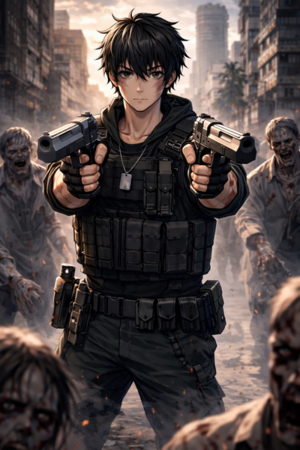
A tactical bulletproof vest.
A sheathed combat knife.
A Mossberg 590 tactical shotgun.
A 9mm Glock with spare magazines.
Two dog tags—one his own, one his grandfather’s.
His fingers closed around the metal.
Cold.
Too cold.
The room tilted.
A white room flashed through his mind.
Bare feet on frozen concrete.
A number painted across his chest instead of a name.
“Again.”
Small fists struck the mat over and over until his arms stopped responding. Too slow. Too sloppy.
Pain followed failure.
Straps biting into his wrists. A needle sliding into his vein. The ceiling blurring as voices murmured above him.
“Subject Thirteen shows no abnormal response.”
No one asked how he felt.
No one used his name.
A child had wanted to scream.
A weapon learned to stay silent.
Arata exhaled slowly and crushed the memory.
He slipped his own dog tag around his neck and placed his grandfather’s into a pouch on the vest.
The Glock settled at his hip.
The knife strapped to his thigh.
The vest went on over his school uniform.
Heavy footsteps thundered up the stairs.
The door burst open.
A soldier stormed in, rifle raised. “What are you kids doing here!?”
The girls screamed and hid behind Riku and Takeru.
The soldier’s eyes dropped to Arata’s gear.
“…Kid,” he said carefully, “where did you get that equipment?”
“My grandfather’s,” Arata replied evenly.
A growl echoed from outside.
The soldier turned.
Arata moved first.
The shotgun roared.
The zombie dropped in a spray of gore.
Arata didn’t wait.
He ran.
Down the stairs.
Into the car.
Gone.
The city swallowed him.
Then he saw it.
Civilians lined up against a concrete wall.
No bites.
No fever.
No visible signs of infection.
A man begged.
A woman sobbed.
A child screamed.
A soldier raised his rifle.
Gunfire cracked.
Bodies fell.
Arata stared through the windshield, frozen.
This isn’t containment.
This is execution.
His grandfather’s voice echoed in his mind.
Survive—but don’t become them.
Arata turned the car around.
When he returned to the apartment building, it was empty.
The door hung open.
The hallway was silent.
Too silent.
His chest tightened.
“…They’re gone.”
In the distance, engines roared.
He climbed to the rooftop and saw them—military trucks rolling down the main road, packed with survivors.
Riku.
Takeru.
The girls.
All heading toward a so-called safe point.
Arata climbed back into the car, his hands tightening around the steering wheel.
“Damn it…”
He followed the convoy from a distance, weaving through side streets, staying out of sight.
The military believed they were taking survivors to safety.
Arata knew better.
And this time—
He wasn’t running away.





Please sign in to leave a comment.