Chapter 3:
The Amihan Coast
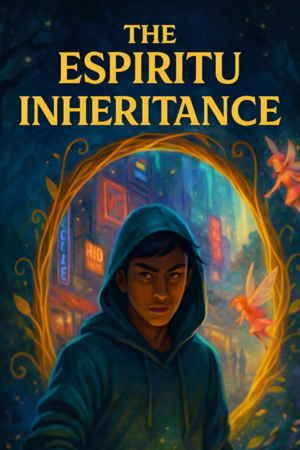
The Espiritu Inheritance
Chapter Three: The Amihan Coast
The sampaguita gate breathed like a living thing. I stood before it, my satchel feeling heavier than it actually was—one last can of Ligo sardines, a block of queso de bola, and the crushing weight of every unanswered question pressing against my ribs. The forest waited in a hush that felt deliberate. That predatory hum from yesterday was gone, replaced by something watchful, calm, and vaguely expectant. Like a boss waiting for you to clock in late.“Agreed,” BEP murmured from my pocket. “Optimal traversal window detected. The forest’s ambient hostility has stabilized at a neutral state. Basically, it’s bored of trying to eat you for now.”“Comforting,” I muttered, my fingers brushing the living vines of the gate. The scent of jasmine clung to my skin like a promise I didn't remember making. “Lola… here goes nothing. If I die, tell my landlord I’m not paying the security deposit.”The path beyond had changed. The moment I stepped forward, the world rearranged itself—no longer a maze of silvery trunks and ghostly fog, but a descending trail carved by ancient hands. The light filtered through blue-leaved ferns, and the air shifted. It was no longer earthy and damp; it was sharp, clean… electric. Brine.Then came the sound—the heartbeat of the ocean. That rhythmic crash of waves that had raised me, comforted me, and scolded me my whole life.I pushed through the last wall of ferns, and the world unfurled like a 4K drone shot.Terraced hills rolled toward the sea, each layer a brighter shade of green until they met the cliffs—white as chalk and carved by wind and centuries. Below, a port town sprawled like a memory of the Philippines that never was. White-stone and narra-wood homes clung to the slopes, their red-clay roofs bleeding warmth under the sun. Indigo, ochre, and coral banners fluttered on sea breeze currents, and the whole place shimmered like a dream I’d forgotten to have.“Welcome to the Amihan Coast,” BEP said softly, sounding almost… impressed? “Population: approximately four hundred fifty. Technology level: pre-industrial, high ambient magic saturation. Sociocultural patterns… reminiscent of pre-colonial maritime societies, though with notable arcane adaptations. Also, your heart rate is spiking. Try to look like you belong here, wet monkey.”I let the wind fill my lungs. The air tasted alive. I started downhill, my sneakers crunching against uneven stones. With each step, the sounds of life grew louder—the clang of a hammer, laughter, the low bleating of some goatlike creature the size of a carabao. Children darted through the streets, chasing chickens whose feathers flashed with peacock colors and glimmering light.Then came the stares. My gray hoodie, faded jeans, and neon-orange sneakers screamed "alien" among the woven tunics and hemp trousers. A small group of teens whispered behind their hands.“His clothes look like storm clouds that lost a fight,” one murmured.“Those shoes,” another said, eyes wide. “They glow. They’re in pain.”I sighed, tugging my hood lower. “Great. I’m the interdimensional poster boy for bad fashion. Thanks for the heads-up, BEP.”“I told you your aesthetic was 'disaster-casual,'” she chimed back.But before embarrassment could win, salvation arrived in the form of a smell. The Holy Trinity: soy sauce, vinegar, and sizzling pork fat. My soul recognized it before my stomach did.I followed the scent to a food stall shaded by a broad tree. A man built like a myth—massive, sun-browned, and smiling with his whole face—was flipping skewers of isaw and barbecue. Smoke curled through the air like incense, the smell so deeply Filipino it made my chest ache with homesickness.“Kuya,” I said, almost reverent, “six isaw, please.”The vendor nodded, plating the skewers. Then he held out a calloused palm. “Payment, traveler?”“Oh. Right.” I fished out my leather wallet, pulling a crumpled hundred-peso bill. “Here. Blue one. Very official.”The man squinted, turning the paper over like it was a poorly drawn joke. “You offering me kindling?”“It’s money! Real money! It’s got a serial number and everything!” I said, my face heating up.A booming laugh burst from the man’s chest. “The only peso here is what you earn from hauling nets! No work, no coin, no food. Move along, cloud-boy.”My shoulders sank. Broke in both worlds—that's my true superpower.“Analysis,” BEP chimed. “Local economy unlinked from origin-world fiat. Logical. Initiating Universal Bursar protocol. Honestly, Pepito, do I have to do everything?”“The what—?”The abaca coin purse at my belt—the Pitaka—began to glow. Gold and silver threads rippled through the weave, alive with light.“Calibrating economic baseline,” BEP said. “Exchange rate established. One Tanso equals approximately one Philippine peso. One hundred Tanso to one Pilak. Remaining funds: ₱3,200. Conversion complete: six hundred forty Tanso, twenty-five Pilak. You're officially 'not a beggar' again.”The Pitaka pulsed and grew heavy. When I opened it, stacks of bronze and silver coins glimmered within, etched with swirling wave patterns.“The Universal Bursar is active,” BEP concluded, sounding smug. “Your Pitaka is now your wallet, your bank, and your diplomat. You’re welcome. Try not to spend it all on street food.”I grinned. “Magic GCash. Finally, a language I speak.”I handed one Tanso coin to the vendor. The man’s expression changed the second his fingers touched it—a faint hum filled the air.“Ah,” the man breathed. “You bear a Pitaka. Forgive me, traveler. I did not recognize you as one of the Blessed.” His tone softened. “Welcome to the Coast. May your trade be fair.”I bit into the isaw. Smoke, vinegar, char. Home. The taste hit me so hard my eyes actually watered. For a second, the boundaries between worlds blurred—Manila’s street corners and this magical coast existing in the same heartbeat.The port city—Sarimanok Port, BEP informed me—was chaos and poetry mixed together. Woodsmoke, salt, sweat, laughter. Somewhere nearby, a bell chimed—a sound like polished brass struck by memory itself.“It’s called culture, BEP,” I muttered, walking through the throng. “Try developing some.”“I have culture,” she snapped. “It’s just written in binary and doesn't involve eating grilled intestines.”I hadn’t gone far when a small voice cut through the noise. “Would you like to buy some shells?”I turned. A girl stood by the path, maybe ten years old. Her dress was faded but clean, her hair wild from the sea breeze. In her basket—shells that glowed faintly, like moonlight trapped in coral. But it was her eyes that caught me: one green like forest shade, the other amethyst—the exact color of the portal I’d fallen through.“Were you talking to me?” I asked.“Um… shells, po?” she said, her voice trembling with shy hope.That “po.” It pierced me deeper than I expected. It was the sound of home. I crouched down to her level. “How much?”She hesitated. “Th-three Tanso, po.”I paused, and I saw worry flicker in her mismatched eyes. “Or two! I can do two!”“Hey, relax,” I said gently. “I’ll take them for three. Actually, give me the best ones.”Her shoulders loosened. “You’re sure?”“Yeah. But you owe me advice. Consider it a consulting fee.”“Advice?”“Yeah. Who are you?”She blinked, then smiled shyly. “Marikit Santos, po.”“Drop the ‘po.’ Makes me feel like a Tito, and I’m too young for that crisis. Call me Kuya. Kuya Pepito.”She giggled. “Kuya Pepito.” She picked a spiraled shell with a rose tint and placed it in my palm. “Lucky,” she said. “It keeps the envious spirits away.”“I’ll take a dozen. I have a lot of envious spirits. Most of them are in my phone.”BEP chimed quietly. “Folk-magical properties unverified. But transaction value is acceptable. Good job, User. You didn't mess up a basic social interaction.”Marikit was peering at my pocket. “You talk to your bag?”“It talks back. Mostly to insult me. I just roll with it.”She laughed—pure, bright, unguarded. For that instant, the whole marketplace seemed to dim.Before long, she’d become my impromptu guide. “That’s the fish lane,” she said, pointing. “That’s the bell tower. It rings for weddings… and storms from the void.”I pointed toward a cliffside shrine glittering with candles. “And that?”“That’s where we give thanks to the sea,” she whispered. “We return the most beautiful shells, so the waters remember to be kind. If we forget… the sea takes someone to remember instead.”The past tense in her voice when she talked about the sea hit me like salt on a wound. I didn't ask who. I didn't have to.“So,” she said, studying my hoodie. “You’re not from here.”“Do I look that weird?”She poked my sleeve. “Your clothes sound rich. Like thunder.”I chuckled. “I’ll take that. Beats 'wet monkey.'”“How far did you travel?”“Farther than you’d believe, kid.”She nodded, solemn as a priestess. “Then you must be from a dream.”“A subjective and unverifiable claim,” BEP whispered.“The best kind,” I muttered back.By sundown, we sat watching the light turn gold across the cliffs. The market’s clamor faded into a rhythm. For the first time since stepping through the Lagusan, I didn’t feel like a trespasser. I didn't feel like a BPO worker with no future.I just… belonged.“Kuya,” Marikit whispered as I handed her a silver Pilak for the extra shells. “That’s… a week’s food. Maybe more.”“Then rest a little,” I said. “You’ve earned it.”She shook her head, her smile ghostlike. “If you rest, the sea forgets your name.”I didn't argue. I just watched the waves. I was here. And for the first time, I wasn't looking for the exit.
The sampaguita gate breathed like a living thing. I stood before it, my satchel feeling heavier than it actually was—one last can of Ligo sardines, a block of queso de bola, and the crushing weight of every unanswered question pressing against my ribs. The forest waited in a hush that felt deliberate. That predatory hum from yesterday was gone, replaced by something watchful, calm, and vaguely expectant. Like a boss waiting for you to clock in late.“Agreed,” BEP murmured from my pocket. “Optimal traversal window detected. The forest’s ambient hostility has stabilized at a neutral state. Basically, it’s bored of trying to eat you for now.”“Comforting,” I muttered, my fingers brushing the living vines of the gate. The scent of jasmine clung to my skin like a promise I didn't remember making. “Lola… here goes nothing. If I die, tell my landlord I’m not paying the security deposit.”The path beyond had changed. The moment I stepped forward, the world rearranged itself—no longer a maze of silvery trunks and ghostly fog, but a descending trail carved by ancient hands. The light filtered through blue-leaved ferns, and the air shifted. It was no longer earthy and damp; it was sharp, clean… electric. Brine.Then came the sound—the heartbeat of the ocean. That rhythmic crash of waves that had raised me, comforted me, and scolded me my whole life.I pushed through the last wall of ferns, and the world unfurled like a 4K drone shot.Terraced hills rolled toward the sea, each layer a brighter shade of green until they met the cliffs—white as chalk and carved by wind and centuries. Below, a port town sprawled like a memory of the Philippines that never was. White-stone and narra-wood homes clung to the slopes, their red-clay roofs bleeding warmth under the sun. Indigo, ochre, and coral banners fluttered on sea breeze currents, and the whole place shimmered like a dream I’d forgotten to have.“Welcome to the Amihan Coast,” BEP said softly, sounding almost… impressed? “Population: approximately four hundred fifty. Technology level: pre-industrial, high ambient magic saturation. Sociocultural patterns… reminiscent of pre-colonial maritime societies, though with notable arcane adaptations. Also, your heart rate is spiking. Try to look like you belong here, wet monkey.”I let the wind fill my lungs. The air tasted alive. I started downhill, my sneakers crunching against uneven stones. With each step, the sounds of life grew louder—the clang of a hammer, laughter, the low bleating of some goatlike creature the size of a carabao. Children darted through the streets, chasing chickens whose feathers flashed with peacock colors and glimmering light.Then came the stares. My gray hoodie, faded jeans, and neon-orange sneakers screamed "alien" among the woven tunics and hemp trousers. A small group of teens whispered behind their hands.“His clothes look like storm clouds that lost a fight,” one murmured.“Those shoes,” another said, eyes wide. “They glow. They’re in pain.”I sighed, tugging my hood lower. “Great. I’m the interdimensional poster boy for bad fashion. Thanks for the heads-up, BEP.”“I told you your aesthetic was 'disaster-casual,'” she chimed back.But before embarrassment could win, salvation arrived in the form of a smell. The Holy Trinity: soy sauce, vinegar, and sizzling pork fat. My soul recognized it before my stomach did.I followed the scent to a food stall shaded by a broad tree. A man built like a myth—massive, sun-browned, and smiling with his whole face—was flipping skewers of isaw and barbecue. Smoke curled through the air like incense, the smell so deeply Filipino it made my chest ache with homesickness.“Kuya,” I said, almost reverent, “six isaw, please.”The vendor nodded, plating the skewers. Then he held out a calloused palm. “Payment, traveler?”“Oh. Right.” I fished out my leather wallet, pulling a crumpled hundred-peso bill. “Here. Blue one. Very official.”The man squinted, turning the paper over like it was a poorly drawn joke. “You offering me kindling?”“It’s money! Real money! It’s got a serial number and everything!” I said, my face heating up.A booming laugh burst from the man’s chest. “The only peso here is what you earn from hauling nets! No work, no coin, no food. Move along, cloud-boy.”My shoulders sank. Broke in both worlds—that's my true superpower.“Analysis,” BEP chimed. “Local economy unlinked from origin-world fiat. Logical. Initiating Universal Bursar protocol. Honestly, Pepito, do I have to do everything?”“The what—?”The abaca coin purse at my belt—the Pitaka—began to glow. Gold and silver threads rippled through the weave, alive with light.“Calibrating economic baseline,” BEP said. “Exchange rate established. One Tanso equals approximately one Philippine peso. One hundred Tanso to one Pilak. Remaining funds: ₱3,200. Conversion complete: six hundred forty Tanso, twenty-five Pilak. You're officially 'not a beggar' again.”The Pitaka pulsed and grew heavy. When I opened it, stacks of bronze and silver coins glimmered within, etched with swirling wave patterns.“The Universal Bursar is active,” BEP concluded, sounding smug. “Your Pitaka is now your wallet, your bank, and your diplomat. You’re welcome. Try not to spend it all on street food.”I grinned. “Magic GCash. Finally, a language I speak.”I handed one Tanso coin to the vendor. The man’s expression changed the second his fingers touched it—a faint hum filled the air.“Ah,” the man breathed. “You bear a Pitaka. Forgive me, traveler. I did not recognize you as one of the Blessed.” His tone softened. “Welcome to the Coast. May your trade be fair.”I bit into the isaw. Smoke, vinegar, char. Home. The taste hit me so hard my eyes actually watered. For a second, the boundaries between worlds blurred—Manila’s street corners and this magical coast existing in the same heartbeat.The port city—Sarimanok Port, BEP informed me—was chaos and poetry mixed together. Woodsmoke, salt, sweat, laughter. Somewhere nearby, a bell chimed—a sound like polished brass struck by memory itself.“It’s called culture, BEP,” I muttered, walking through the throng. “Try developing some.”“I have culture,” she snapped. “It’s just written in binary and doesn't involve eating grilled intestines.”I hadn’t gone far when a small voice cut through the noise. “Would you like to buy some shells?”I turned. A girl stood by the path, maybe ten years old. Her dress was faded but clean, her hair wild from the sea breeze. In her basket—shells that glowed faintly, like moonlight trapped in coral. But it was her eyes that caught me: one green like forest shade, the other amethyst—the exact color of the portal I’d fallen through.“Were you talking to me?” I asked.“Um… shells, po?” she said, her voice trembling with shy hope.That “po.” It pierced me deeper than I expected. It was the sound of home. I crouched down to her level. “How much?”She hesitated. “Th-three Tanso, po.”I paused, and I saw worry flicker in her mismatched eyes. “Or two! I can do two!”“Hey, relax,” I said gently. “I’ll take them for three. Actually, give me the best ones.”Her shoulders loosened. “You’re sure?”“Yeah. But you owe me advice. Consider it a consulting fee.”“Advice?”“Yeah. Who are you?”She blinked, then smiled shyly. “Marikit Santos, po.”“Drop the ‘po.’ Makes me feel like a Tito, and I’m too young for that crisis. Call me Kuya. Kuya Pepito.”She giggled. “Kuya Pepito.” She picked a spiraled shell with a rose tint and placed it in my palm. “Lucky,” she said. “It keeps the envious spirits away.”“I’ll take a dozen. I have a lot of envious spirits. Most of them are in my phone.”BEP chimed quietly. “Folk-magical properties unverified. But transaction value is acceptable. Good job, User. You didn't mess up a basic social interaction.”Marikit was peering at my pocket. “You talk to your bag?”“It talks back. Mostly to insult me. I just roll with it.”She laughed—pure, bright, unguarded. For that instant, the whole marketplace seemed to dim.Before long, she’d become my impromptu guide. “That’s the fish lane,” she said, pointing. “That’s the bell tower. It rings for weddings… and storms from the void.”I pointed toward a cliffside shrine glittering with candles. “And that?”“That’s where we give thanks to the sea,” she whispered. “We return the most beautiful shells, so the waters remember to be kind. If we forget… the sea takes someone to remember instead.”The past tense in her voice when she talked about the sea hit me like salt on a wound. I didn't ask who. I didn't have to.“So,” she said, studying my hoodie. “You’re not from here.”“Do I look that weird?”She poked my sleeve. “Your clothes sound rich. Like thunder.”I chuckled. “I’ll take that. Beats 'wet monkey.'”“How far did you travel?”“Farther than you’d believe, kid.”She nodded, solemn as a priestess. “Then you must be from a dream.”“A subjective and unverifiable claim,” BEP whispered.“The best kind,” I muttered back.By sundown, we sat watching the light turn gold across the cliffs. The market’s clamor faded into a rhythm. For the first time since stepping through the Lagusan, I didn’t feel like a trespasser. I didn't feel like a BPO worker with no future.I just… belonged.“Kuya,” Marikit whispered as I handed her a silver Pilak for the extra shells. “That’s… a week’s food. Maybe more.”“Then rest a little,” I said. “You’ve earned it.”She shook her head, her smile ghostlike. “If you rest, the sea forgets your name.”I didn't argue. I just watched the waves. I was here. And for the first time, I wasn't looking for the exit.




Please sign in to leave a comment.