Chapter 0:
Foreword
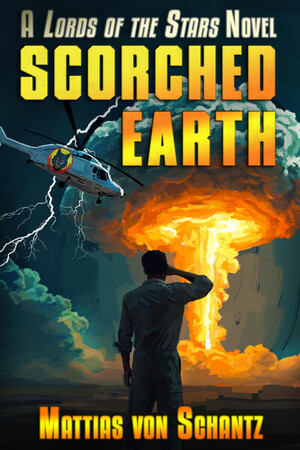
Scorched Earth
In 1993, I wrote the first story in what would become the Lords of the Stars universe. That single story spawned many others, all independent yet connected by an overarching narrative and timeline. Over the years, the future history I created became more and more detailed, with each successive tale firmly planting dates and events into the long tapestry of canon. I know what will happen in the Lords of the Stars universe in 2083 AD, in 2140 AD, in 3072 AD, and if you’ve read my other stories, you know those dates as well. And if you haven’t—don’t worry! Scorched Earth is entirely standalone, and you can read it without any knowledge of the wider universe whatsoever, though you may miss out on an easter egg or two.
1993, that was over thirty years ago. For more than three decades, I’ve been writing tales set in an internally consistent timeline. Now, 3072 AD is very far into the future. I could easily afford to predict events that will happen a millennium from now. Even 2083 AD is far enough removed from our time that I felt safe making up the events that will shape the end of this century. After all, by that time, I will most likely be dead, so I won’t be around to take the blame when certain events in Lords of the Stars, for some inexplicable reason, turn out not to actually have happened that exact way in the real world.
But this novel, Scorched Earth, starts in 2029 AD. That’s just three years from now. One could easily be forgiven for thinking that writing a book like that is something of a literary suicide for a science fiction author. After all, by the time the book is published, the history of the real world will already be lurking around the corner, ready to leap ahead of the story and bite me in the rear. And isn’t that a very unnecessary risk for an author to take?
The truth is, that has already happened. The real world overtook Lords of the Stars many years ago. The future worlds I’ve been depicting have, by now, been obsolete for decades. When I wrote my first Lords of the Stars story, not a single exoplanet around a sun-like star had yet been discovered. Out there in the galaxy, I was free to invent my own worlds to fit my stories—within the laws of physics, of course. Today, that is no longer true. Many, perhaps most, of the star systems where my tales are set have by now been studied in great detail, and while we don’t know exactly what the planetary systems around those stars look like, we do know enough to be certain they are nothing like what I’ve depicted in my stories.
Since Lords of the Stars is hard science fiction, that makes my tales obsolete. And yet, I keep writing them, even though they’re now effectively outdated on arrival.
Here’s the thing, though: have you ever heard of a little book called De la Terre à la Lune? Well, maybe you haven’t, but I’m sure you’ve heard of its English translation, From the Earth to the Moon. Written in 1865 by Jules Verne and depicting three astronauts traveling to the moon by means of an oversized cannon, you might not consider the book to be a prime example of hard science fiction, but I do. You see, my personal definition of what is and isn’t science fiction is that it has to be scientifically plausible at the time of writing, and future discoveries do not invalidate the genre. That’s why, in my mind, De la Terre à la Lune is still science fiction today, while, say, Star Wars is not, and never was. I mean no disrespect to Lucas—if you were to look at the Star Wars section of my private library, you’d know I love that universe, but science fiction, it is not.
And there you have the explanation for why I keep writing hard science fiction stories set in a universe that technically is already antiquated (though I must admit that obsoleting thirty years of books because of the orbital characteristics of a planet around a star tens of light-years away might be a bit of nitpicking anyway). A long time ago, I made the decision that the Lords of the Stars universe is distinct from our own, and that I would keep my fictional world intact as an alternate reality of a future that’s already in the past. You could say the divergence point was in—you guessed it—1993. I don’t mean that the timeline of Lords of the Stars split from ours in that year. No, I mean that the two realities were never the same, but the Lords of the Stars universe was, and still is, in many ways like what we thought the universe was back in 1993.
However, this story doesn’t take place around distant stars. Scorched Earth is set here, and almost now. But the canon-busting ability of real-world history isn’t just limited to faraway planets. The total environmental collapse on Earth in the 2030s that this book deals with is yet another event that’s been established in Lords of the Stars canon for as long as my literary universe has existed. And the Fall of Old Earth is more than just a well-known event in my future history—it’s one of the core pillars upon which the entire storyline of the universe hinges. Predicting back in 1993 that the greenhouse effect would become uncontrollable and render the planet uninhabitable by the middle of the next century felt, at that time, quite plausible. Not necessarily likely, but still plausible. Now, as we’re closing in on those dates in the real world, conditions on our planet are unfortunately not that far removed from my predictions from three decades ago, but they’re still not quite as severe as I feared back then.
Let me be blunt, though—just because this is an alternate future doesn’t mean the issues depicted here don’t have an impact on our world. The greenhouse effect is, of course, very real and already affects billions of people here and now, and yet I feel we’re still only taking token action to combat it. We happily drive our gas-guzzling cars to the supermarket to buy ecological cucumbers, and we feel very good about ourselves for being so environmentally conscious. The Mad Century is still alive and well, thank you very much, and while it’ll take longer and events will be different, I do still believe something like the Fall is inevitable in our world as well.
To be clear, none of this alternate history business gives me a blank check to ignore real-world science and history whenever I want to. On the contrary, as an author of hard science fiction, I still strive to incorporate both current events and the latest discoveries into my stories, but when there’s no way around facts and events already made permanent in canon, I’m allowing myself to keep them canon.
That’s why I feel safe setting the first chapters of Scorched Earth in 2029 AD. The world depicted here is very similar to the one you’re familiar with outside your window, but when that year comes around, you might find it’s not identical. Chances are that, in three years’ time, the differences will be so small you might not even notice them, but they will be there, and the further we get into the future of the Lords of the Stars timeline, the bigger the differences between the real world and the future history of my fictional universe will be.
You’ll have to live with that, because the alternative would mean I’d have to throw out all my Lords of the Stars stories every time a real-world event or a scientific discovery invalidated something I predicted in them, and start anew, time and time again.
I’ve made peace with that, and I hope you can, too.
Mattias von Schantz, Sweden, December 2025 AD
Author's Note
The story you're reading is one of many set in the Lords of the Stars universe I've been creating over the past 30 years, where familiar characters and places reappear, and new favorites await discovery. Check out my profile to explore more stories from this universe.
While Scorched Earth is entirely standalone and can be read without any prior knowledge, I think you'll also enjoy Wonders From Beyond the Sky, Time for Memories and Choices of Steel, all of which are standalone sequels to this story.
Visit the official Lords of the Stars blog for more information about this hard sci-fi universe: https://lordsofthestars.wordpress.com
If you enjoyed this chapter, please consider giving it a like.




Please sign in to leave a comment.