Chapter 10:
The Showman and the Lakanbini
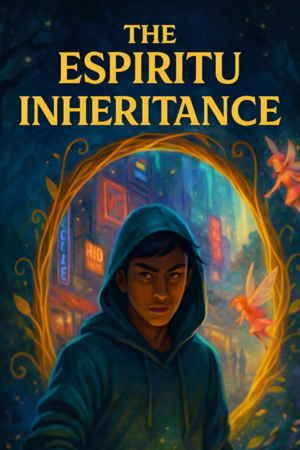
The Espiritu Inheritance
Chapter Ten: The Showman and the Lakanbini
In sales, the most valuable commodity isn't the product. It's the story. You can sell sand in the desert if you tell the customer it’s "exfoliating stardust."
A shop can be rebuilt with soap, elbow grease, and rechargeable LEDs.
A town, however, needs something harder to sell.
The restoration of the Cliffside property had been a victory of modern chemistry over ancient grime. We’d worked until our arms ached, scrubbing twenty years of neglect from the old bakery until the place finally breathed again. Sunlight now spilled through the tall, cleaned windows, and the salt air from the sea clashed violently with the aggressive “Spring Freshness” of Ninang Josie’s industrial-strength detergent.
It smelled like a laundromat in Atlantis.
I was wiping down the counter, admiring the way the narra wood glowed under the harsh white light of my camping lanterns, when it happened.
Knock. Knock. Knock.
Three sharp, rhythmic raps echoed through the heavy front door.
I froze. Marikit, who was arranging cans of sardines into a precarious tower, dropped a can. Clang.
I opened the door.
Lakanbini Susan Sumilang stood at the threshold.
She looked every inch the ruler of Sarimanok. Her hair was immaculate, pulled back in a severe bun held by pearl pins. Her silken baro shimmered softly in the twilight, shifting from indigo to violet. But beneath the regal exterior, something was wrong. Her shoulders were too tight. Her eyes were shadowed with a fatigue no amount of magical glamor could disguise.
“Lakanbini,” I greeted, leaning casually against the doorframe to hide the fact that my heart was doing gymnastics. “Here to inspect the merchandise? We’ve got the best Barako coffee this side of the rift. It puts hair on your chest. Metaphorically.”
“Pepito,” she said, stepping inside without waiting for an invitation.
Her gaze swept across the glowing lanterns, the neatly stacked shelves, the clean floorboards. She paused at the "Spring Fresh" smell, her nose twitching slightly.
“You’ve done... remarkable work here,” she said, her voice neutral.
She turned to face me. The mask of the politician slipped, just a fraction.
“I need to speak with you. Privately.”
[BEP ALERT: Subject Sumilang under significant physiological stress.]
[Cortisol Levels: Elevated by 48%. Heart Rate Variability: Low.]
[Conclusion: This is not a social visit. This is crisis management.]
“Marikit,” I said gently. “Why don’t you go check the stock in the back? Count the noodles again.”
Marikit looked at Susan, then at me. She nodded, grabbed a notebook, and scurried away, her new sneakers squeaking on the floor.
I led Susan to the small seating area I’d set up near the window—two stools and a small table.
“Coffee?” I asked.
She sat down heavily, as if her legs had suddenly decided they were done for the day. “Please.”
I poured a cup of the Batangas blend from the French press I’d brought. The aroma—earthy, pungent, and strong—filled the space between us.
She accepted the ceramic cup, holding it with both hands like an anchor. Her knuckles were white. She didn’t drink. She just stared into the black liquid.
“Do you know the Whispering Seagulls?” she asked quietly.
“The Adventurers’ Guild?” I nodded, taking a sip of my own cup. “Sure. Even the peddlers know them. They’re the ones keeping the sea-monsters off our docks. The bouncers of the coastline.”
“Their Guild Master died last month,” she said. “Natural causes, they said. Old age.”
She looked up, her eyes hard.
“Two nights ago, the Vice-Master vanished. Along with the entire guild treasury. The vault is empty.”
I choked on my coffee. “He embezzled the guild? In a town full of people with swords?”
“He fled toward the Capital,” she said, her voice tight. “Now the guild is fracturing. The veteran captains are fighting over scraps. The younger hunters are leaving. If the Seagulls dissolve, Sarimanok loses both its shield and its spine. The sea monsters will return. The trade routes will close.”
The silence stretched between us, heavy and cold.
“And it gets worse,” she continued. “A branch inspector from the Royal Capital is watching. He arrives in three days. If he sees a dying town, he will recommend that the Crown revoke our charter and place us under martial administration.”
She took a breath, finally sipping the coffee. She grimaced at the bitterness, but then sighed as the caffeine hit her system.
“I need him to see that Sarimanok isn’t dying,” she whispered. “I need him to see that it is evolving.”
She looked at me. The vulnerability was gone, replaced by desperation.
[Analysis: Political pressure detected. Probability of hostile administrative takeover: High.]
“Show them your wares,” she said. “The fire that clicks. The light that doesn't flicker. The food that cooks in minutes. Let them see what prosperity looks like. If the market is bustling with ‘foreign miracles,’ the Inspector might believe we are a trade hub on the rise, not a port on the decline.”
“You want me to sell hope,” I said slowly. The word felt heavier than the bronze key in my pocket.
“For once,” she said softly, “yes.”
I stood up. I walked to the window and looked out at the darkening street.
I was a call center agent. I was a middle-manager. I was a guy who de-escalated Karen from Ohio because her package was late.
But before that? I was the guy who sold burned CDs in high school. I was the guy who organized the neighborhood basketball league.
I turned back to her. The Showman took over.
“Okay,” I said, grinning. “We don’t just sell them hope, Lakanbini. We sell them a revolution. We make them believe that Sarimanok is the silicon valley of magic.”
Her relief was immediate, and heartbreakingly fragile.
“You have my gratitude, Pepito.”
She stood to leave, smoothing her silk skirts.
“Wait,” I said. “One question.”
She paused, hand on the door.
“Why is the cellar locked?” I asked. “I have a key for the front door, but the cellar... and I keep hearing sounds. Scratching.”
She blinked, genuinely confused. “The cellar? It’s been sealed for years. I was very young when my grandmother Josephine and her partner managed this place.”
“Her partner?”
“Yes,” Susan said absently. “Lady Ynez. A fierce woman. She had a temper like a storm.”
I froze. The cup in my hand rattled against the saucer.
“Lady... Ynez?” I asked, my voice barely a whisper. “Ynez Espiritu?”
Susan looked at me, puzzled. “Yes. Why?”
“That’s...” I swallowed. “That’s my grandmother. Lola Ynez.”
For a moment, the universe felt like it was holding its breath. The dust motes stopped dancing. The LED lights seemed to hum louder.
I glanced around, half-expecting hidden cameras or a divine punchline. My Lola Ynez? The woman who taught me how to cook adobo and gamble on spider fights? She was a Lady here? A business partner to the Lakanbini’s line?
Susan stared at me, her eyes widening. “You are of her blood? I thought ‘Espiritu’ was a common name where you came from.”
“It is,” I said. “But... she disappeared when I was a kid. We thought she went to the province. You’re telling me she was here?”
Susan’s expression softened into something unreadable. “If you are Ynez’s kin... then the house isn't just a loan, Pepito. It’s a homecoming.”
She opened the door, letting the night air in.
“Whatever is in the cellar,” she said, “might just be waiting for family. Goodnight, Pepito.”
And just like that, she was gone.
The Frenzy
The next three days blurred into a frantic rhythm of commerce, chaos, and caffeine.
Our relocation to Cliffside Street didn’t slow us down—it turned us into a landmark. The rumor that the Lakanbini herself had visited the shop spread like wildfire.
I embraced the role. I wasn't just a merchant; I was an event.
I stood on the front steps, wearing my gray hoodie like a wizard’s robe, holding a megaphone I’d snagged from the inventory.
“Welcome to Pepito’s Wonders & Wares!” I shouted, my amplified voice booming over the cobblestones. “Practical magic! Absurd miracles! Fire that never fails! Light that never dims! And soup that hugs you back!”
Marikit was a revelation. Wearing her new indigo overalls and red sneakers, she moved through the shop with a confidence that surprised me. She wasn't just an assistant; she was the floor manager.
“No pushing!” she commanded a burly orc who was eyeing the Instant Mami. “Line starts there! Have your payment ready! Exact change gets a free candy!”
She translated my Earth-born nonsense into local logic.
“It’s not ‘Instant Noodles,’ sir,” she explained to a skeptical mage. “It is ‘Dehydrated Essence of Feast.’ Just add hot water to re-animate the spirit of the chicken.”
The mage bought a crate.
[Sale Logged: 10x Type-S Stormproof Lighters — 750 Tanso.]
[Sale Logged: 50x Packs Pancit Canton (Calamansi Flavor) — 1,000 Tanso.]
[Weekly Gross Revenue: 82,400 Tanso.]
[Net Profit Margin: 890%.]
[User Status: Economically Anomalous.]
“We’re rich, BEP,” I whispered during a rare five-minute lull, fanning myself with a stack of silver Pilak. “Fantastically, absurdly rich.”
[Clarification: Wealth is statistically temporary. Taxes, overhead, and hostile spellcasters are permanent variables. Also, you need to restock the coffee. The caffeine addiction rate in this sector has risen by 300%.]
“Killjoy,” I muttered—though I couldn’t stop grinning.
By the evening of the third day—the night before the Inspector arrived—we were completely sold out. The shelves were bare. The coffee grinder was empty.
I rolled down the heavy wooden shutters, locking out the world. The silence that filled the shop was sudden and ringing.
“We did it,” I exhaled, turning around. “Mari, we—”
I stopped.
Marikit was slumped against the counter. Her cheek was resting on her folded arms, haloed by the soft white glow of the LED lantern she had refused to turn off. Her breathing was slow and deep.
[Subject requires recovery period: Minimum ten hours. Fatigue levels critical.]
She looked so small. The big confident merchant was gone, replaced by a tired little girl in oversized clothes.
“Yeah,” I whispered. “She’s earned it.”
I walked over and lifted her carefully. She was lighter than she looked—bird bones and grit. She stirred but didn’t wake.
I carried her upstairs to the living quarters. The floorboards sighed beneath my steps—not ominous this time, but welcoming. Like the house was accepting us.
I laid her on the cot I’d set up and tucked the blanket around her shoulders.
Her lips parted.
“…Papa.”
My chest tightened. I froze.
“Papa… I was waiting for you…” she murmured, one small hand reaching into empty air, grasping at a dream.
I caught her hand gently. It was rough, calloused from years of shucking shells.
“Shh,” I whispered, my throat thick. “I’m here.”
“Cuddles, Papa… cuddles…” She pressed her cheek into the pillow. “Mama was waiting too… give cuddles to Mama, okay?”
Then she went still, sinking deeper into sleep.
I stayed there a long time, holding the hand of a child that wasn’t mine, in a house that might be mine, while the sea wind whispered through old wood. The faint, ghostly scent of Ninang Josie’s tinola seemed to linger in the air, mixing with the smell of the sea.
“BEP,” I said softly. “Record journal entry.”
[Recording.]
“I thought I was building a business,” I said, watching Marikit sleep. “Selling arroz caldo, lighters, kape barako. Just grinding for gold.”
I exhaled, running a hand through my hair.
“But it stopped being about profit somewhere along the way. The Sari-Sari Espiritu isn’t about selling everything under the sun. It’s connection. Utang na loob (Debt of gratitude). Taking care of your own when the world forgets they exist.”
A tired laugh escaped me.
“Guess I didn’t leave that part behind in Pasig after all. Lola Ynez would be proud. Or she’d smack me for selling the coffee too cheap.”
[Entry logged under: Philosophical Reflection.]
“New directive,” I said, my voice hardening.
[Listening.]
“Protect Marikit. At all costs. If the Inspector, or the Guild, or the ghosts in the basement try to hurt her... we burn them down.”
[Directive logged. Priority: Alpha. Combat Protocols: Standby.]
I stood up and walked downstairs.
I went outside one last time to check the sign. The wind was picking up, rattling the iron fixtures.
I looked up at the wooden sign hanging above the door. It was covered in years of grime and soot. I had been so busy selling that I hadn't even looked at it properly.
I dragged a stepladder over. I grabbed a rag and the spray bottle of detergent.
I climbed up.
Spray. Scrub. Spray. Scrub.
The black soot dissolved. The wood beneath was dark, rich narra, carved with deep, masterful strokes.
I wiped away the last of the grime.
The new painted sign I’d hung—Pepito’s Wonders & Wares—swung below it. But the original carving, burned into the wood itself, was finally visible.
ESPIRITU’S BAKERY & ODDITIES
Est. 1994
I stared at the date. 1994. The year my grandmother vanished.
The wood hummed softly under my hand, a vibration that traveled down my arm and settled in my chest. It felt like a handshake. It felt like a lullaby remembered through thin walls.
“Hello, Lola,” I whispered to the night.
I climbed down, folded the ladder, and went inside. I locked the door.
Tomorrow, the Inspector would come. Tomorrow, the cellar would have to be opened. But for tonight, the shop was closed, the family was home, and the lights were on.
Author’s Note:
And the plot thickens! The connection to Lola Ynez anchors Pepito to this world. He isn't just a random Isekai protagonist; he is a legacy hire.
Cultural Note: Utang na Loob is a core Filipino value. It translates to "Debt of the Inner Soul" or "Gratitude," but it’s deeper. It’s a binding social contract. Susan helped Pepito; Pepito helps Susan. Pepito takes care of Marikit; Marikit works for Pepito. It is the glue of society.
The Sign: 1994. Time flows differently here, or perhaps... exactly the same?
Next Chapter: The Inspector arrives, and he is not impressed by instant noodles. And we finally find out what is scratching in the basement.
- Author




Please sign in to leave a comment.