Chapter 3:
Termination
Traveller In The Dark
“Sweetheart, come here, you’ve got food all over your face.”
He bounced over, grinning a gap-toothed smile. “Guess what?”
I dabbed at his cheek with a wet wipe. “What is it?”
“Everyone in kindergarten is learning a song, and we’re gonna, gonna get to go up and sing along with the big kids’ choir at—in front of everybody!”
“Wow!” I scrubbed at the peanut butter and jelly around his mouth. “Can you sing it for me?”
“Umm…” He looked off into the distance. The skin of his cheeks was flushed hot red by the sun. It grew redder and redder as I looked. “Wait, wait, hold on…” It blackened and began to flake, little pieces falling onto my hands. The liquid on the wet wipe evaporated, floating into the air as steam. More and more skin sloughed away to reveal raw muscle underneath.
“Twinkle, twinkle, little star. How I wonder what you are.”
I clutched my head, curling into a ball around the hat. It’s just oxygen deprivation. How can I get the oxygen back? How can I get the lights back on? How can I get back into the cryopod?
“Up above the world so high, like a diamond in the sky.”
I stumbled up, leaning heavily on the wall. It was burning cold to the touch. Where was he singing to me from? Where had he gone? “Sweetheart? Baby?”
“Twinkle, twinkle, little star. How the fuck’d you get this far?”
“You can’t say that word, baby, it’s not nice…” I tripped over a cord and fell hard on the floor.
Get up. You’re a scientist. You’re the best out of everyone. I wiped cold tears from my eyes. The propeller hat was gone. It hadn’t been real. It wasn’t real. He wasn’t real.
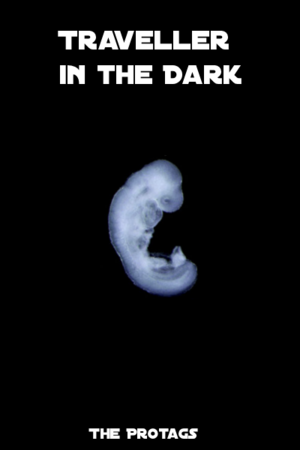
Around me, the frosted containers pulsed, expanding and contracting at the edges of my vision. I dragged myself up on one. Instinctively—I wanted to look away, but my gaze flickered down to the baby inside. Not a baby like the baby I’d held in my arms and kissed and had still been my baby even when the bombs hit. Just an embryo, a little twisted thing with a big head and tiny hands.
“I’m sorry…” I murmured. “I might die here…”
The embryo’s big head tilted up. It flexed its body, its shoulders, moved its hands. Its shoulders pushed out and expanded, its waist too, ears pushing out, and legs fattening. The container broke with a crash. I stared as it lay back across the rows of them, sharpened teeth filling its mouth, falling, regrowing, getting taller and taller and for a second I blinked to see a mess of colours pressed on top of its long and lanky mats of hair—then taller still, then wrinkles covering its face—
I covered my ears and shut my eyes tight. Through my firmly pressed palm,s I could hear the crack of growing bones. Time stretched on. Eventually, it stopped.
I opened my eyes and found that nothing had happened. The ten-thousand-year old embryo was still there, preserved like a pinned butterfly painted over with resin, looking nothing more than six weeks old. I, and those embryos, were older than an ancient Egyptian mummy, with blackened skin and grinning teeth. At least we didn’t look it.
After I went back into the cryo-chamber, I’d be under again for another ten-thousand years. What if the Aegis broke down in that time? The wakeup mechanisms could fall apart. I would go under and never wake up. My babies would die, all of them! I couldn’t sleep. Maybe I should take one of them to the gestation bay. Raise it into an adult. Someone who could sing to me. I would take care of it well, teach it well. We wouldn’t be lonely. And after I died, it could run everything for me. Wouldn’t that be nice?
“Sweetheart,” I said, standing and tapping on the glass, “wouldn’t you like to be a real boy?”
The embryo opened a big mouth like an otomatone and said, “No! Who would want you!”
“I know,” I said. “I let you die. In the bombings, you burned to death. I’m sorry.” I was dizzy, seeing things, hearing things. I needed to get back to the pod. Where I…wouldn’t ever wake up?
“What are you gonna do on the new planet? Gonna raise all of us? Huh?”
“Yeah…yeah, I guess…yeah, I can.” A spacesuit. That’d give me oxygen. Where had I left it? I’d found it earlier, lying in the hall like a corpse.
My saliva tasted like metal, and my stomach rolled. I pressed a hand to my mouth and limped a few feet before heaving and gagging out anything I could. Only a small trail of yellowish bile made it down my chin. In cryo, it was a bad idea to have food in your system, and of course, I didn’t eat in between.
In the dark, it was almost impossible to find where the suit bay was. I wandered back, tripping over more cords and cables, into walls that I didn’t think were there. But then, when I arrived back, my vision was flooded with technicolour. The suit was there, standing. My head was in it, blackened, mummified, one or two strands of lanky hair hanging down. And scarlet red blood soaked the white Dacron, from pelvis to thighs.
I gagged again, blinked several times. The image of the suit went away. I was standing in the dark in a deserted bay.
Hesitantly, I reached out. My hand brushed the hardened polyester of the spacesuit. It was dry. I fumbled up until I reached the helmet and toggled the little light on.
For a second, a shadow showed the outline of a head.
I tilted my head to the side, and it went away. The suit was ordinary, just ordinary. The only blood on it was a few tiny red spots.
…Shouldn’t there be no blood on it at all?
Whatever. At this point, I wasn’t trusting my eyes. There was no blood; I had made up the blood both times.
I strapped on the suit, each limb and body part growing heavy as I covered it up in thick insulation. Finally, I got the helmet on and took a deep, full breath.
In, out. In, out. In, out.
I took my toolkit out of its cubby. Now I had to get back into the cryopod. Even though I was still worried about never waking up…it wasn’t in the mission description to stay up longer than an hour or so, much less to turn the Xochiquetzal into a generational ship. It wasn’t equipped for that.
I made my way back, the helmet light shining a dim path ahead of me. The locking mechanism was near the head; if I could deconstruct that—then some manual overrides were hidden at the bottom, under shellac casings I’d have to carefully screw open.
“Twinkle, twinkle, little star, won’t you wonder where we are? Out across the sky so wide, a little invader forced outside…”
“Shut up. What do you even mean?” I had oxygen. Why was I still hallucinating? The dark?
…Was it real?
“S-shut up?” My son sniffled back tears, then started crying loudly.
“I’m sorry, I didn’t mean that…I’m stressed right now, you know, baby? Where are you?”
“Embryonics Bay 7, obviously.”
“I was just there.” I reached my cryobay and knelt to start unscrewing the first casing. “I didn’t see you.”
“Didn’t you? I came out wrong. I got old, then I suffered, then I died.”
I got the casing open.
Inside was, not switches, but a grayish, round-eyed little skull.
“You won’t be there to watch us grow up. You’ll die, and we’ll die.”
The bombs had ripped everyone apart. Burnt everyone up. Sent gooey holes through their skulls, made people vomit blood until their lungs and heart were coming up with it. My partner and I had been told, of course, that we couldn’t ever have children again. It was a small loss, then, when compared to the loss of him. Selfishly, shallowly, I loved the embryos.
How could I act like I was going to take care of them? We were so far beyond, in time, from everything I knew.
I stood up and felt the crack of another baby’s bones beneath my spacesuit boots. Another step, and it was a teenager’s ribcage I tripped over.
But I landed on the smooth floor. I looked back. Of course, there wasn’t anything there. But I’d felt it. It had been real, for a moment.
“How are all of us gonna exist without a mama or daddy? Where are we gonna live? Who’s gonna take care of us? I don’t wanna be humanity’s last hope!”
I went back to the Embryonics Bay.
A few hundred embryos, all neatly numbered off, to seed a new planet. The ship would take care of them, provide food, water, and educational programs for the first fifteen years of their lives. If any of that worked. If the planet they landed on was still habitable in nine hundred and ninety thousand years.
They lay there, so small, so vulnerable.
The planet would have bombs, I decided, that would rip through and mutate their little bodies. I couldn’t let them die like that.
I went to the panel on the back wall and unscrewed it. There were all the settings for their preservation, their future gestation, all of it. Glowing red buttons and one key lever, carefully taped over.
I could hear crying. A cacophony of hundreds of infants, all wailing and sobbing at once.
“Shh, it’ll be okay.” I sang with a faltering voice, one of the lullabies I used, rocking him, getting him to quiet down. “Hush little baby, don’t say a word, Mama's gonna show you a hummingbird…” There were no more birds, not anymore. “If that hummingbird should fly, Daddy's gonna point to the evening sky…When the nighttime shadows fall, Mama's gonna hear the crickets call…” No hummingbirds, no crickets, no evening, just an endless expanse of sickening universe. “As their song drifts from afar, Daddy's gonna search for a shooting star…”
And I pulled the lever down, hard.










Please sign in to leave a comment.