Chapter 2:
Chapter 1:the last hand
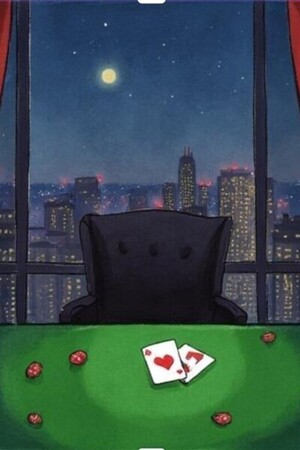
All in
ALL IN
Chapter 1: The Last Hand
The thing about playing poker in a Tokyo bar at two in the morning is that the vending machines outside have better card sense than half the people at the table.
Kenji Tanaka watched a particularly bold salaryman stumble past the window, tie loosened, dignity dissolving, and thought that's me. Just smaller. And with better career prospects.
"You gonna bet or meditate on the salaryman's life choices?" demanded Tetsu, the self-styled "King" of Kabukicho, who ran this illegal game out of a back room that smelled like stale whisky and poorer life choices.
Kenji looked at his hole cards. A seven and a two. Off-suit. The kind of hand that made professional poker players weep into their matcha. Then he looked at Tetsu's gold chains, gold teeth, brain made of gold foil and saw the tell immediately. Tetsu was sweating despite the AC being broken in the way all ACs in Tokyo were broken, which is to say they worked just well enough to mock you. But the sweat was on his upper lip only. Classic sign of a man who's bluffing and hoping his mustache will hide it.
"Raise," Kenji said, pushing forward a stack of chips that represented his mother's blood pressure medication for the next three months.
Tetsu's left eye twitched. Bless you, science.
"You're raising with what? Your good looks?" Tetsu laughed. His two henchmen, standing by the door like potted plants with tattoos, laughed too. They were paid to laugh. It said so in their contracts, probably.
Kenji leaned back in his chair. It was plastic. It wobbled. Everything in his life wobbled these days. "I'm raising because I respect your mother's opinion of me."
Tetsu stopped laughing. "What about my mother?"
"I said I respect her opinion. Very dignified woman. When I called her this morning to ask about your childhood, she said you were a sweet boy who cried when the neighbourhood cats ignored you. That's the energy I'm betting against."
The table went silent. The salaryman outside paused, sensing the shift in power dynamics.
Tetsu's face cycled through three shades of purple that didn't exist in nature. He looked at his cards. He looked at Kenji. He looked at his cards again. Then he folded, throwing his hand toward the dealer with unnecessary violence.
"Show," he demanded. "Show what you had."
Kenji considered this. The rule in most games was that if you got caught bluffing, you had to show. But if you bluffed successfully and the other player folded, you could keep your cards secret forever, letting the mystery haunt them like an unpaid electricity bill.
Kenji showed his seven-two off-suit.
Tetsu stood up so fast his chair fell over. "You called my mother a cat and bluffed me with that?"
"I called your mother dignified. The cat thing was about you. Reading comprehension, Tetsu. It's like poker, but with newspapers."
One of the henchmen laughed. The other one elbowed him. Tetsu pointed a thick finger at Kenji. "You think you're clever, you Todai reject?"
"I didn't go to Todai."
"Exactly. Reject."
Kenji scooped the pot toward him. Four hundred seventy thousand yen. Enough for the medication. Enough to keep the loan sharks at bay for maybe another week. Not enough to solve anything, but enough to survive until tomorrow's problems arrived, which they always did, right on schedule, like the Yamanote Line.
The game broke up at 2:47 a.m. Kenji knew the time because his watch was the one nice thing he still owned a gift from his first big tournament win in Osaka, back when people called him "The Professor" and women pretended to understand poker just to talk to him. Now the watch was ten minutes fast and so was everyone's opinion of him.
He walked through the bar's main room, past drunk advertising executives singing old karaoke songs with the confidence of people who would regret everything in six hours. The air smelled of greasy yakitori and desperation. His two favourite things.
Outside, the parking lot was empty except for his 2008 Toyota Corolla paint faded, AC broken in the way all ACs in Tokyo were broken and a black Alphard with tinted windows that hadn't been there when he arrived.
Well, Kenji thought. Hello, Tuesday.
The Alphard's doors opened. Two men got out. They were wearing matching black shirts and matching expressions of professional unpleasantness. Behind them, from the passenger seat, emerged a third man who didn't need to get out to make his presence felt.
Yamamoto "Aniki" Kaito rolled down his window. He had the face of a man who'd started life as a sweet child and then, at some point, made a series of increasingly poor decisions about whom to disappoint. His hair was oiled back. His moustache was oiled forward. His smile was oiled in directions that suggested he'd recently watched a yakuza film from the 90s and thought, Yes. That. That's the energy I want.
"Kenji," he said. Not a question. A confirmation.
"Yamamoto-san," Kenji replied. "Looking well. New shirt?"
"Get in."
"I have a car."
"I noticed. 2008 Toyota Corolla. Very reliable. Your mother uses it to go to the market on Tuesdays and Fridays. Today is Tuesday, but she's not going anywhere because she's waiting for you to come home with her medicine." Yamamoto paused, letting the information land. "Get in."
Kenji got in.
The back seat of the Alphard smelled like vanilla air freshener and existential dread. The two enforcers sat on either side of him, close enough that he could feel their body heat and the general sense that they hadn't hugged their fathers enough.
Yamamoto turned around from the front passenger seat. "You owe me 2.2 billion yen, Kenji."
"2.2 billion? I thought it was one billion eight."
"Interest, my friend. Interest is the gift that keeps on giving. Like herpes, but more expensive."
"I don't have it."
"I know." Yamamoto sighed, the sigh of a man who had to explain basic concepts to children. "If you had it, we wouldn't be having this conversation in my car at three in the morning. We'd be having it at a restaurant, over dinner, with you paying. But you don't have it, so here we are."
The enforcer on Kenji's left cracked his knuckles. It was the most original thing he'd done all night.
Kenji looked at Yamamoto. Really looked. The man was calm. Too calm. Loan sharks with 2.2 billion yen on the line didn't sit in parking lots having philosophical discussions about interest rates. They took fingers. They made examples. They did things that required the victims to buy new shoes because the old ones didn't fit anymore.
But Yamamoto wasn't looking at him like a debtor. He was looking at him like an investment.
"I'm listening," Kenji said.
"Good. Because I have an offer for you. A way out." Yamamoto reached into his pocket and pulled out a phone. He tapped the screen and handed it over.
Kenji read the message. *"You have been invited. Penthouse, Park Hyatt, Shinjuku. Tomorrow. 9 pm. Buy-in: ¥2.2 billion Come alone."*
"I don't have two and a half billion either," Kenji said. "I have four hundred seventy thousand and a car that may or may not survive the next typhoon."
"The buy-in is covered."
Kenji felt his eyebrows try to escape his face. "By whom?"
"By people who don't explain themselves to me, and I don't explain myself to you. That's how these things work. It's a pyramid of people not explaining things."
"I'm not going."
"Yes, you are."
"Why?"
Yamamoto smiled. It was not a nice smile. It was the smile of a man who'd been waiting for this question. "Because if you don't go, I'll have to collect my 2.2 billion yen the old fashioned way. And your mother's medication? The one you just won money for? Very expensive. Very necessary. Very easy to interrupt."
The enforcer on Kenji's right cracked his knuckles. Clearly they'd rehearsed this.
Kenji looked at the phone again. Park Hyatt. Penthouse. 2.2 billion yen buy-in, comped. People who didn't explain themselves.
In his entire life, Kenji had never been given anything for free. Even samples at the depachika came with the implicit understanding that you'd feel guilty enough to buy the full-sized product. This invitation wasn't generosity. It was a trap wrapped in a mystery inside an enigma, with a bow made of "you'll find out soon enough."
But the alternative was Yamamoto's collection methods, which he'd heard about from people who now walked with limps and saw the world through one eye.
"I'll need new shoes," Kenji said.
Yamamoto blinked. "What?"
"For the Park Hyatt. I can't show up in these." He pointed at his feet, where his shoes had recently developed a relationship with the pavement that could best be described as "codependent."
Yamamoto stared at him for a long moment. Then he laughed. It was genuine surprised out of him like a cough. "You're either the bravest man I've ever met or the stupidest."
"I get that a lot."
"I'm sure you do." Yamamoto nodded to the enforcers. They got out. Kenji got out. The Alphard drove away, leaving him alone in the parking lot with his four hundred seventy thousand yen and a phone full of new nightmares.
He drove home slowly, through the empty streets of Tokyo at that strange hour when the city holds its breath between the last drunk and the first train. By the time he reached Naka-Meguro, the sky was thinking about turning grey, like it wasn't sure it wanted to commit to morning.
Their apartment was in an old building that had been modest when his grandfather first saw it. The stairs creaked in ways that suggested they'd been taking bribes from termites for decades. His mother's apartment was on the second floor, two rooms and a kitchen the size of a wealthy person's closet.
She was awake. Of course she was awake. Mothers in Tokyo didn't sleep until their children were home, regardless of how old those children were.
"Kenji?" Her voice through the door. Thin. Worried.
"It's me, Kaasan."
The door opened. His mother stood there in her nightgown, grey hair escaping from her braid, eyes scanning him for damage the way she'd been doing since he was six years old and fell out of a cherry blossom tree.
"You're late."
"The game ran long."
"Did you win?"
He held up the money. Four hundred seventy thousand yen. Her face did something complicated relief that he was safe, guilt that he was doing this for her, love that he'd never quite learned how to accept.
"Your medicine," he said. "I'll get it in the morning."
She pulled him inside, pushed him toward the kitchen, where a plate of food waited under a plastic cover. "Eat. You're skin and bones."
"I'm actually exactly average weight for my height and age."
"Skin and bones," she repeated, because when your mother had decided something, the Ministry of Health could publish a contrary study and she'd still call you malnourished.
He ate. Rice and miso soup and some pickled vegetables that had probably been better earlier in the evening but were still edible. His mother sat across from him, not eating, just watching. This was her hobby now. Watching him eat. Cheaper than television.
"Someone called today," she said.
Kenji's hand paused, chopsticks halfway to mouth. "Who?"
"A man. He asked for you. I said you were at work. He said he'd call back."
"Did he leave a name?"
"No. But his voice..." She trailed off, frowning. "It was very flat. Like he was reading from a script. No emotion at all."
Kenji thought about the invitation. Park Hyatt. 2.2 billion yen . People who didn't explain themselves.
"Did he say anything else?"
"He said to tell you that the game starts at nine, and to bring your A game." She looked at him with those eyes that had seen him through chicken pox, through entrance exams, through the crash when the poker sponsors dropped him and the world decided he was nobody. "What game, Kenji? What's happening?"
He should tell her. He should explain about Yamamoto, about the invitation, about the trap he was walking into. But he looked at her facethe lines around her mouth that hadn't been there five years ago, the grey in her hair that kept spreading like news of a family scandal and he couldn't.
"Nothing, Kaasan. Just a private game. High rollers. Good money."
"You're lying."
"Yes."
She nodded, accepting this the way she accepted everything about her strange son who'd rather read people's faces than become a salaryman like his cousins. "Then at least eat properly before you go lie to rich people."
He finished his food. He washed his bowl. He kissed her forehead dry skin, warm, familiar and went to his room.
The room was small. A futon, a desk, a laptop that was three generations obsolete. On the wall, a single framed photograph: him at the World Series of Poker Asia Pacific, four years ago, holding a trophy and smiling like he'd solved life.
He looked at that boy now. Clean-shaven. Confident. Unaware that the world was about to reach into his pocket and take everything.
His phone buzzed.
A photo.
His mother, on the balcony, drinking her evening tea. The photo was taken today. From the building across the street. From someone who'd been watching.
The message: "See you tomorrow, Tanaka-san. Don't be late."
Kenji looked at the photo. Then he looked at the invitation still open on his phone. Then he looked at the wall, thin enough that he could hear his mother moving around in the next room, alive and safe for now.
He started laughing.
It wasn't funny. None of this was funny. He was trapped between a loan shark who wanted his fingers and a mystery game that wanted God knows what, with his mother as the bargaining chip. His career was over, his bank account was a joke, and his only marketable skill was the ability to tell when strangers were lying.
Which meant, if he thought about it, he was perfectly qualified for whatever was waiting in that penthouse.
He laughed harder.
In the next room, his mother called out, "Kenji? Musuko? Are you okay?"
"Fine, Kaasan!" he shouted back, still laughing. "Just thinking about how my life is a Japanese film directed by someone who hates happy endings!"
Silence. Then: "At least it's not a Hollywood film. Those have snakes on planes. We don't have snakes."
This made him laugh even more, because only his mother could find the silver lining in his existential crisis by comparing cinematic ecosystems.
He stopped laughing eventually. He looked at the photo again. He looked at the invitation.
Then he did what any sane, reasonable person would do in his situation.
He opened his laptop and started researching how to spot micro-expressions in people who might want to kill him.
Tomorrow, he was going to a penthouse.
Tomorrow, he was going to play poker for stakes he didn't understand.
Tomorrow, he was going to find out who these people were, what they wanted, and whether the salaryman outside Tetsu's bar had better survival instincts than he did.
But tonight, he was going to sleep.
Probably.
Hopefully.
With one eye open.
In the building across the street, a man lowered his camera. He was nondescript in every way average height, average weight, average face except for his eyes, which were flat in a way that suggested he'd stopped being surprised by anything approximately forty years ago.
He dialed a number.
"He's home," he said. "He saw the photo. He laughed."
A pause on the other end. Then: "Laughed?"
"For about three minutes. Then he started using his laptop. Research, probably."
Another pause. Then, a voice so calm it could only belong to someone who'd never had to worry about rent: "Interesting. The others all reacted with fear. Ryo threatened us. Isamu tried to track the number. Yuria offered money. But this one... laughed."
"Should I be concerned?"
"No. You should be fascinated. A man who laughs when cornered is either very brave, very stupid, or very good at hiding how terrified he is. Either way, he'll be entertaining. Tomorrow, we'll find out which."
The call ended.
The man with the flat eyes looked at the apartment one more time, at the single light still on in Kenji's room, and allowed himself the smallest flicker of curiosity.
Then he packed his camera and disappeared into the Tokyo night, leaving behind nothing but the memory of a laugh that might have been courage, might have been madness, and might have been the only sane response to a world that had finally stopped pretending to play fair.


Please sign in to leave a comment.