Chapter 11:
Episode 11 - "What Survives the Cold"
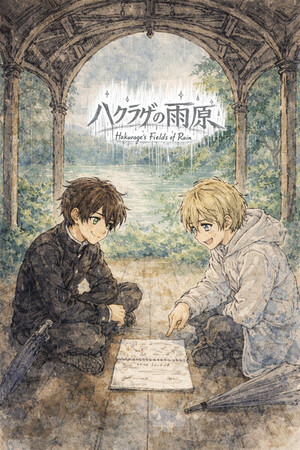
Hakurage no ame Hara (ハクラゲの雨原-Hakurage's Fields of Rain)
The snow comes in earnest on a Wednesday night, three days after the academic board meeting.
Shinji wakes at 2 AM to Hakurage shaking his shoulder, urgency in the touch. Outside, the world has transformed into something hostile and beautiful—snow falling so thick it erases Tokyo, turning everything into white static.
"We need to cover the plants," Hakurage says. His voice is steady but his hands shake. "If the temperature drops below freezing with this much accumulation, we'll lose everything."
They dress in layers, stumble into boots, and go out into the storm.
The garden is unrecognizable. Snow buries the paths, weighs down branches until they crack and fall. The winter camellias—those impossible blooms—are already bowing under white weight, petals frozen into sculptures of themselves.
Hakurage moves through the garden like someone possessed, pulling tarps over the most vulnerable beds, constructing makeshift shelters from bamboo poles and plastic sheeting. Shinji follows, holding things in place while Hakurage ties them down, both of them working in the kind of desperate silence that comes when there are no words big enough for what you're trying to save.
They work until dawn, until their fingers are numb inside wet gloves, until their breath comes in ragged clouds and their legs shake from cold and exhaustion.
When the sun finally rises—pale and useless through the snow—they survey what they've managed to protect. Maybe half the garden. Maybe less. The rest sits exposed, vulnerable, slowly dying under conditions it was never meant to survive.
"It's not enough," Hakurage whispers. His face is gray with cold and exhaustion and something deeper. "Even with the covers. If this keeps up for more than a day, the freeze will penetrate. The roots will die. Everything my parents worked for—everything I've been trying to save—it's all dying and I can't stop it."
Shinji's heart breaks watching him. Hakurage has been strong for so long, held together through the sheer will and stubbornness, but this—nature itself turning hostile—this is beyond fighting, beyond fixing.
"Come inside," Shinji says gently. "You're hypothermic. We both are. We need to warm up, rest, then figure out what to do next." "There is no next. Don't you understand? This is it. This is the end."
"Haku—"
"My parents spent fifteen years cultivating these species. Fifteen years of research, of will power, of learning what makes winter blooms possible. And I'm going to lose it all in one night because I'm not smart enough, not strong enough, not them." His voice breaks completely. "I promised I'd keep their work alive. I promised."
Shinji takes Hakurage's frozen hand. "You're not losing it all. Some will survive. The hardiest ones. And we'll rebuild from those. That's what your parents' research was about, wasn't it? Resilience. Survival through adaptation."
"Survival isn't the same as thriving. I don't want to just survive—I want to honor what they built."
"You honor them by living. By trying. By recognizing when you've done everything you can and accepting it." Shinji pulls him toward the small living quarters. "Come inside. Please. Before we both freeze to death and the garden loses both of us."
Hakurage lets himself be led, too exhausted to resist, and they stumble inside where it's barely warmer but at least sheltered from the wind.
They eventually wrap themselves in every blanket Hakurage owns, and huddle together near the portable heater—barely adequate, running on limited electricity, but better than nothing.
Shinji can feel Hakurage shaking beside him, and it's not just from cold. It's grief and exhaustion and six years of holding everything alone finally exceeding his capacity to bear it.
"I'm tired," Hakurage says quietly. "I'm so tired of fighting. Tired of trying to save things that want to die. Tired of being the only one who cares about this place."
"You're not the only one. I care."
"You've been here two months. I've been here six years. Alone. Watching everything slowly fall apart despite everything I do." Hakurage presses his face into his knees. "Sometimes I think about just letting go. Letting the bank take it. Letting it become a parking lot or apartment complex or whatever they want. At least then I wouldn't have to watch it die slowly."
"You don't mean that."
"Don't I?" Hakurage looks at him with eyes that have forgotten how to hope. "What's the point, Shinji? My parents are dead. The research ended with them. I'm just a moron playing gardener, pretending their work matters when the world has moved on. When even nature itself is trying to kill what they built."
Shinji doesn't have answers. Doesn't have words big enough to fill the hole Hakurage is falling into. So he just pulls him closer, wraps his arms around him, and holds on while Hakurage finally, finally breaks.
The crying is violent. Six years of grief compressed into sounds that sounded tragic. Shinji holds him through it, feeling his own tears come—for Hakurage, for the garden, for all the beautiful things the world destroys through indifference.
Outside, snow continues falling, burying dreams under white weight. They sleep fitfully through the morning, both too cold and too exhausted to stay awake but too worried to rest properly.
When Shinji wakes around noon, he's alone. Panic floods through him until he sees Hakurage's coat is gone, his boots missing from the entrance. Shinji gets ready quickly and goes outside into a world that has become a stranger.
The snow has stopped, but the damage is everywhere. Branches snapped under weight, lying scattered like broken bones. The tarps they secured have collapsed under accumulation, burying the plants they were meant to protect. The winter camellias—those defiant blooms—are blackened with frost damage, their petals turned to mush, hanging from stems like small deaths.
He finds Hakurage in the eastern section, kneeling in the snow beside a bed of paper-whites that have frozen solid. Hakurage is pulling them up one by one, examining the bulbs for signs of life, finding only ice-destroyed cells.
"These were my mother's favorite," Hakurage says without looking up. "She said they smelled like hope. That no matter how dark the winter, paper-whites would bloom and remind you spring was coming." He sets down a ruined bulb. "She was wrong. They're just plants. Fragile. Temporary. Meaningless in the face of real cold."
Shinji kneels beside him. "Not all of them are dead. Look—" He points to a corner where three paper-whites still stand, damaged but upright, their blooms frozen but not destroyed. "Those three survived. That's not nothing."
"Three out of thirty-seven. That's not survival. That's extinction." "That's seed stock. That's what you rebuild from."
"I don't want to rebuild!" Hakurage's voice rises to a shout. "I don't want to start over again! I want what was! I want my parents alive and the garden whole and research continuing and none of this nightmare that's been my life for six years!"
The words echo across the snow-covered garden, and then dissolve into silence.
Hakurage sits back in the snow, all the fight gone out of him. "I can't do this anymore. I thought I could. Thought if I just worked hard enough, cared enough, it would be enough to save everything. But it's not. It's never enough."
Shinji sits beside him, both of them in the snow, the cold seeping through their emotions. "Maybe saving everything isn't the point. Maybe saving what matters most is."
"Everything matters. Every plant here is part of my parents' work—"
"No. You matter. Your survival matters. Your future matters." Shinji takes Hakurage's hand. "The garden is important. But it's not more important than you. And if keeping it is destroying you, then maybe we need to rethink what we're fighting for."
"If I give up the garden, what do I have left? It's all that's left of them."
"You have their research notes. Their journals. The knowledge they taught you. The way you see the world—that's them living on. Not these plants. You." Shinji squeezes his hand. "And you have me. That's what's left. That's what survives."
Hakurage looks at him with devastated eyes. "What if you're not enough?"
The words should hurt, but Shinji understands what he means. No person can fill the hole left by dead parents and six years of isolation. No friendship can compensate for that much loss.
"I'm not enough," Shinji says honestly. "Nothing will ever be enough to replace what you lost. But maybe I'm enough to help you keep living anyway. To help you figure out what surviving looks like when everything you're trying to save dies despite your best efforts."
They sit in the snow as afternoon fades toward evening, two figures in a dying garden, learning that sometimes friendship means sitting with someone while their world ends, offering no solutions because there are none, just presence and the stubborn refusal to let them face destruction alone.
That night, Hakurage's phone rings. It's a number he doesn't recognize, but he answers anyway, too tired to care about screening calls. "Am I speaking with Shizu Hakurage?" A voice, professional and crisp.
"Yes."
"This is Kimura Akane from the Tokyo Botanical Foundation. I attended the exhibition of your parents' research last month. I was very impressed by the work displayed."
Hakurage sits up straighter, suddenly alert. "Thank you, but—the exhibition was just student work. Informal."
"I'm aware. But the research notes included suggested your parents were very close to significant discoveries about stress adaptation in winter-blooming species. I've been authorized by the foundation to inquire whether you'd be interested in partnering with us to continue that work."
Hakurage's heart is hammering. "What kind of partnership?"
"We would provide funding to preserve the garden as a research site. You would continue your parents' cultivation work under the supervision of our senior botanists. We'd formalize it as an educational fellowship—you'd receive training, stipend, and most importantly, resources to maintain the property and expand the research."
"Why? Why now?"
"Because your parents' work on environmental stress response is more relevant than ever. Climate change is destroying ecosystems globally. If we can understand how some species not only survive but thrive under stress, we can apply those principles to restoration efforts worldwide." Kimura's voice softens. "Your parents were ahead of their time. We'd like to help you prove they were right."
Hakurage looks at Shinji, who's listening with wide eyes. "I—I need to think about it. The garden just suffered major damage from snow. I've lost most of the specimens."
"That's actually perfect. Documentation of failure is as valuable as success. How plants die tells us as much as how they survive. If you're willing, we'd like to send a team next week to assess the damage and begin planning recovery."
"A team?"
"Three botanists, a restoration specialist, and myself as project coordinator. We'd be working with you, not taking over. This is your parents' garden. Your research. We're just providing support."
After the call ends, Hakurage sits in stunned silence. "Did that just happen?" he asks. "I think so." Shinji's face is breaking into a smile. "I think someone just threw you a lifeline."
"They want to fund the garden. Continue my parents' work. They actually care about what happens here." "Of course they do. Your parents were brilliant. You're brilliant. The work matters."
Hakurage looks around the small living space—the sparse furniture, the cold seeping through inadequate walls, the weight of six years of fighting alone. "I don't have to do this by myself anymore."
"You never did. I've been here."
"I know. But now—now there's institutional support. Resources. People who understand the science." His voice breaks with something that might be hope or might be fear of hoping. "This could actually work. We could actually save this place."
"Not could. Will." Shinji pulls him into a hug. "We will save this place. And we'll do it together, with help, the way it should have been from the beginning."
They had each other in the cold room while outside, the snow-covered garden waits. Damaged but not destroyed. Diminished but not dead. Ready to be rebuilt by hands that finally aren't alone.
The next morning, they go back outside to assess the full damage in daylight.
It's worse than they thought. Seventy percent of the cultivated specimens are dead or dying. The greenhouse has sustained structural damage—more panels cracked from ice expansion. The pond has frozen solid, and they won't know until thaw whether the koi survived.
But Hakurage moves through the destruction differently now. Not with despair, but with scientific observation. Taking notes. Photographing damage patterns. Documenting which species failed and which endured.
"The foundation will want detailed records," he explains, his voice steady for the first time in days. "Every failure is data. Every survival is a lesson."
Shinji watches him work, sees the shift from grief to purpose, and understands something important: sometimes survival requires witnessing, sometimes it requires documentation, and sometimes it requires transforming your pain into knowledge so someone else might suffer less.
They spend the day cataloging loss. By evening, they have lists of what died and what lives. The survivors are few but significant—three paper-whites, five winter camellias, a patch of Christmas roses that endured through snow and ice, blooming defiantly through frozen ground.
"These are the ones we rebuild from," Hakurage says, touching the surviving camellia with his fingers. "These proved my parents right. Some things are strong enough. Some things survive when everything else fails."
"Like us," Shinji says. "Like us."
They stand together in the ruins of the garden, watching the last light fade over Tokyo, and for the first time in weeks, maybe months, there's something in the air that feels like possibility.
Not certainty. Not guarantee. Just the smallest seed of maybe, planted in frozen ground, waiting for conditions to change enough to grow.
TO BE CONTINUED...





Please sign in to leave a comment.