Chapter 1:
The Promise
The Spirit Beside Me
The cabin lights had dimmed hours ago.
The airplane had settled into that strange artificial night unique to long flights. Most of the passengers around Ren had surrendered to it completely.
Heads tilted against windows.
Mouths slightly open.
Blankets twisted around legs.
Somewhere behind him, someone snored with a consistency that bordered on talent.
Ren stayed awake.
One shoulder rested lightly against the window as he watched darkness stretch beneath the plane like an endless sheet of ink.
The Pacific at night did not look like water.
It looked like absence.
Like the world had simply run out beyond the glass.
A faint reflection stared back at him in the window.
Light brown hair that had long since given up any attempt at neatness.
Tired eyes.
A face trying very hard not to think too hard.
At his feet sat the only luggage he had brought with him.
A dark hiking backpack, scuffed at the corners, overstuffed in an unimpressive way.
Not enough to look adventurous.
Just enough to look underprepared.
Three shirts.
A camera.
A notebook.
Enough money, hopefully.
Not enough common sense, probably.
He bent down, unzipped the small front pocket, and pulled out the notebook.
The cover was soft with wear.
He had opened it too many times over the years, enough that the spine had given up resisting.
On the first page, written in handwriting far neater than his own, were four words.
Hikari’s Japan List
His thumb brushed over the letters.
Below them, in the same handwriting, were the items written with a mix of excitement and determination.
See cherry blossoms in person
Eat ramen in Tokyo
Ride the Shinkansen
Visit a real shrine
See the ocean in Okinawa
Watch fireworks in summer
He stared at the list until the words blurred.
“You’d be making fun of me right now,” he muttered softly.
The passenger beside him shifted under their blanket but didn’t wake.
Ren looked back down at the page.
At the pressure marks in the paper where her pen had pressed too hard.
At the tiny crooked flourish on the last word because she had always gotten impatient near the end of a sentence.
His chest tightened with a familiar, dull ache.
The memory came so quickly it felt less like remembering and more like falling.
Rain tapped against the hospital window in a soft, steady rhythm.
The television in the corner of the room was turned low, some late-night travel program drifting through shots of Kyoto streets and blooming sakura trees.
The sound was little more than a murmur beneath the beeping of the monitor.
Ren sat in the uncomfortable chair beside the bed with his arms folded, pretending not to be tired.
Hikari Aizawa watched the television with the kind of attention people gave to things they wanted very badly and feared they would never touch.
“Oh wow. Look at that, Ren,” she said quietly.
On the screen, a camera moved beneath rows of pale pink blossoms.
Petals fell across a narrow stone path.
Tourists laughed somewhere off camera.
Ren followed her gaze.
“Yeah.”
“There’s no way it looks that pretty in real life. It looks absolutely stunning.”
“It’s not going to meet your expectations,” he said.
She turned her head, offended.
“That is such a mean thing to say.”
“You say that about everything you get excited about online.”
“Not Japan.”
“Especially Japan.”
Her mouth twitched.
“You’re impossible.”
“And yet,” he said, leaning back in the chair, “you keep me around.”
The smile that touched her face was thinner than it used to be.
But it was still hers.
“I have bad taste.”
He looked at her then.
Really looked.
At how small her hand seemed against the blanket.
At the way the hospital gown made everybody look fragile no matter how stubborn they were.
At the tiredness she tried to hide every time he visited.
The travel show moved on to Tokyo.
Neon signs.
Crowds.
Vending machines glowing under the night sky.
A ramen shop steaming at the entrance.
Hikari’s eyes stayed on it.
“Ren.”
“Yeah?”
“If you ever make it there…”
He frowned immediately.
“When we make it there.”
She didn’t correct him.
That was what hurt.
Instead, she kept watching the screen.
“If you go,” she said softly, “see everything, for me.”
Ren said nothing.
Her fingers shifted against the blanket.
He reached over and took her hand before she had to ask him to.
“Hikari.”
“Promise me.”
He hated promises when people asked for them in voices like that.
Because voices like that already knew the answer to questions nobody else was ready for.
He swallowed hard.
“You’re going to be there, Hikari,” he said quietly. “You’re going to be with me. We’ll see it together.”
Her eyes moved from the television to him.
There was apology in them.
And affection.
And a sadness so quiet it made him angrier than tears would have.
“Promise,” she repeated.
The heart monitor kept its patient rhythm beside them.
Rain kept tapping against the glass.
Finally, Ren tightened his hand around hers and nodded once.
A tear slipped down his face before he could stop it.
“I promise, Hikari,” he said, his voice shaking.
Her smile this time was small and real.
“Good,” she whispered. “Then at least one of us gets to.”
Her grip loosened just slightly in his hand, like she had already started letting go of something he couldn’t see.
The voice over the intercom startled him back into the present.
“Attention all passengers, we’ll be beginning our descent shortly into Narita International Airport…”
The cabin lights brightened by degrees.
The world outside the window shifted from pure dark to the deep blue of pre-dawn.
Thin ribbons of city light appeared below, first scattered, then multiplying, until the land looked like it had been stitched together with gold.
Japan.
For a moment Ren forgot to breathe.
It was one thing to buy the ticket.
To count the savings.
To tell himself over and over that he was actually doing this.
It was another thing entirely to see the lights below and realize there was no more distance left to hide behind.
He glanced down at the list again.
Then, with slow care, he slid the notebook back into his bag.
The plane descended through cloud.
By the time the wheels touched down, his hands were clenched so tightly around the armrests that his knuckles hurt.
He laughed once under his breath.
“Awesome,” he murmured. “Very normal reaction. Definitely not letting my anxiety get the best of me.”
The landing was smooth enough to insult him for bracing.
As the plane taxied, people around him began waking fully into themselves.
Seatbelts unclicked too early.
Overhead bins popped open.
Someone in front of him stood up before the seatbelt sign turned off and immediately got told to sit back down in three different languages.
Ren smiled despite himself.
That helped.
Just a little.
By the time he stepped off the plane and into the terminal, the unreality had started to break into smaller, manageable pieces.
Fluorescent lighting.
Signs in Japanese and English.
The rumble of suitcase wheels.
The smell of coffee from a small airport kiosk that was somehow already open and doing brisk business.
He followed the flow of passengers through immigration with the obedient blank expression of someone trying not to look as tired as he felt.
The line moved faster than expected.
The officer at the desk looked at his passport, looked at him, stamped it, and waved him through with all the ceremony of approving a grocery receipt.
That was it.
After years of wanting and planning with Hikari, months of budgeting and saving, and one very long flight.
That was it.
Ren stepped into the baggage area and stared at the carousel before realizing, with a small stupid laugh, that he didn’t have a checked bag.
Right.
Just the backpack.
One older woman standing nearby gave him an amused glance, as if she had somehow heard the thought happen.
Ren bowed reflexively out of sheer awkwardness.
She bowed back.
He bowed again.
She bowed again.
Another bow almost escaped him before he physically stopped himself and fled in the direction of the exit.
“That was embarrassing,” he muttered to himself. “What am I even doing? I should’ve paid more attention to Hikari’s lessons.”
He tried to laugh it off.
The first breath of air outside the terminal was warmer than he expected.
It hit him with summer all at once.
Humid.
Alive.
Carrying traces of asphalt, distant exhaust, and something green he couldn’t place.
Even this early, the air clung lightly to his skin.
Narita.
He stood there for a second with one hand on his backpack strap and simply looked.
Buses arrived and left with impossible efficiency.
Travelers moved in practiced lines.
Station signs glowed in neat order.
Everything felt organized in a way that made his own internal state seem even more obvious by contrast.
He pulled out his phone, checked the route to Tokyo, and followed the signs to the train station beneath the airport.
This was where his confidence lasted exactly three minutes.
The ticket machine, at first glance, did not look threatening.
Then it became threatening.
Ren switched the interface to English.
That turned out not to be helpful so much as it was aggressively informative.
Fare adjustments.
IC cards.
Reserved seats.
Skyliner.
Access Express.
Lines crisscrossing the screen like a conspiracy board.
He leaned slightly closer.
Then farther back.
Then closer again.
A businessman in a navy suit stepped up behind him and waited exactly long enough to be polite before sighing.
Ren turned halfway and gave him an apologetic smile.
“Sorry. First day in Japan.”
The man’s expression didn’t change, but there was a flicker of understanding there.
“Clearly.”
Ren laughed once.
“That obvious?”
The man pointed at the screen.
“Where are you going?”
“I’m attempting to get to Tokyo.”
“That narrows it down very little.”
“Right. Sorry. Near Asakusa first. Hotel tonight.”
The man nodded, stepped beside him, and pressed four buttons in less than two seconds.
A ticket slid out.
Ren stared at it like he’d witnessed sleight of hand.
“…I would have never figured that out.”
The businessman picked up his own ticket from the next machine.
“Nobody does the first time.”
“Thank you.”
“Welcome to Japan.”
The train ride into the city passed in a blur of fatigue and fascination.
At first there were stretches of airport outskirts.
Parking lots.
Low buildings.
Utility poles.
Then neighborhoods thickened.
Rooftops multiplied.
Signs grew denser.
Roads layered over roads.
And then Tokyo began to rise.
Not all at once.
Not as a skyline reveal like in movies.
It accumulated.
Quietly.
Relentlessly.
Until Ren looked up from his phone and realized the city had surrounded him.
By the time he emerged from the station into full daylight, it felt like the world had turned up its volume.
People everywhere.
Not chaotic.
Not exactly.
Just constant.
The streets moved like living currents.
Businessmen in dark suits.
Students in uniform.
Tourists with shopping bags.
Cyclists threading through spaces Ren wouldn’t have trusted his own body to occupy.
Screens climbed the sides of buildings in impossible scale.
Music spilled from storefronts.
Advertisements flashed overhead.
Somewhere nearby, something fried in oil and smelled incredible.
Ren stepped out of the station, stopped dead, and looked up.
Tokyo towered and glittered and pressed in from every direction.
A laugh escaped him before he could stop it.
“You would have lost your mind,” he said quietly, and for a moment it felt like Hikari was close enough to hear him.
He walked for hours.
Partly because he wanted to.
Partly because standing still in a city this large felt like admitting defeat.
He crossed streets he had only ever seen online.
He passed capsule toy machines stacked in dizzying rows.
He stopped outside a ramen shop just to watch steam billow every time the door opened.
He bought bottled tea from a vending machine largely because it still felt absurd to him that there was a vending machine every fifteen steps.
At one crosswalk he stood obediently waiting for the signal despite the road being totally empty.
A teenage boy beside him glanced at the dead street, then at Ren, then back at the empty street.
“You can cross, you know.”
Ren looked up.
“Oh.”
The boy grinned.
“You’re not from here.”
“That obvious too?”
“Not at all.”
Ren narrowed his eyes. “I could feel the sarcasm radiating from you.”
That got a laugh out of the boy.
Ren crossed quickly, laughing under his breath at himself.
At the next major intersection, the crowd swelled around him in bright shirts, umbrellas, shopping bags, and the restless shimmer of a summer afternoon.
Heat rose from the pavement in soft waves.
Somewhere above the noise, cicadas buzzed from a line of roadside trees that looked too green to belong in the middle of so much concrete.
For a moment, across the street, he thought he saw a girl with white hair standing perfectly still among the moving crowd.
Not checking her phone.
Not talking.
Not reacting.
Just there.
Someone passed in front of her.
When the space cleared, she was gone.
Ren frowned and looked twice more, but the signal changed, the crowd surged, and the city swallowed the moment before he could decide if he had actually seen anything at all.
Later, at a convenience store, he ordered onigiri and water in Japanese so practiced and natural that the cashier blinked.
“Your Japanese is very good.”
Relief flickered through him.
“Thank you.”
The woman at the register smiled.
“Better than my son’s.”
Then she turned and yelled toward the stockroom.
“Look. He speaks better Japanese than you. Study harder.”
A customer waiting behind him snorted.
“That’s not hard.”
Ren bowed, accepted his change, and nearly got trapped in another accidental bow exchange on the way out.
Tokyo, he decided, was determined to humble him in creatively specific ways.
By late afternoon, the awe had softened into something more intimate.
Less spectacle.
More observation.
Lanterns hanging outside a tiny side-street restaurant.
A florist spraying water over buckets of stems.
Schoolgirls laughing too loudly outside a train entrance.
Soy, warm concrete, distant cigarette smoke, and something sweet from a dessert stand drifted through the street.
He was crossing a quieter road when the car horn split the air.
Ren turned instinctively.
At first he saw only motion.
A car, too fast for the narrow street.
People on the sidewalk starting to react.
Then, in the middle of the lane, a girl standing absolutely still.
Not walking.
Not stumbling.
Just standing there as if she had stepped into the world a second too late to understand it.
His body moved before thought did.
He ran.
His hand caught her wrist.
She was colder than she should have been.
Momentum took both of them hard to the side, shoes scraping pavement as he half-dragged, half-threw them toward the sidewalk.
They hit the ground together.
His shoulder barked in protest.
The car shot past in a burst of sound and wind.
For a moment all he heard was his own breathing.
Then he pushed up on one hand and looked at her.
“Are you okay?”
She stared at him.
Her face was beautiful in a way that didn’t register fully at first because shock got there first.
Then confusion.
Then something stranger.
Her eyes were different colors.
One warm gold.
One clear, striking blue.
Ren blinked.
For half a second the whole street felt wrong.
Too still.
Too distant.
Like the sound had thinned out around them and the late-day heat had gone hollow.
Then people rushed in from the sidewalk.
“Hey. Are you okay?”
“That was dangerous.”
“Did he hit you?”
“Your arm.”
“Someone should call an ambulance.”
Hands reached for him.
Voices pressed in.
Questions stacked over each other.
No one spoke to her.
Not one person even looked at her.
Ren shifted to his knees and offered the girl his hand.
“You need to be careful,” he said, softer now.
She looked at his hand as if she didn’t know what it was.
Then she took it.
When he pulled her to her feet, he realized she was still staring at him, wide-eyed, not with fear exactly but with stunned disbelief.
Like he had done the impossible.
“You probably have people who care about you,” he said, brushing dust from his sleeve before glancing back up at her. “Family. Friends. Somebody.”
The words came before he could second-guess them.
“I know I may have just met you,” he said, “but I’d be really sad if I saw you get hit.”
That did something to her.
Something small but immediate.
Like a crack appearing in ice.
Her mouth parted slightly, but no sound came out.
A man stepped between them to look at Ren’s shoulder and never so much as glanced in her direction.
Another woman reached for Ren’s elbow and asked if he could stand.
He turned for no more than two seconds to reassure them he was fine.
When he looked back, the girl was gone.
Not walking away.
Not turning a corner.
Just not there anymore.
Ren stood still.
He scanned the crosswalk.
The sidewalk.
The alley entrance twenty feet away.
Nothing.
His pulse, which had only just started to settle, jumped all over again.
“What…”
A few more people drifted off once they realized there was no dramatic aftermath to witness.
The city stitched itself back together around him.
Traffic resumed.
A cyclist passed.
Somewhere nearby, a jingle from a storefront speaker chirped cheerfully into the late afternoon.
Ren rubbed the back of his neck.
Maybe she’d slipped into the crowd.
Maybe he’d lost sight of her.
Maybe.
He looked up sharply.
That’s when he noticed the cat.
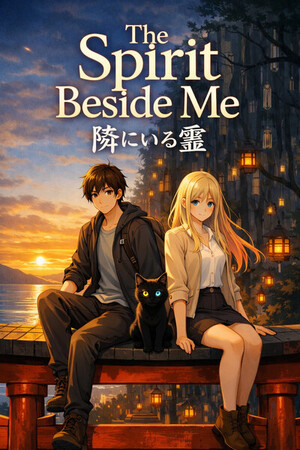
Across the street, beneath a narrow streetlamp mounted to the corner of a building, a black cat sat perfectly still.
It watched him with unnerving focus.
Ren stared back.
One eye caught the light gold.
The other a sharp, unnatural blue.
His stomach tightened before his mind caught up.
Those colors.
He had just seen them.
A prickle moved up the back of his neck.
Then someone bumped his shoulder while hurrying past, and the spell of the moment broke just enough for self-consciousness to return.
“Okay,” he muttered under his breath. “I’m either more tired than I thought, or Tokyo is trying to humble me.”
The cat rose smoothly to its feet.
A salaryman cut directly across the sidewalk in front of it without looking down once.
When Ren started walking again, it followed.
Not close enough to trip him.
Not far enough to ignore.
Just there.
He glanced back twice in the next block.
Both times the cat was behind him, stepping lightly through the city as if it had always belonged there.
He told himself not to think too hard about it.
That lasted until the smell of grilled batter and savory sauce drifted across the street and caught him mid-thought.
A takoyaki stand.
Small.
Bright.
Crowded enough to look trustworthy.
Ren slowed, looked once at the cat, and then at the vendor turning octopus-filled batter with quick practiced movements.
“Yeah,” he said quietly to himself. “I need food. That has to be it.”
He ordered a tray and took a seat on one of the narrow stools by the side of the stand.
The metal surface was still warm from the sun.
The evening air hadn’t cooled much.
It still held the day’s heat in the pavement and the walls and the glow of the signs.
The vendor, a man in his fifties with a towel slung over one shoulder, gave him a measuring glance.
“You’re not from around here.”
Ren laughed softly.
“What gave it away?”
“You walked past twice.”
“Three times,” Ren admitted.
The man snorted.
“Tourist.”
“Yeah. Caught me.”
The vendor handed him a paper boat filled with takoyaki glazed in sauce and threads of bonito flakes that shivered in the heat.
The smell hit him first.
Rich, savory, sweet, hot enough to make his stomach tighten with sudden awareness of how little he’d eaten all day.
“Your Japanese is good,” the vendor said.
Ren took the toothpick, careful not to burn himself immediately and fail at basic dignity.
“Thanks. I studied for a long time.”
“For work?”
The question was casual.
The answer wasn’t.
Ren looked down at the food, then out toward the passing crowd.
“…For someone important.”
The vendor didn’t push.
He just nodded once, the way older people sometimes did when they recognized weight in a sentence and chose not to make it heavier.
Ren took a bite and nearly burned the roof of his mouth anyway.
He hissed through his teeth.
The vendor laughed.
“It’s always too hot.”
“That’s evil,” Ren said.
“It’s tradition. Welcome to Japan.”
When Ren lowered the tray, the black cat was there again, sitting a few feet from his stool with perfect composure.
Ren stared at it.
The cat stared back.
“At this rate, you’re about to adopt me.”
The cat blinked once.
He looked around as if expecting someone to claim it.
Nobody did.
A woman with shopping bags brushed past and never looked down.
Two schoolboys cut around the stand, arguing over something on a phone screen, and one of them came close enough that he should have noticed the cat at his feet.
He didn’t.
After a moment, Ren tore off a cooler edge of batter, waited until it wasn’t steaming, and set it carefully on a napkin near the cat.
“Don’t tell anyone I’m sharing street food with a stranger.”
The cat stepped forward delicately and ate.
Ren laughed under his breath.
“Well,” he said, reaching down to scratch lightly behind one dark ear, “at least somebody’s enjoying Tokyo with me.”
The fur was softer than he expected.
The cat tolerated the touch with the quiet grace of something allowing a privilege rather than accepting affection.
Ren took another bite of takoyaki and closed his eyes for half a second.
Hikari would have loved this.
Not just the food.
The stall.
The noise.
The closeness of everybody.
The smallness of the moment in a city too large to care about any one person, and the way that somehow made it feel more precious instead of less.
He pulled the notebook from his bag again.
The page opened easily to her list.
His pen hovered for a second over the line.
Eat ramen in Tokyo
He smiled despite himself and wrote in smaller letters beside it:
Takoyaki first. Close enough.
Then he drew a careful checkmark.
The image came immediately.
Hikari sitting cross-legged on the floor of his room years ago with travel magazines spread around them, pointing at a picture of street food with theatrical seriousness.
“This,” she had said, “is the kind of thing we’re eating.”
“We?”
“Yes, we. You think I’m letting you go alone?”
“You hate crowds.”
“I hate waiting. Different problem.”
He had laughed then.
Now he only smiled and closed the notebook again with gentle care.
By the time he stood from the stool, weariness had settled into his bones with real authority.
Jet lag.
Walking all day.
Too many sights for one brain to process.
He adjusted the straps of his backpack and looked down at the cat.
“Okay,” he said. “I’m officially exhausted.”
The cat watched him.
Ren checked the route on his phone, squinted at the map, and let out a long breath.
“Hotel. Shower. Maybe sleep. No, definitely sleep.”
He started walking again.
The cat followed.
At this point, he no longer questioned it.
Night had fully fallen by the time he found the capsule hotel.
The sign glowed modestly above the entrance, more functional than flashy.
The street around it was quieter than the ones he had wandered earlier, the noise of the city softened into a distant hum.
Somewhere down the block, a bicycle bell rang once.
A cluster of cicadas rattled from a tree wedged improbably between two buildings.
Ren stopped at the curb and looked up at the building.
Not luxurious.
Not especially memorable.
But right now it looked beautiful.
“First night in Japan,” he murmured.
The words felt strange in his mouth.
Real in a way the plane and station and city hadn’t quite managed yet.
He reached into the side pocket of his backpack and touched the notebook once through the fabric.
“I made it,” he said quietly, not to the hotel, not to the city, but to someone no longer there to hear him.
Then he stepped through the automatic doors.
Outside, beneath the streetlight, the black cat sat down and watched the entrance until it closed.
One eye gleamed gold.
The other blue.
By the time Ren reached the check-in counter, exhaustion had settled into him completely.
Not the dramatic kind.
Not the kind that made him stumble or sway.
Just the deep, creeping weight of a day that had been too long, too full, and far too new.
His shoulders ached from carrying the backpack.
His legs were beginning to feel hollow.
Even his thoughts had started to slow down, as if his brain had finally looked at everything Tokyo had thrown at it and said, That’s enough for one day.
Inside, the lobby was spotless.
A compact front desk.
Rows of lockers.
Shelves lined with slippers.
Everything arranged with such neat precision that Ren immediately felt like he was one wrong move away from violating some unspoken rule of Japanese hotel etiquette.
He checked in carefully, doing his best to follow the clerk’s instructions without looking like he needed every step translated into a survival guide.
Shoes off.
Slippers on.
Backpack stored.
Key received.
Bow politely.
Try not to look like a confused raccoon in human clothing.
The clerk bowed.
Ren bowed back.
The clerk bowed again.
Ren nearly bowed a third time before catching himself and retreating down the hall with what little dignity he had left.
The capsule corridor was dimly lit and quieter than the lobby.
Pods lined the walls in stacked rows, each one like a little cocoon tucked into place.
Some curtains were already drawn shut.
Soft lights glowed behind others.
Ren stopped and looked up at them.
He was too tired to be impressed properly, but some part of him still managed it.
“Okay,” he whispered to himself. “This is actually kind of awesome.”
He checked the number on his key.
Found the matching capsule.
Climbed the small ladder.
By the time he reached the top, sleep felt so close he could practically lean into it.
He slid the curtain open, already imagining the relief of finally collapsing into stillness.
Then stopped.
There was a girl in his capsule.
Ren’s brain, worn down by jet lag and confusion and one too many impossible things in a single day, failed to react for a full second.
She was sitting inside like she belonged there.
Long blonde hair catching the soft capsule light.
Stylish clothes.
One bag beside her.
She looked up at the exact same moment he did.
Their eyes met.
Her expression shifted from confusion to horror.
She screamed.
Ren jerked back so hard he nearly slipped off the ladder.
“Oh, crap.”



Please sign in to leave a comment.