Chapter 0:
Prologue
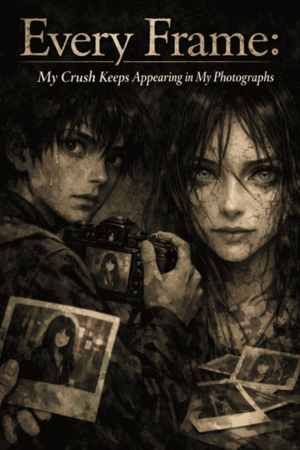
Every Frame: My Crush Keeps Appearing In My Photographs
His wife had once said that this was the sort of thing old men did after retirement, not the sort of thing men in their thirties did before breakfast on a Tuesday. He remembered that because she had laughed when she said it, and because he had not laughed back. Even then, three years before she left, he had already begun to feel the thinness in ordinary life -- the places where the day did not seem properly attached to itself, where one hour slid against the next without friction. Photography had become, in those years, less a hobby than a way of pinning things down. If he photographed the vending machine outside the shuttered tobacco shop, then the vending machine had been there. If he photographed the bridge in the noon light, then the bridge had held the noon light exactly once and not some vaguer, less trustworthy thing his mind might later turn it into.
That was how he explained it when people asked.
The truer answer was that he had begun to distrust looking at things without something between them and himself.
He left Tokyo at 4:17 a.m. in his cream-colored Corolla with three lenses in a padded bag, two rolls of Fuji Superia 400, a thermos of coffee already cooling, and a road atlas with a page corner folded over a town name he had seen once in a magazine and then again, weeks later, on the back of a milk carton in a different context entirely. The repetition had bothered him. He was not a superstitious man, but he had started to feel that places sometimes wanted to be noticed, and that it was impolite to refuse.
The town was called Natsume.
He arrived a little after eight. It was smaller than the map had made it seem. One main road, a narrow shopping street with most shutters down, a primary school on the hill, and beyond that a river with a concrete embankment too broad for the amount of water it held. The station was unmanned. A local election poster board stood near the exit with only half its spaces filled. Several of the candidate photographs had faded so badly that the eyes looked bleached out, as though whoever had printed them had forgotten that eyes needed darkness to mean anything.
Hiroshi parked near the river and took the Nikon out of its case. It was already warm in his hands from the car. He liked the first minute after lifting a camera -- the settling of the strap on the back of his neck, the adjustment of weight, the little pressure in his chest that came from no longer needing to decide whether he was going to take a picture. Once the camera was in his hands, the day had already chosen its shape.
He spent the morning walking.
He photographed a barber pole frozen in place behind dusty glass. A row of potted hydrangeas gone blue with the season. A deflated soccer ball trapped in weeds beside the school fence. The river, then the river again from lower down, then the river once more through the rusted frame of a bicycle basket. He took pictures in clusters, then long gaps, then clusters again. Now and then he wrote down frame numbers in his notebook beside single words: bridge, shrine path, empty lot, red mailbox leaning left.
At 10:42 he bought canned coffee from a machine under a persimmon tree and drank it in the shade of a warehouse whose corrugated siding had been eaten through with rust. That was when he saw the first strange thing, though he did not understand it at the time.
Across the road, in the second-floor window of a boarding house with lace curtains, someone was standing behind the glass.
Not standing, exactly. The impression was of a figure that had already been there when he looked and had no interest in whether he went on looking. A young woman, maybe. Dark hair. No movement.
He raised the camera, mostly because the scene was balanced nicely -- the warehouse in shadow, the bright road, the upper window floating above them -- and took the shot.
By the time he lowered the camera, the window was empty.
That meant nothing. People stepped back from windows all the time. He drank the rest of the coffee, crushed the can, and crossed the road to get a closer shot of the building. He photographed the entrance, the mailboxes, the yellowing notice taped crookedly beside the door. The building had a nameplate: Mizuki House. One of the mailboxes had no surname at all, only a strip of white tape gone gray at the edges.
He noticed then that the second-floor curtain moved not with the breeze, but against it.
He took another shot.
At noon he ate soba in a place near the station where the owner never once asked where he was from, as if strangers passed through often enough not to be remarked upon. The television above the refrigerator showed a daytime talk program with the volume turned low. Twice, while he ate, Hiroshi had the sharp and ridiculous feeling that someone had entered the shop and stopped behind him. Both times he turned, and there was no one there except a rack of weekly magazines and a hand-painted sign asking customers not to leave umbrellas unattended.
He left a little after one and walked uphill toward the primary school.
The town looked flatter in the heat. Sound thinned out. The white lines on the road had softened at the edges. Somewhere nearby a radio was playing enka so quietly that it felt less like music than memory leaking through a wall. Hiroshi photographed the school gate, the padlocked equipment shed, and the line of children’s sun hats hanging from hooks just inside a classroom window. In one classroom, paper windmills had been taped in a row along the sill. They did not move.
He stood there for perhaps fifteen seconds before understanding what was wrong.
Every windmill in the row faced inward.
Not angled that way. Not caught halfway in some random turn. They all pointed into the room as if responding to a breeze that came from somewhere inside the building.
He wrote down the frame number and did not write a word beside it.
From the school he followed a narrow lane up to a small shrine. It was the kind of place that existed in many towns and was rarely used except at New Year’s: stone foxes darkened by rain, a rope bell, a box for donations with the wood splitting slightly around the corners. Cicadas had begun in earnest by then, a wall of sound so complete that when it paused all at once he felt, absurdly, as if the air itself had stopped.
He looked around. The cicadas resumed.
There were ema tablets hanging beneath the eaves, old enough that many of the prayers had faded. Hiroshi did what he often did in such places and began reading.
Good health for Mother.
Please let me pass the high school entrance exam.
Find my cat, Mimi.
Let him come home safely.
The handwriting changed from plaque to plaque, but after a while he noticed a single phrase recurring on several of them.
Not identical, not copied, but near enough.
Please let her stop looking at me.
Please let that girl go away.
I don’t want to see her in the pictures anymore.
He read the last one twice.
The wood was older than the others, split at one corner, the brushstrokes faded almost to dust. There was no date on the front, so he turned it carefully and found one on the back written in smaller hand.
1987.
He did not photograph the tablet immediately. Instead he stood under the eaves listening to the cicadas and to the tiny hard tapping of one loose plaque against another in the heat. The phrase itself was not impossible. A town had children, children played pranks, someone had probably written it as a joke. But he had spent enough time in enough small places to know the difference between the way people wrote jokes and the way they wrote around things they did not want to name directly.
He took two photographs of the plaques, one wide and one close.
As he lowered the camera, he became aware of a person standing at the foot of the shrine steps.
A girl.
No--young woman. Not local schoolgirl young, not office worker old, somewhere in the unstable middle where age depended on the distance from which you observed it. Dark hair hanging loose. Pale top, dark skirt. She was not looking up at the shrine. She was looking directly at him.
Not with surprise. Not even with curiosity.
It was the fixed, level look of someone who had arrived exactly where she meant to arrive and was waiting, with perfect patience, for someone else to understand that.
Hiroshi did not feel fear then. What he felt was a strange and immediate embarrassment, as though he had been caught reading a private letter.
He lifted the camera almost apologetically.
When he looked through the viewfinder, there was no one at the foot of the steps.
He lowered the camera. She was there.
He raised it again. Empty steps, bright stone, green on either side.
Lowered it. She was there.
He did it three times before his hands began to shake enough to blur the image.
He took the picture anyway.
Afterward, he could not have said why he went down the steps toward her. There are moments in which the body chooses before the mind catches up, and later one must pretend the two moved together. He descended slowly, the camera hanging against his chest, aware of the blood moving in the base of his throat.
At the bottom there was no one there.
The lane stretched empty in both directions. A dog barked behind a house. Somewhere a screen door slapped shut. The afternoon was ordinary again in the way ordinary things become unbearable once they have briefly ceased to be.
Hiroshi told himself he was overheated.
He stayed in Natsume until evening anyway. That was perhaps the most unreasonable part. He walked the river again, photographed the station from the opposite side, and took one final roll around the shopping street as the shadows lengthened. In the window of the boarding house he again thought he saw movement. In the reflection of a fish shop’s metal shutter he thought, for half a second, that someone stood just behind him. He did not turn quickly enough. Once, while photographing a row of bicycles outside the clinic, he had the distinct feeling that every visible face in the street had angled away a fraction too soon, like flowers following a light he could not see.
He drove home in darkness with all the car windows closed despite the heat.
That night he did not develop the film. He left the bag on the kitchen floor and sat on the edge of the bed without taking off his shoes. His wife asked, from the bathroom where she was brushing her teeth, whether he had gotten anything good. He said, “Maybe,” and heard in his own voice something flat and unfamiliar. She came out, looked at him, and asked if he was all right.
He nearly said yes.
Instead he asked, “If someone were in the background of a photograph, and no one had noticed them when the picture was taken… would that mean anything to you?”
His wife frowned. “Like a ghost?”
“No,” he said too quickly. “Not a ghost.”
She studied him for a second longer in the doorway mirror. “It would mean you missed someone.”
He slept badly and woke before dawn with the image of the girl at the shrine steps fixed behind his eyes--not her face, exactly, but the quality of her attention, the humiliating certainty of it.
He called in sick to work and developed the rolls in his bathroom with the extractor fan on and both windows shut.
The first strip came up normal.
River. Warehouse. Vending machine. Boarding house.
In the upper window of the boarding house, just visible behind lace curtain, the shape of a woman looking out.
He clipped the negative to dry and reached for the second strip.
School gate. Children’s hats. Classroom window.
The windmills all pointed inward.
Third strip.
Shrine path. Fox statue. Ema plaques.
He held the wet negative nearer the light.
At the foot of the steps, exactly where he had seen her standing, was the dark vertical figure of a girl. Not blurred. Not partial. Not caught in movement.
Looking directly into the lens.
Hiroshi set the strip down very carefully in the sink. His fingers had begun to prickle with cold though the room was hot enough to sweat in. He waited until the dizziness passed and then lifted the negative again.
The frame after that was the one he had taken when he looked through the viewfinder and seen nothing.
Empty steps. Empty lane. No figure.
The frame after that:
the bicycles outside the clinic.
Three women in conversation, one man unlocking his car, a child with a balloon.
Every one of them turned away from the camera.
Not one face visible.
The last strip was from the shopping street at dusk. He did not need to hold it to the light to feel something wrong in it. The wrongness was in the arrangement before it was in the content, in the way the eye slid across the figures and found no return.
Storefront. Shutter. Public phone. Two pensioners at a crossing.
All turned away.
Next frame. Fruit stand. Taxi pulling past. A boy running with a plastic bag.
All turned away.
Final frame. The station platform through chain-link fence.
No train. No passengers. No stationmaster.
Only, at the far end of the platform beneath the timetable board, the girl.
Closer than before.
Looking straight at him.
Something occurred to Hiroshi then that was so simple he felt stupid for not having seen it sooner, and so complete that once it arrived there was no room left in him for anything else.
The girl was not appearing in the photographs.
She was where the photographs were looking from.
He stood unmoving in the bathroom while the fan rattled overhead and the strips dripped chemical water into the sink in slow, regular taps. After a while he became aware that he was staring not at the negative in his hand but at the mirror above the sink.
In the mirror he saw himself: shirt wrinkled, hair damp at the temples, one sleeve rolled higher than the other. Behind him, the bathroom door stood open to the hallway.
For a long time nothing moved.
Then, in the mirror only, at the edge of the hallway where the light did not fully reach, a shape darkened as if someone had stepped into frame and stopped there.
Hiroshi did not turn around.
He stood very still, looking at the mirror, and understood with a clarity so sudden it felt almost merciful that if he turned and there was no one there, the fear would remain his own.
If he turned and there was someone there, it would belong to her.
The fan rattled on.
The strips kept dripping.
At some point, in the apartment next door, a telephone began to ring.
He closed his eyes.
When he opened them, the hallway in the mirror was empty.
He left the negatives hanging and went into the kitchen and sat at the table until his wife came home at six and found him there in the same position, his hands dry and smelling faintly of fixer.
“What happened?” she asked.
Hiroshi looked at her, trying to answer honestly.
In the end, the only thing he could say was, “I think I photographed the wrong side.”








Please sign in to leave a comment.