Chapter 1:
The promise
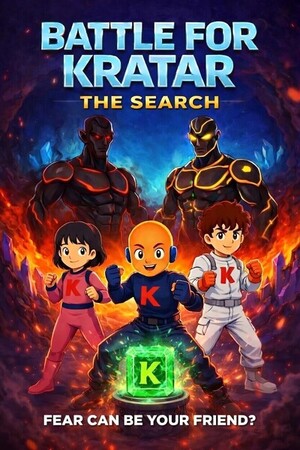
Battle for kratar in search of the kratar
CHAPTER 1 — The Promise
Year 2097. The farm.
The farm did not appear on any map.
It was too small for anyone to bother looking for it. A square of cultivated land surrounded by open fields, with a wooden house at the center that smelled of damp earth, old wood, and something indefinable that Marek, at seven years old, had no word for—but recognized as the smell of mornings here.
That afternoon was orange and calm. The sun sank slowly over the crops as if it had nowhere else to be. Marek watered the plants with a watering can too big for his arms, focused, his tongue slightly sticking out between his teeth whenever he tried not to spill water outside the furrow.
A few meters away, Joe watched him from the porch’s shade.
He said nothing. Did nothing. Just watched, his wrinkled hands resting on his knees, with that expression Marek had learned to recognize without fully understanding. It wasn’t exactly pride. It was something quieter than that. Something closer to the satisfaction of someone watching something grow, knowing he didn’t have to do anything for it to keep growing.
Marek looked up and saw him.
His brown eyes lit up.
He set the watering can down and ran toward him with the particular clumsiness of seven-year-olds who still haven’t quite figured out how to coordinate their legs when they’re in a hurry.
“Grandpa,” he said, breathing fast. “I’m going to make you a promise.”
Joe looked at him.
“Are you?”
Marek nodded with a seriousness that didn’t quite match his size.
“I promise that this farm—and you—will be protected by me.” He paused, searching for the words. “I won’t be afraid of anything.”
The old man stayed silent for a moment.
“Not being afraid of anything is a big promise,” he said.
“I know,” Marek replied. “But I’m going to keep it anyway.”
Joe looked at him for a moment. Then he leaned forward. Not to hug him. For something smaller, more ordinary—more like them.
“Come,” he said.
He led him to the barn. Marek followed without asking, his bare feet against the cool evening dirt.
Inside, it smelled of hay and animals that weren’t there—because Joe hadn’t had animals for years. The barn was empty except for tools hanging on the wall and a wooden bench against the back.
Joe sat down. Marek sat beside him.
The old man didn’t speak right away. He picked up a branch from the ground—one of those that fall from old trees when the wind blows hard—and held it in his wrinkled hands.
“See this?” he said.
“A branch,” Marek answered.
“Yes.” Joe turned it between his fingers. “It’s a branch. It can be many things. It can be firewood. It can be a stick to hit something. It can be a tool to reach something that’s out of your reach.”
Marek looked at him, confused.
“It depends on what you decide to do with it,” Joe continued. “The branch doesn’t change. What changes is how you use it.”
He pulled a match from his overalls pocket. Struck it against the bench. A small orange flame appeared between his fingers, trembling in the still air of the barn.
He brought the flame to the branch.
Marek held his breath.
The branch didn’t catch fire immediately. The flame danced along the dry bark, searching for the spots most willing to burn. Then, slowly, a small flame began to grow at the tip.
Joe held it between them.
The orange light filled the empty barn with shadows that moved along the walls like living things.
“Fire,” Joe said in a low voice, “can warm you on a cold night. It can cook what you eat. It can light your path when you can’t see where you’re going.”
He set the branch on the dirt floor between them. The flame kept burning—smaller now, but steady.
“It can also burn your house down,” Joe continued. “It can burn an entire forest if it gets out of control. It can cause damage that cannot be undone.”
Marek watched the flame.
“So is fire good or bad?” he asked.
Joe didn’t answer immediately.
“It depends,” he said at last.
“On what?”
“On whether you control it,” Joe said, “or it controls you.”
He crushed the flame with his foot. A dull thud, a bit of smoke, and the branch lay charred on the barn floor.
Marek stared at it for a moment.
“Fear is like fire,” Joe said in that same calm voice. “If you let it grow out of control, it will reduce you to ashes. But if you learn to contain it… it will be the fire that gives you strength to walk in the dark.”
He didn’t say it like a speech. He said it like someone commenting on the weather. Like pointing out a plant that had grown since the last time you saw it. Like something he had known long before Marek was born.
Marek looked at the burned branch.
“How do you learn to control it?” he asked.
Joe stood up and extended his hand.
“By practicing,” he said.
Marek took his hand and stood.
“Not being afraid of anything,” Joe said as they walked out of the barn, “is not bravery. It’s not understanding what you’re facing. Bravery is being afraid—and acting anyway.”
“Are you afraid?” Marek asked.
Joe stopped at the barn door.
He looked at the orange horizon. The crops swaying in the wind. The wooden house with the kitchen light on.
“Yes,” he said.
“Of what?”
Joe took a moment.
“That this world isn’t as good as it should be,” he said quietly. “That people who have nothing will take from those who have even less.”
Marek looked at him.
“I won’t let that happen,” he said.
Joe looked at him.
With the same eyes as always. Attentive. Warm. Carrying the weight of someone who has lived long enough to know that a promise made at seven is fragile—and beautiful precisely because it is fragile.
“I know,” he said.
And said nothing more.
Three days later.
Marek was in the chicken coop when they arrived.
He didn’t see them enter. He heard the clucking first—that specific sound chickens make when something isn’t right, when the space they know is filled with something that shouldn’t be there. He dropped the watering can. Ran.
Three men were inside the coop.
They didn’t look like thieves. They looked like people who did this because it’s what you do when you don’t have enough. One of them was putting eggs into a sack with the indifference of someone handling routine work. The other two stood watch, bored, as if this were just another task before the one that actually mattered.
Marek stopped at the entrance.
His fists clenched.
He remembered the promise.
“Leave them!” he shouted. His voice came out higher than he wanted—but it came out. “This is our farm!”
The three men looked at him.
The tallest one—the one with the sack—looked down at the seven-year-old boy standing in the doorway with clenched fists and eyes shining with something that wasn’t fear yet. It was something before fear. The impulse to act before fear has time to arrive.
He smiled.
Not cruelly. With the indifference of someone who doesn’t consider the other a real threat.
The kick came without warning.
Straight to the stomach.
Marek was thrown backward and hit the ground hard, folding over himself, hands clutching his abdomen, all the air knocked out of his lungs.
The three men walked out without hurrying.
Their footsteps on the dirt sounded normal. Calm. As if nothing important had happened.
Marek heard their laughter fading away.
He stayed on the ground.
First because his body wouldn’t respond.
Then because something heavier than physical pain kept him there.
The words came back on their own.
I won’t be afraid of anything.
He had said them three days earlier with total conviction.
Now he was on the ground of his own chicken coop.
With his stomach burning.
And the eggs he had promised to protect leaving in someone else’s sack.
The tears came without calling them.
First from the pain.
Then from something that hurt more than the pain.
Helplessness has a specific taste.
Marek didn’t have words for it at seven years old.
But he recognized it immediately as something he never wanted to feel again.
He stood up with difficulty.
Walked to the big tree beside the coop.
He didn’t think about what he did next.
His hand closed into a fist.
And he struck.
The tree split from the base with a loud, sharp crack. Its upper branches fell to one side, raising a cloud of dust and leaves. The ground trembled slightly beneath his feet.
Marek stepped back.
Looked at his hand.
His knuckles weren’t bleeding.
They didn’t hurt.
But his palm was glowing.
A small, trembling yellow energy pulsed around his fingers like something alive that had just awakened without knowing where it was.
Marek’s eyes widened.
The fear that came then was different from the one he felt toward the men.
Deeper. More intimate.
The fear of someone realizing they don’t know themselves as well as they thought.
The energy grew.
Without his control.
Without him knowing how to stop it.
Instinctively, he raised his hand.
A yellow flash shot across the sky like an inverted lightning bolt and vanished into the clouds with an echo that rumbled over the empty fields.
Silence.
Marek slowly lowered his hand.
The energy was gone.
His breathing was uneven. His legs trembled slightly.
He sat down in the old wooden chair beside the coop.
The one Joe had placed there years ago.
He stayed still.
He didn’t cry.
The crying had passed.
What remained was heavier.
The awareness that something inside him didn’t work the way it should—or worked too well—and that he didn’t know what to do with it.
The sound of boots on dirt announced him.
Joe appeared behind the farm.
He saw the broken tree.
Saw Marek in the chair.
Saw his hands.
He didn’t ask about the tree.
He sat beside him on the ground—not on the chair—as if he knew this moment required being lower.
“What happened?” he asked.
Marek didn’t answer immediately.
“Some thieves,” he said finally. “They went into the coop.”
“Did they hurt you?” Joe asked.
“They kicked me,” Marek said. “I tried to stop them. I failed.”
Joe said nothing. He waited.
“I promised you I’d protect the farm,” Marek continued, his voice smaller now. “And I couldn’t do anything.”
“You weren’t supposed to be able to,” Joe said.
Marek looked at him.
“You’re seven,” Joe said. “They’re three grown men. There was nothing you could do.”
“But I promised—”
“A promise isn’t a magical contract,” Joe said. “It’s a direction. An intention. Something you choose to do with what you have at the moment you make it.”
Pause.
“Today, you didn’t have what you needed to keep it,” he continued. “That doesn’t mean the promise has no value. It means you need time to gain what you lack.”
Marek looked at his hands.
“And what if I never get it?”
Joe looked at him.
“Are you going to be seven forever?” he said.
Marek blinked.
“One day you’ll be older,” Joe said. “Stronger. You’ll understand more. And that day, you’ll be able to do what you couldn’t today.”
“And what if I fail that day too?”
Joe smiled slightly.
“Then you’ll have another day after that. And another after that. At some point, you’ll realize it’s not about never failing. It’s about getting back up as many times as it takes.”
Marek didn’t reply.
But something in his posture changed.
He looked at his hands again.
The same hands that had split a tree.
The same hands that had sent a flash into the sky.
He made two decisions in silence.
The first: he wouldn’t tell Joe about the yellow flash. Not yet. Not until he understood what it was.
The second: he would learn to control it.
Alone.
In secret.
For as long as it took.
Joe stood up.
Extended his hand.
“Come,” he said. “Let’s see which chickens still have eggs.”
Marek took his hand.
Stood up.
And that night, while Joe slept, Marek looked at the sky from his window.
The stars were where they had always been.
Still.
Unaware that one of their own was looking up at them from below, at seven years old, with a broken promise and something yellow sleeping in his palms.
But this time, he didn’t feel only the shame of failing.
He also felt the certainty that one day, he wouldn’t fail.
And that certainty, he thought, was what Joe meant by the fire that lights instead of burns.
He closed his hand over his empty palm.
The heat didn’t return.
But he knew it was there.
END OF CHAPTER 1




Please sign in to leave a comment.