Chapter 4:
Beetween rest and memory
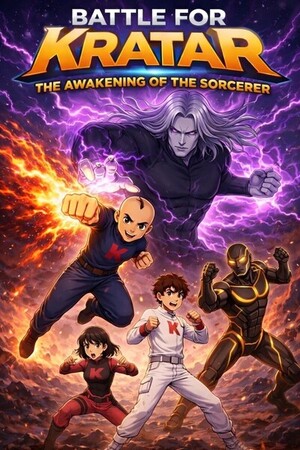
Battle for kratar the awekening of the sorcerer
Chapter 4 — Between Rest and Memory
Year 2113. Zekra.
Zekra's purple sky had that particular quality of late afternoons when the turquoise mists moved slowly and the sunlight came filtered and soft, without the direct intensity of noon.
It was the kind of afternoon made for doing nothing important.
The four of them had decided to take advantage of it.
The game had been Arlo's idea.
As always.
It was called Impact. Or at least that's what Arlo had named it—he had a habit of naming everything he invented, as if naming were part of creating it.
The rules were simple in theory.
Each player had five flat stones from the river that crossed Zarpon's palace gardens. The goal was to throw them toward a row of targets—six wooden blocks of different sizes placed at varying distances—and accumulate points based on the size of the target hit. The smallest was worth five points. The largest was worth one.
Arlo's twist was this.
If your stone hit another player's stone in mid-air before reaching the target, that player lost all their accumulated points for that turn.
"That's not a game," Marek had said when Arlo explained the rules. "That's an ambush with scoring."
"It's strategy with dynamic elements," Arlo replied.
"It's the same thing."
"It's not the same thing."
Sira had already picked up her five stones from the ground.
"Are we starting or are we continuing the seminar?"
They started.
Zarpon threw first.
With his usual calm precision. His stone crossed the air in a clean trajectory and hit the second smallest block with a dry thud.
Three points.
"Nice," Arlo said with the tone of someone taking a mental note.
Zarpon looked at him.
"Nice?"
"Predictable," Arlo corrected. "But nice."
Zarpon raised an eyebrow.
Arlo threw his with a technique he had clearly practiced. Low trajectory. Calculated angle. The stone bounced off the ground before the target and hit the smallest one from below.
Five points.
"That can't be legal," Marek said.
"The rules don't specify direct trajectory," Arlo replied.
"You wrote the rules."
"Exactly. And they don't specify direct trajectory."
Marek looked at Sira.
Sira was looking at Arlo with the expression of someone who had already decided the best response was not to respond. She threw her stone with a precision that hit the smallest target cleanly.
Five points.
"That is legal," Marek said.
"Everything is legal," Arlo said.
Marek threw.
Too hard, as always at the beginning. The stone sailed past all the targets and landed in the grass behind them.
Silence.
"I was calibrating," Marek said.
"Of course," Arlo said.
"The next one will be different."
"Sure."
Zarpon almost smiled.
---
By the third round, the game had become something else.
Arlo had started intercepting stones in mid-air with his own—which was technically the variation he himself had invented, but when it actually happened in practice, it produced reactions the written rules hadn't fully anticipated.
Marek had developed a low, fast throwing strategy that was hard to intercept but sacrificed accuracy on the targets.
Sira simply continued being precise.
With a consistency that didn't draw attention because she did nothing flashy. She just placed each stone exactly where she wanted it and accumulated points with the patience of someone who understands that long games are won by the one who makes fewer mistakes, not the one who makes the flashiest plays.
"Sira is winning," Marek said in the fourth round.
"I know," Arlo said.
"And?"
"And I'm processing."
"You've been processing for three rounds."
"Complex problems take time."
"It's a game of stones, Arlo."
"It's a dynamic system with interdependent variables."
Zarpon threw his stone calmly.
It hit the smallest target.
Five points.
The other three looked at him.
"Since when?" Marek said.
"Third round," Zarpon said without particular expression. "I changed my angle."
Arlo looked at him for a second with the expression of someone recalibrating an evaluation.
"Predictable," he murmured.
"You said that before," Zarpon replied.
"This time I mean it differently."
---
The game ended with Sira winning by eight points over Zarpon, eleven over Arlo, and seventeen over Marek.
They sat down in the palace garden grass.
The purple sky above them. The turquoise mists moving slowly. The lights of Zekra city turning on one by one with the sunset in the distance.
Arlo was mentally reviewing the rules for the next version of the game. It showed in the way he looked at the ground without really seeing it.
Marek had his elbows on his knees, watching the horizon.
Zarpon rested with his arms crossed, eyes on the sky.
Sira looked at the stones still in her hand. She turned them slowly between her fingers.
The silence came naturally. Not because no one had anything to say, but because the kind of afternoon it was didn't demand that anyone say anything.
It was Marek who spoke first.
Without thinking too much. With the calm voice of someone saying aloud what he had been thinking in silence for a while.
"Sometimes I wish evil didn't exist."
No one answered immediately.
Arlo stopped looking at the ground.
Sira stopped turning the stones.
Zarpon didn't move, but something in his posture shifted slightly.
"Germon," Sira said. Not as a question.
"And Gravar," Marek said. "And everything that happened between them."
The garden fell silent for a moment.
Memories came without anyone summoning them.
Sira thought of the pale plain on the nameless planet. Of the crimson collapsing inward. Of the small, clean crater where two people had been and then there was nothing. She thought of her arms that hadn't found their usual position after the explosion and had simply hung at her sides because there was no right way to hold them in that moment.
Arlo thought of the bomb's mechanism. Of his hands inside something with no documentation or precedent. Of the three minutes where everything depended on a hypothesis he couldn't confirm before executing it. He thought that Sira had seen what he hadn't seen, and that without that one correct question, everything would have ended differently.
Zarpon thought of Gravar saying "this time I choose it myself" in a voice that wasn't surrender. Of the moment at the crater's edge where he had closed his eyes for a second—just a second—and then opened them because there were things to do and people watching and the weight didn't disappear by staying still.
Marek thought of Germon.
In the cell. Of the question Gravar had asked him. "Are you choosing this, or is the weight you carry choosing it?" Of the light-blue eyes of a man who had spent forty years being the smartest person in any room and who at the end had said "no. Not completely" with the most honest voice he'd had in his entire life.
"Germon built everything he wanted to build," Marek said. "He calculated everything. Controlled everything. And in the end, anyway…"
He didn't finish the sentence.
He didn't need to.
"He was unhappy," Sira said quietly. "I don't think he knew it. But he was."
"He knew it," Zarpon said.
The other three looked at him.
The Zekran still had his eyes on the sky.
"Gravar's question made him hesitate," Zarpon continued. "And no one hesitates about something they don't recognize as true somewhere inside."
Silence.
"I wish all of that hadn't had to happen," Arlo said. "I wish Germon had been different from the start. I wish Gravar hadn't had to choose what he chose."
"I wish evil didn't exist," Marek repeated.
The words hung in the air over Zekra's garden with all their real weight.
No one refuted them.
Because it was an honest wish, and honest wishes don't need refutation.
But Marek thought of Joe.
Of the orchard. Of the wrinkled hands working the earth. Of the old man's calm voice telling him something that had sounded simple at first and that the more time passed, the more layers it had.
"Evil and good need each other. Like fire and firefighters. Like heat and cold. Like the strong and the weak."
"My grandfather told me something," Marek said.
The other three looked at him.
"That evil and good can't exist without each other." He paused. "That it's not an injustice of the universe. It's just how everything that matters works."
Sira looked at him.
"And is that enough for you?" she said.
Marek thought about the honest answer.
"No," he said. "It's not enough. I still wish it were different."
A pause.
"But it helps me understand why it isn't. And understanding something doesn't make it disappear... but it changes how you carry it."
The garden fell silent.
Zarpon watched Zekra's horizon with the city lights turning on one by one in the distance. Buildings that hadn't existed eleven years ago. Streets that smelled like home.
"Gravar understood it," he said quietly. "That evil existed. That good existed. And he still chose."
"Without hesitation," Sira said.
"Without hesitation," Zarpon confirmed.
Marek looked at his hands.
The same as always. With the marks of training and farm work and everything that had happened in recent years layered on top in ways he could no longer distinguish.
"You decide who you are. Not with your words. With your choices."
"I think," he said finally, "that the only thing we can do is what Gravar did."
The other three looked at him.
"Know that evil exists," Marek continued. "Know that good exists. And choose. Every day. With every decision."
No one answered immediately.
Arlo looked at the purple sky.
"That sounds harder than beating Garpon," he said.
"It is," Marek said.
"And is it worth it?"
Marek thought of Joe on the porch. Of Gravar on the plain. Of Germon's face saying "no. Not completely" for the first time in forty years.
"Yes," he said. "It's worth it."
Zekra's garden remained exactly what it was.
Purple and turquoise and peaceful.
With four people sitting in the grass who had seen enough to have plenty of reasons for cynicism and who still kept choosing something else.
One decision at a time.
END OF CHAPTER 4



Please sign in to leave a comment.