Chapter 6:
What They Heard
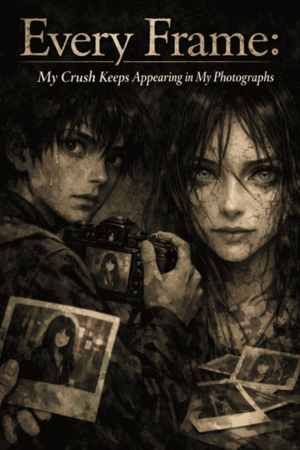
Every Frame: My Crush Keeps Appearing In My Photographs
They did not speak properly until they were outside the cemetery gates.
That was not because there was nothing to say.
It was because once they crossed back into the city, words had to be chosen again, and all three of them seemed to understand that whatever had happened inside the cemetery had not yet decided what shape it wanted in language.
The walk to the station felt longer than it had on the way there.
Yuto no longer joked. That, more than anything, made the evening feel wrong in a lasting way. He walked half a step behind at first, then half a step ahead, as if he could not settle on the right position in relation to the other two. Now and then he looked over his shoulder without trying to hide it.
Reina kept one hand in the pocket of her coat and the other around the voice recorder, though none of them had remembered to use it after the laughter. Her face had gone very still, the stillness she wore when trying not to turn one clear feeling into several worse ones.
Makoto had the camera strap looped twice around his wrist.
He had done that without thinking.
By the time they reached the platform, full night had settled. Fluorescent light made everyone look flatter and less attached to themselves. Commuters stood in neat exhausted lines near the edge. A student in another university’s jacket was asleep against a pillar with his backpack between his shoes. Somewhere farther down the platform, somebody was playing a game on their phone with the volume too low to be useful and too loud to ignore.
They did not board the first train.
Reina was the one who made that decision. She looked at the car doors when they opened, then at the crowd inside, then said, very quietly, “Not this one.”
No one argued.
The doors shut. The train left. The platform exhaled around the space it had taken with it.
Yuto sat down first on a cold metal bench and scrubbed both hands over his face.
“All right,” he said, not looking at either of them. “I think we need to say the obvious things before the stupid ones.”
Makoto remained standing. Reina sat beside Yuto but turned slightly so she could see both him and the dark tracks.
“Say them,” she said.
Yuto swallowed once.
“I heard my name. No joke. No confusion. I heard my name from behind me and neither of you said it.”
He looked up at them finally.
“And then all three of us heard that laugh. If either of you is about to suggest stress or acoustics, please do it carefully so I can decide whether to be offended or relieved.”
Makoto lowered his eyes to the notebook in his hand.
The page with the new entries looked uglier than the old ones.
Frame 6. Yuto heard name called. Neither of us spoke.
Frame 7 retaken. All three heard female laughter. Source unseen.
His handwriting had gone tighter. Harder. The letters leaned forward as though bracing against something.
“I’m not suggesting acoustics,” he said.
Reina let out a slow breath.
“Neither am I.”
There it was.
The first plain admission.
Yuto leaned back against the bench and stared up at the station ceiling. “Good. Terrible, but good. I didn’t want to be the only one who crossed into bad fiction.”
Reina turned the recorder over once in her hand, then tucked it into her bag.
“How did it feel to you?” she asked him.
He gave a short laugh with no amusement in it. “That’s a strange question.”
“Yes. Answer it anyway.”
Yuto thought for a moment.
“Like certainty without context,” he said at last. “Not like I imagined it. Not like I thought maybe somebody said my name. More like my body knew before my head did that it was my name and that I was supposed to turn around. That’s the part I hate.”
Makoto looked at him.
Yuto noticed. “What?”
“That’s close to how it felt to me too.”
“The laugh?”
Makoto nodded.
“Not loud. Not dramatic. Just already near enough to belong to us by the time we heard it.”
Reina’s eyes had gone distant in that inward way they did when she was trying to pin an impression before it dissolved.
“I thought it sounded happy,” she said.
Both boys looked at her.
She frowned slightly. “Not kind. That’s not what I mean. But it didn’t sound threatening either. That’s what bothered me. If something had screamed or whispered or done anything obvious, I would know where to put it. That laugh sounded private. Like we walked into the edge of a moment that had already started without us.”
The platform speaker crackled overhead with the warning for the next arriving train. All three of them flinched almost invisibly.
Yuto muttered, “I hate that you said it like that because now it sounds worse.”
Makoto finally sat down opposite them on the bench across the platform pillar. He set the notebook on his knee.
“There was something else,” he said.
Reina looked at him immediately. “What?”
“After the laugh. Near the stone on the edge of the path. I thought I saw something move back out of sight.”
Yuto sat forward. “You didn’t say that.”
“Because by the time you both looked, nothing was there.”
Reina was quiet a moment.
“Did it look like a person?”
“I don’t know.”
“That means no.”
Makoto shook his head. “It means I don’t know.”
That silenced the three of them again.
The next train arrived. They boarded this one because not boarding it would have turned the platform itself into part of the problem. Yuto stood by the door. Reina sat, bag in her lap, eyes on the dark window where their reflections floated over the city lights. Makoto remained standing near the opposite pole and watched those reflections too.
He had never liked photographing people.
The thought came to him without warning.
Not because of anything they had just said. Because Reina’s face in the train window looked doubled, half over the city and half in it, and the sight of her reflection made something old move in him. The old discomfort. The old refusal.
He always took pictures without human figures if he could help it.
People had commented on that often enough over the years.
Yuto called it his monk period once. Reina, less lazily, had said his images were all waiting rooms after the person who mattered had already left. Shinohara said only that if Makoto wanted to make the world hold still, he should at least learn to admit that was what he wanted.
Makoto had never answered any of them.
He did not answer the thought now either. He let it pass and fixed his eyes on the dark outside until the train carried them back into the city.
They got off two stops before campus and went to a coffee shop that stayed open late for students who mistook overhead light for endurance. It was mostly empty. A man in a suit asleep over a laptop. Two girls sharing fries and a single textbook. One barista who looked as though no one alive could surprise him anymore.
They took the back table.
Makoto laid out the contact sheet from yesterday and the roll he had just shot. He would not develop the new roll tonight. That decision had already hardened in him by the time the train left the station. He did not want the first sight of those images to happen in solitude.
Reina noticed the hesitation before he voiced it.
“Tomorrow in daylight,” she said.
Makoto nodded.
Yuto wrapped both hands around his cup and said, “All right. Now we say the second obvious thing. We’re doing this again.”
No one objected.
That, more than anything else, made the table feel sealed.
Reina said, “Not blindly. We need structure now. If this is only one place, that matters. If it’s tied to the assignment frame specifically, that matters. If it’s attached to Makoto and not the location, that matters more.”
Yuto looked at Makoto. “You did say the same place felt familiar before you reached it.”
Makoto disliked having that remembered.
“Yes.”
“And the first photograph happened before we got involved. The second event happened with us there. That means whatever this is either widened or didn’t care about witnesses. Both are bad.”
Reina reached for the notebook and flipped back to yesterday’s page.
“We need another layer of record. Not just Makoto’s notes. Mine too. Yuto’s too if he can write legibly without committing emotional vandalism against the page.”
“Cruel,” Yuto said.
“Accurate,” she replied.
Makoto watched the two of them and felt, for the first time since frame seven surfaced in the developer, something close to balance return to him.
Not safety. Just a little less collapse.
Reina tapped the old entry with the box around No visible figures.
“This matters,” she said.
Makoto looked at the page.
“I know.”
“No, I mean more than as evidence. It matters that this is how you work. It matters that you don’t photograph people. It matters that if a person enters a frame, you notice and adjust. That means if this is a mistake, it cuts against your whole method. If it isn’t a mistake, then the thing it cut through wasn’t only the image. It was your process.”
Yuto let out a low whistle. “I liked it better when this was just creepy.”
Makoto said quietly, “I don’t photograph people if I can avoid it.”
Reina and Yuto both looked at him.
He had not meant to say that aloud.
Yuto was the first to speak. “That has been obvious for years.”
“No,” Makoto said. “I mean really avoid it. On purpose. Even when I don’t tell myself that’s what I’m doing.”
Reina’s eyes narrowed slightly. Not curiosity alone. Recognition of a line she had seen before and not pressed.
“Why?” she asked.
Makoto looked down at his coffee.
He could have said many things. People moved too much. People distorted images by noticing the lens. People introduced variables. All of those were partly true. None of them felt large enough to hold the real shape of the answer.
“I don’t know,” he said at last.
That was not true either, not entirely. But it was as much truth as he could bear in that light.
Reina did not push.
That restraint felt like its own kind of care.
They stayed in the shop another hour, drawing lines that did not yet look like a map.
Tomorrow they would develop the new roll together.
They would compare it to frame seven.
They would start separate notes.
No one would tell Shinohara.
No one would mention the laugh outside the table.
Yuto would ask around, casually, whether anyone knew anything odd about that cemetery without making it sound odd.
Reina would go through her own field recordings and see whether the recorder had accidentally caught anything while walking in or out.
When they finally left, the city had thinned toward midnight.
Makoto walked home alone from the station. In apartment windows above, televisions flickered blue and white over rooms he would never enter. Somewhere in a side alley a cat upset something metal and sent the sound clattering briefly into the night.
At his building door he stopped and looked at his reflection in the glass.
Only himself.
Still, before going in, he checked behind him once.
No one there.
Upstairs, the apartment was exactly as he had left it.
He undressed, set the undeveloped roll on the desk, and opened his notebook to add one last line before sleep.
10:58 p.m. All three heard it.
He stared at the sentence for a while after writing it.
Not because he doubted it.
Because the opposite was becoming impossible.
When he turned off the lamp and lay down, he kept the notebook open on the desk.
At some point in the night he woke without knowing why.
The room was dark.
The notebook pages moved faintly in the window draft.
And from the desk, where the undeveloped roll and the open notebook lay side by side, he had the unbearable feeling that something in the room had been reading over his shoulder.







Please sign in to leave a comment.