Chapter 1:
Tale 01 — The Chrono-Stew Scam
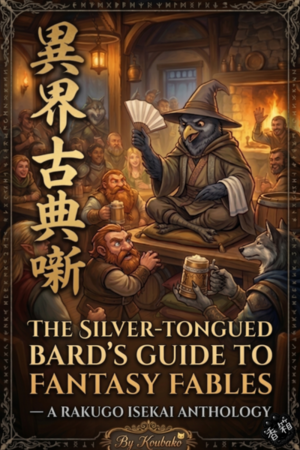
The Silver-Tongued Bard’s Guide to Fantasy Fables — A Japanese Rakugo Isekai Anthology
"Gather ‘round, brave souls and coin-pinchers alike! In this grand Imperial Capital, magic can bend space, and alchemy can turn lead to gold. But did you know that a clever tongue can bend time itself? Oh, yes. While wizards rot over ancient scrolls, the common folk study the art of the 'Short Count.' Let me tell you a tale of two nights, two bowls of stew, and one very confused Lizard-man."
ーーー
The night market pulsed with the scent of roasted manticore and glowing sigils. Barnaby, a half-dwarf with a beard perpetually tangled in soup-stains, was stirring a massive iron pot. His sign read: BARNABY’S DRAGON-TAIL STEW – 16 COPPER.
A Wolf-folk traveler, draped in a silver-grey cloak, sauntered up with a confident grin.
"Evening, Barnaby! Give me a bowl of the good stuff. Extra spicy—enough to make a Phoenix sneeze!"
"Coming right up, lad!" Barnaby ladled the steaming broth into a delicate dish.
The Wolf-folk took the bowl and gasped as if he’d found a holy relic.
"By the Gods, Barnaby! Look at this craftsmanship! Most vendors use clay thick enough to stop an arrow, but this? This is Lunar-Porcelain, isn't it? It’s so delicate, if I blow on the rim, it might sing a lullaby! And the pattern—these painted vine-leaves—they’re so vivid I’m worried they’ll start growing if I spill a drop!"
Barnaby beamed, his dwarven pride swelling. "You’ve got a keen eye, lad!"
"And this spoon! Carved from White-Ash, polished smoother than a silk-worm’s belly. No wood-taste to ruin this... ambrosia. And the stew! Look at the clarity! I can see my own handsome reflection in the broth. The meat? It’s cut into perfect cubes, shimmering with fat like gemstones. It doesn't just smell like food; it smells like victory."
He slurped it down with a rhythmic, musical sound. Slurp. Ahhh. Slurp. Divine.
"Sixteen copper for a masterpiece? It’s a crime, Barnaby. You’re too honest. Here, let's count it out into that hardworking palm of yours."
The Wolf-folk began dropping coins.
"One, two, three, four, five, six, seven, eight— By the way, Barnaby, what’d the clock tower just cry?"
"That was the nine-bell, lad."
"Ten, eleven, twelve, thirteen, fourteen, fifteen, sixteen! Keep the change, master chef!"
The Wolf-folk vanished into the shadows. He had paid only fifteen copper, but Barnaby was too drunk on flattery to notice.
ーーー
Watching from behind a rune-pillar was a Lizard-man named Ssk-Rat. His tail twitched with greedy excitement.
"I see... I see!" he hissed. "Praise the bowl, ask the time, and the gold stays in the pocket! I shall feast for cheap tomorrow!"
The next night, Ssk-Rat rushed to the market. But he was too eager—he arrived far too early. Worse yet, Barnaby’s spot was empty due to a broken axle. In his place stood Mog the Orc, a vendor whose cart was covered in soot and smelled like a wet goblin in a swamp.
Ssk-Rat didn't care. He had a script to follow.
"Hey! Orc! Give me... uh... Dragon-Tail Stew! Fast!"
"It's Orc-Tail Stew. Take it or leave it," Mog grunted, slamming a greasy, chipped stone bowl down.
Ssk-Rat took a sip and nearly saw his ancestors. It tasted like rusted iron and old socks. But he gritted his teeth and began his "praise."
"Ah... ahh! Now this is a bowl!" he shouted, his scales turning a sickly shade of yellow. "Look at the... the heft! It’s not one of those sissy, thin bowls. No! This is Battle-Stone! If an assassin jumps me, I can kill him with the bowl and then finish my soup! It’s a weapon and a dish! I love efficiency!"
Mog didn't even look up; he was busy picking his teeth with a rusted dagger.
"And the spoon! Look at this... jagged edge! Most spoons are boring and round, but this one has character. It’s like a tiny saw! It exfoliates my tongue while I eat! And the aroma... it’s like a damp cellar after a flood! Very... nostalgic!"
He forced a spoonful of the 'stew' down. A clump of something hairy and purple floated in it.
"And the broth! It’s... robust! It’s so thick the spoon stands up on its own! You don’t drink this stew, you... you survive it! It’s like a training montage for my stomach! Best... stew... ever..."
Wiping a tear of pure agony, he held out his claw. "Sixteen copper! Here!"
"One, two, three, four, five, six, seven, eight— Hey, Mog! What's the hour?"
Mog squinted at the sun, which was still high in the sky. "Four-bell. Early shift."
Ssk-Rat’s brain whirred like a broken gear. The script said nine! Why is the sun still up?! But his tongue was on autopilot, desperate to finish the trick.
"...Five, six, seven, eight, nine, ten, eleven, twelve, thirteen, fourteen, fifteen, sixteen! There! Paid in full!"
Mog’s tusks curled into a terrifying grin as he scooped up the pile of coins. "Thanks, lizard. Come back anytime. I like customers who tip 25% for my 'Gravel Soup.'"
Ssk-Rat limped away, his stomach growling and his purse empty, wondering where the "magic" had gone wrong.
ーーー
ーーー
[ Commentary ]
This story is a fantasy reimagining of "Tokisoba" (Time Noodles), a masterpiece of Rakugo—the traditional Japanese art of comedic storytelling—born about 400 years ago during the Edo Period. In that era, night-time streets were visited by noodle vendors known as "Yonaki Soba" (Night-Hawking Noodles), who carried their portable stalls on shoulder poles.
■ The "Night-Hawking Noodles" of Old Japan
In an age without convenience stores or streetlights, the sound of the vendor’s reed pipe (charumera) or wooden clappers echoing through the dark streets was a source of great comfort. The rising steam from the wooden stall was a symbol of late-night indulgence for the common folk. A bowl of soba cost 16 "mon," which would be roughly equivalent to a few hundred yen (a few dollars) today—a simple, affordable treat for everyone.
■ Wisdom and Traps in a World Without Watches
During the Edo Period, wristwatches did not exist. Instead, people kept track of time by listening to the "Time Bells" that rang throughout the city. Because of this, asking a vendor "What’s the hour?" was a perfectly natural part of daily conversation.
The "Short Count" trick performed by the Wolf-folk in this story is a clever exploit of this daily routine, blending "Iki" (the Edo spirit of stylishness) with a bit of street-smart deception. By distracting the vendor with flattery about the food and the craftsmanship of the bowl, the first man interrupts his payment to ask the time. The moment the vendor replies "It’s the 9th hour!" (around midnight), the man uses that number to jump his count straight to "10," effectively skipping a coin.
■ The Timeless "Humanity" of the Fool
In the classic Rakugo tale, the true "hero" isn't the clever man who successfully pulls off the scam. It is the second man—the "lovable fool"—who tries to copy the trick without understanding the logic behind it. He thinks, "If he can eat for cheap, so can I!" only to arrive far too early and end up paying much more than the actual price.







Please sign in to leave a comment.