Chapter 1:
Borrowing Titles
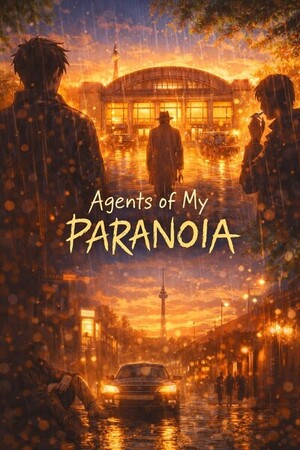
Agents of my Paranoia
“How long are you going to keep stealing titles?”
Borowski grabbed me by the collar, but to me it felt more like he was playing to the audience than actually being angry.
“It’s not stealing, it’s a tribute to the director,” I replied.
Borowski let go, and I dropped back into my chair. A second later I was already on my feet again, heading for the far corner, trying not to flicker in front of the others sitting at the table.
Now came the hardest part — coming up with a title.
A striking one. Memorable. Something that would drill into the skull like a bit through rock. If there was one thing I could do better than anyone here, it was naming things.
Ideas went up on the board in green marker — and got crossed out just as quickly. Half an hour of brainstorming led nowhere. Then, for some reason, Borowski lunged at me, just as suddenly let go, and only after that did Zhanna call us to order — when there was nothing left to stop.
I paced along the far wall, trying to come up with a better title, glancing at Borowski every time I turned. He sat there with his arms crossed, as if nothing had happened. In fact, everyone seemed to have forgotten it already — even though just moments ago Zhanna had told us to cut it out. I had heard that clearly.
“Let’s leave it for now,” Zhanna finally said, sighing tiredly as she looked at the current result of our efforts. “Back to work. If you think of something before the end of the day, write it down here. We still have time until tomorrow.”
***
On the board, in uneven handwriting, it read:
“DIE VEREINIGTEN STAATEN VON AMERIKA IM 15. JAHRHUNDERT.”
“‘The United States of America in the fifteenth century’? And what is that supposed to mean?” Alina raised an eyebrow.
“We’re running a science fiction festival for emerging directors, right?” I began.
“Go on.”
“There was this film… what was his name again?” I snapped my fingers, trying to recall.
“Udinelli,” Borowski muttered. “That’s the title you were trying to steal — and now you can’t even remember his name.”
“Right! Francesco Udinelli. He made this film. Sci-fi, alternative history — the idea was that the U.S. had been founded two hundred years earlier, back in the fifteenth century, and then things just spiraled from there.”
“But naming the whole festival after a single film isn’t exactly a great idea,” Zhanna objected.
“I’m not arguing that — but it’s a cult thing among people who know the genre. Hardly anyone knows Udinelli, sure, but it’s where the whole alternative history wave really started.”
“We’re not limiting ourselves to alternative history,” Alina reminded me.
“And most people won’t even get the reference,” Konrad added, finishing me off.
They piled on the counterarguments, but I tried to push back:
“But that’s exactly the point — it’s clickbait! The title sounds absurd until you get it. And if you do get it, maybe you’ll want to come. If you don’t — you might at least get curious enough to look into it.”
“I still don’t like directly borrowing a film title,” Zhanna said flatly.
Without her approval, there was no chance my idea would make it.
“And you might get your own Borowski among the visitors — someone offended enough to throw a punch over such shameless ‘title theft,’” Konrad quipped from the far end of the table.
Borowski bared his teeth in response.
So it had really happened. He had tried to hit me.
Strangely enough, once the obvious was confirmed, I felt better.
“If we really have nothing else, then—”
“I’ve got one more!” I cut in. “If not a title, we could use a quote.”
“What kind of quote?”
“The climax. The ship is coming in for landing. The characters see a vast island below them. The protagonist turns to the camera and says:
‘There is one thing all people share. We can build ships, sail beyond the horizon toward the unknown, spend years discovering countless unseen worlds — and in the end, we are all the same. We all want grass beneath our feet, birds singing overhead, and a clear sky above us.”
And the title would be:
‘All as One — Toward Our Horizons.’”
Zhanna said nothing, as if tasting the idea.
“That ‘all as one’ part sounds clunky,” Konrad said first. “Was it really phrased like that?”
“It was. Director’s intent.”
We fell silent, waiting for Zhanna’s verdict.
“It’s fine,” she said at last. “But it needs adjusting.
‘Together, as One — Toward Our Horizons.’”
Udinelli would never forgive you for that, I thought — but said nothing.
***
The small German town of Kehl lay across the Rhine from Strasbourg, forever doomed to languish in the shadow of its French counterpart. The owner of the tavern The Gloomy Günter had long since sunk into a fittingly bleak mood because of it.
In a cramped, stuffy room usually used as a staff changing area, Konrad was receiving his final instructions:
“Industrial espionage?”
“I despise it and strive to prevent it.”
“Reverse engineering?”
“I despise it and strive to prevent it!” Konrad straightened like a rod.
“What is object-oriented programming?”
“Programming oriented toward objects!”
“And what do you say if someone asks what brand of windows you have at home?”
“Schüco, of course!”
“How much were you paid to give that answer?”
“Quality is priceless!”
“Good,” Herr Schwarzberg snapped the file shut and rose from his chair. “Now you’re ready, Konrad.”
“I’m being sent to Strasbourg?” Konrad lit up.
Herr Schwarzberg walked over slowly and placed his hands on Konrad’s shoulders with almost paternal gravity.
“No, Konrad. Think bigger. You’re going to Berlin.”
“To Berlin…” Konrad echoed, disappointed.
“Now, now. You’re far more useful to us there — and it will do you good as well.”
“But why?”
Schwarzberg glanced around, as if someone might overhear them over the idle noise filling The Gloomy Günter each evening.
“I have reason to suspect that someone in our cabbage barrel has developed a taste for frog legs.”
“No way.”
“Just a suspicion. But when you get there — keep your eyes open.” Schwarzberg slipped a folded piece of paper into Konrad’s pocket. “Everything’s already arranged. Just say you’re from me. Though I doubt they’ll mix you up with anyone else.”
“Alright…” Konrad still looked unsettled. This wasn’t how things were supposed to go.
“Before you leave — while you’re still here — there’s something I need to show you.” Schwarzberg slapped him on the shoulder so hard Konrad shook, then grabbed him by the arm and dragged him toward the exit.
They stepped out into the corridor. Schwarzberg slammed the door behind them, then led Konrad through the hall, across the crowded main room, past the bar, tossing short replies to the regulars already fueling themselves with beer. Then he practically shoved Konrad onto a narrow, creaking staircase and began climbing after him.
The second floor of The Gloomy Günter was used as a makeshift storage space. Not ideal, but there was nowhere else. Schwarzberg hauled several cardboard boxes over to the window in one sweep — glass clinked inside — and stacked them into something resembling a sniper’s perch. Then he pulled a pair of binoculars from a nearby cabinet and gestured for Konrad to come closer.
“Look,” he said, handing them over.
“At what?”
“The window.”
Directly across from The Gloomy Günter stood another tavern — almost identical — with a sign that read The Last Hearth of Germany. Beyond it stretched the Rhine, and further still — the setting sun and the outline of Strasbourg.
“I’m supposed to watch Strasbourg?” Konrad raised the binoculars.
“To hell with Strasbourg,” Schwarzberg waved him off. “Here. The ‘Last Hearth.’”
“Then why the binoculars?”
“They should’ve called themselves The First Hearth of France,” Schwarzberg ignored the question. “I’m telling you, Konrad — something’s not right. I dropped in the other day, did a little reconnaissance. And what do you think? The bartender — French. The menu — crêpes and all that nonsense no self-respecting man should even touch.”
“Horrifying,” Konrad said without much enthusiasm.
“But you, don’t worry!” Schwarzberg slapped him on the back again — the binoculars smashed into Konrad’s nose and slipped from his hands. “You just go to Berlin, find the rat, and we’ll handle things here. ‘The Last Hearth’… my ass.”
At that moment, Konrad’s phone rang. He reached to decline the call — but too late. As if on command, Schwarzberg dropped to the floor, did two explosive push-ups with a clap, and sprang back up again. All of it with surprising agility for a man his age.
“Alarm! What is it?!” he snapped, glaring wildly at Konrad.
“It’s just a call,” Konrad stepped back.
“Again? Separate negotiations? With France, is that it?! You could at least have the decency not to call your whores in front of your grandfather!”
“Grand— I don’t even speak French…”
“Herr Schwarzberg, when you’re in formation, Konrad!”
“Do I at least get a rank, then?”
“Are we in the army?”
“But—”
“Konrad, in our time the whole world is a battlefield! First front, second front— if we keep thinking in the categories of the past, they’ll have us by the throat in no time. But we’ll outsmart them!”
Schwarzberg stepped close again. Konrad instinctively pressed his back against the wall as the old man placed his hands on his shoulders.
“But for that, we need your help. Deal with this Berlin rat — and I’ll take care of the ‘Hearth’ myself.”
“Yeah… I got it,” Konrad muttered, trying to free himself. This time Schwarzberg let go.
“Then go! Get some rest tonight. Your train leaves tomorrow at 8:80.”
“8:80?”
“9:20,” Schwarzberg winked, already heading down the stairs. “And remember—” he turned halfway, “no French!”
“I don’t even know the language, Grand…”
Schwarzberg descended, whistling a march that, these days, would earn you at the very least a polite but firm conversation at a police station.
Konrad lingered a moment longer, then followed. Making sure Schwarzberg was already deep in conversation with someone over a mug of beer, he slipped through the hall, nodded to the bartender, and quietly stepped outside.
On his way home, he sent two messages.
The first — to his mother:
“Mom, bring the pills. Grandpa’s decided to relive his youth.”
The second — in reply to the missed call:
Ma chérie!
Les circonstances ont changé. Demain matin je pars pour Berlin. Il n'y a rien à faire. Je suis désolé. Nous nous reverrons bientôt, je le promets. Je t'embrasse.
Conrad





Please sign in to leave a comment.