Chapter 1:
Mother of Reality
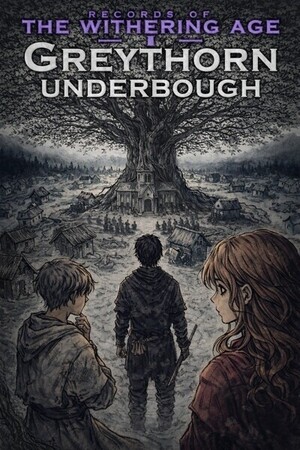
Greythorn Underbough —RotWA I—
A woman shrieked in pain, far away, in the middle of the night.
The forest opened its eyes as the echo scattered like a cold wind. Owls stood at the high branches, their pupils like a setting dark moon as they peered below. Slowly, the eyelids closed one by one, the reflections of light snuffed out back into a sea of shadows.
As natives would say back then: “No matter what you hear, or what you think you heard. Let it rot and die. The last thing you should do is to talk back to these cursed woods.”
Even wild creatures know better than to risk their survival with unnecessary action.
Here, you’re northwest. Between the mountains, in a place once known as Greythorn Underbough. Its trifling population full of humble pretenders, whisperers of superstition. People more fearful of the dark than its unprotected, scrawny cattle. Not without reason.
The woman screamed again, a sound too prolonged for comfort.
She hid from the cold inside a crude house of wood. A piece of cloth covered the window, not dampening the noise as one would prefer. A lamp flickered within, warming the room with color only, its firelight dwindling. Blood on the stone floor.
A desperate groan reverberated through her clenched teeth.
She breathed in broken pulls, sharp and uneven. Each inhale arriving too late, each exhale too soon. Pain forced her awake whenever her body tried to escape it.
The village had no means to soothe the process.
They had no healers. No proper tools. No relief worth naming. Only hands.
A hunter’s hands to carry her.
Three maidens’ hands to hold her down.
And a priest’s hands, clasped together, praying out loud for a bountiful harvest.
Hopefully, no gods were watching.
It took time. The kind that stretches until it feels deliberate.
Eventually, a new soul arrived in this underworld.
The room exhaled.
Relief passed quietly between those present, as though speaking might undo the result.
The infant was brought up, cleaned quickly, and wrapped in rags as was proper.
The mother reached for the hunter’s arm beside her and held on a smile, her fingers tightening with a fragile certainty. He glanced at her, but did not return the expression.
He knew better than to entertain one’s delirium.
Silence drowned the room. Cold air whistling through the rotten gaps of the wooden walls. The first lights of the day highlighted the stagnant dust in the air.
The child did not cry.
The mother lifted herself from her warm, sweated pillow. The hunter steadied her as her eyes followed the bundle being passed from one maiden to the oldest.
They shook him slightly, checked for fine details, then, with a stern look, the midwife readied her throat to speak.
“It’s a boy.” – She announced dutifully, but earnestly.
The mother smiled.
Having a boy was good news. Their family gained more strength, and the village: a new hunter. But the mother did not care for such information.
“Is it pure?”
The people glanced among themselves. The head maiden came closer and extended the child as the answer.
The baby was not fully cleaned. Traces of blood remained along the edges of his eyes. He moved sluggishly, raising his frail arms out of the wraps and, with his eyes open, he mesmerized the back of his own hands.
Instead of crying, the baby giggled.
As if the idea of being brought into this world was, by itself, fun.
His eyes laughed innocently as his toothless mouth widened, and when he lost the strength to keep his arms up, he dazzled at his mother’s face for the first time.
She was exhilarated. Imperceptive, but exhilarated.
The boy was healthy.
Too healthy for their standards. Enough so for her to laugh in return.
She did not want to let him go.
It took some time before they could retrieve the baby from the mother's embrace, waiting until she was too tired to stay awake. It was expected that the midwives would care for the child during its first weeks. That was the order of things.
The mother did not accept it.
Her requests began within days.
They became demands soon after.
And thus, the boy was delivered earlier than usual.
He was named Ishmael, of the Harrowmere family.
It carried weight from a story no one could recall. One that did not matter. Names rarely need understanding to function.
What mattered was intention.
His mother believed he was exceptional. So it had fit perfectly in her eyes.
The neighbours disagreed. They whispered, not quietly enough.
Laughing at birth. Eyes opening too early. Knowing things he had never seen. Being too cautious. Having dreams.
The word used varied depending on who spoke it.
“Unfortunate.”
“Tainted.”
“Cursed.”
“Rotten.”
The mother covered the boy’s ears when she could. Spoke louder when she couldn’t.
At three years old, the boy walked and spoke without difficulty. At four, he worked.
The hunter did not instruct him much on how to debone prey or separate their innards. He did not need to. The boy understood what was required simply by watching.
That, more than anything else, unsettled people.
Some gathered to talk with her one day. Their words chosen carefully.
“The world is already difficult as is.”
“A child should act like a child, even if just for the short moment they are allowed to.”
“But the boy deserves to know the truth.”
However, once she noticed her kid listening in from the edge of their doorstep, her face shifted into fury.
The mother grabbed the nearest tool at her disposal, a pitchfork, and pushed them away, threatening to have them killed once her husband came back later that night.
The villagers understood.
They did never return.
The mother became more isolated. The house quieter. Windows closed, dampening the air. Walls closing in. The boy was her only witness.
She often vented about the impurity of the village. Circled around how the boy was perfect and should be left alone. Argued that the world should be thankful for his mere existence. A kitchen knife thrown at the ceiling and walls punched as if they were guilty. She screamed at the mirror, hair strings knotted on her fingers, her scalp bleeding.
The boy watched.
He learned when to speak.
He learned when not to.
Eventually came the point where belief alone no longer satisfied her.
Belief requires reinforcement.
She sought the help of a man willing to serve her such a purpose.
He was not a powerful mage. But he knew enough to imitate authority.
That was often sufficient.
They were brought into a dark room, where a sapling stood on an adorned altar of stone.
The man spoke of acceptance. Of exchange. Of possibility.
She did not hesitate.
The mother slit the palm of her hand and let the blood trickle onto the plant.
A few leaves unfurled.
It grew taller, wider.
As if days had passed by in a blink of an eye.
The magician grinned.
He called it proof.
The boy said nothing.
He watched the soil instead.
Its roots adjusting to something unseen.
They left shortly after.
Payment had been made. Interests satisfied.
On their way home, the mother grabbed the boy’s shoulders and pulled him closer.
“Believe it, Ishmael. Or it will not hold.”
Her eyes pierced through his skull, as if she saw something creeping behind the boy’s neck but did not want him to notice.
“Repeat after me: ‘This is my first life’.”
He did not understand it yet, but he recognized the words.
“This is my first life.”
The borders of her eyes laughed, but not in happiness.
She ordered him once more, slower.
He repeated it.
This was his first life.
She nodded to herself. – “It was all worth it. It was all true.” – If not by fate, then magic would prove how everyone else was wrong.
Finally. He was pure.
Without a doubt.










Please sign in to leave a comment.