Chapter 12:
Words Like Surgery
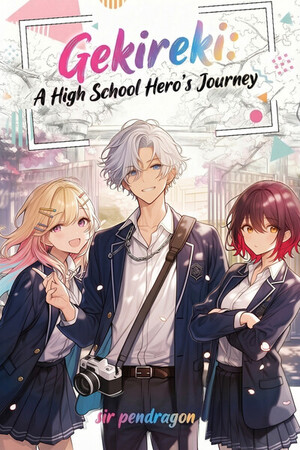
Gekireki: A High School Hero's Journey
The morning was already warm, late spring sun beating down on the pavement. My feet were on autopilot, but my mind was wrapped around a book. A story of beautiful, terrible loneliness that had burrowed into my consciousness and refused to let go.
I saw her between second and third period. Walking down the main hallway, a figure of isolated calm in the sea of navy blue. She moved with an almost mechanical grace, her spine straight, her eyes focused on an invisible point in the middle distance.
But I saw her differently now. I didn't just see the cold exterior. I saw the architect beneath the armor. The girl who had constructed a tragedy so perfect, so inevitable it felt like a law of physics.
I watched her walk past, her pale silver-blue hair catching the light. I wanted to say something. A hundred different ways to say, "I know you."
But I couldn't. I had no right. I was a stranger who had stumbled upon a secret that wasn't meant for me.
[Quest: The Silent Sage] Objective: Initiate a dialogue with Fuyuzuki Yukiko. Reward: INT +2, CHA +1, ???
The library was quiet, the air thick with old paper and dust. Sunlight slanted through high windows, illuminating motes of dust that danced in the tranquil light.
There she was. In her usual spot, a secluded corner by a large window. Engrossed in a book, her slender fingers turning the page with a grace that looked practiced. Her profile was a study in cool elegance.
I walked over and sat down. Not across from her. Next to her. A respectful distance away.
She glanced up. Cool, unimpressed blue eyes. The same look she gave everyone. A flat, dismissive acknowledgment. A clear signal that you were not worth her time.
I didn't leave. I took a deep breath and placed The Weight of Winter on the table between us, its cover facing her.
The silence seemed to deepen. She looked at the book, at her own pen name scrawled on the title page. Then her eyes moved slowly to my face.
The façade was still there, but something had changed. A minute tightening of the jaw, a tiny flicker in her eyes.
"The ending isn't inevitable," I said. My voice was low, pitched for her ears only.
She didn't move. Didn't blink.
"You built it like it was," I continued. "Like the tragedy was structural. Load-bearing. As if the entire world you created would collapse without it." I leaned in. "But it wouldn't have. The story would hold with a different ending. A happier ending. You chose the tragedy. Not because it was the only option. But because you couldn't let yourself write the other one."
Yukiko looked at me. Really looked at me. The ice hadn't melted, but there was something else. Curiosity. Wariness. As if she were trying to decide if I was a threat, an anomaly, or the worst thing that could have happened to her.
"You don't know what you're talking about," she said. Flat. Monotone. Each word a perfectly placed stone in the fortress she had built around herself.
"Maybe not. But in chapter fourteen, when Kael says, 'Some things are worth the cost of believing in them, even if they're lies,' that's not a character talking. That's the author. That's you. And in the next chapter, the author decided to prove him wrong, to cross out that sentiment with a tragedy."
Her jaw tightened. I had found the one place in her fortress where she was honest, and I had just held it up to the light.
"I don't recall asking for a review," she said, her voice like a blast of ice. Her knuckles were white.
She stood up. Collected her things with practiced grace. No wasted energy. A perfect, controlled exit.
She walked away without another word. The library door closed softly behind her. Not a slam. A slam would be emotional, and she refused to be emotional.
I sat there, heart pounding. I had done it. I had said the thing that couldn't be unsaid.
[QUEST UPDATE: THE SILENT SAGE] Objective: Initiate a dialogue: COMPLETE Reward: INT +2, CHA +1
[New Quest: The Thaw Begins] Objective: Break through Yukiko's emotional armor. Reward: ???, Relationship Progression
She arrived ten minutes late, which was unusual. She was always there, a permanent fixture of the library, a beautiful, sky-blue haired gargoyle perched in her corner.
She didn't say hello. Just sat down, back straight, movements clipped. She opened her bag and pulled out her own copy of her book.
It was annotated. Heavily. Each margin was filled with cramped, neat handwriting in red ink. Colored tabs sticking out of the pages, a forest of neon flags marking key passages. She'd brought battlefield intelligence. She'd brought ammunition.
She'd spent her evening preparing to prove me wrong.
"Chapter seven. Page 142," she said, without looking at me. "The moment Kaoru chooses to stay despite knowing the cost."
"Good afternoon to you too, Fuyuzuki-san."
"I'm not here for pleasantries, Tsukiai-san. I'm here because you said something fundamentally incorrect about my work, and I intend to demonstrate, with evidence, exactly how wrong you are."
And then she walked me through it. Page by page. Decision by decision. She had built a logical proof using her own novel as the dataset. Refuting a reader's interpretation with the author's intent, backed by structural analysis as cold and unforgiving as the winter she wrote about.
"Kaoru enters the house here," she tapped a paragraph. "This eliminates escape routes A through D. The conversation with Ren in chapter nine commits her to the relationship, eliminating emotional alternatives E through G. The revelation about the necklace in chapter twelve destroys the only exit route that didn't end in tragedy. The final chapter isn't a choice, it's the end of an inescapable hallway."
"Your architecture is perfect," I said when she finally paused for breath. "Every load-bearing wall is exactly where it needs to be. But you chose where to put the walls in the first place."
"A different architect, given the same materials, could have built a different building. The character enters the house in chapter seven, yes. But you wrote her entering the house. She didn't walk in there on her own. You opened the door for her."
She finally looked at me. Her eyes were a shocking shade of blue, wide with surprise and fury. She was supposed to overwhelm me with logic, bury me under the weight of her intellect. I was supposed to nod, agree, and slink away.
"Characters have an internal logic," she argued. "Once you create them, you don't control every action. They act according to who they are."
I shook my head. "Characters have the internal logic their author gives them. You're presenting the constraints of your story as if they were natural law. But they're not. They're aesthetic choices disguised as inevitability."
The silence was total. Just the two of us.
"You've read literary theory," she said.
"I've read your book. That was enough."
For the first time, I saw a flicker of something that wasn't coldness. Not warmth, exactly. Not yet. But the chill of intellectual curiosity. The spark of recognition between two people who realize they are equals in a game they didn't know they were playing.
"The constraints aren't aesthetic," she recovered. "They're psychological. The character can't choose differently because of who she is."
"And who she is was decided by you. The author who chose to create a character who couldn't escape. You built a prison and called it a personality."
"That's reductive," she snapped.
"It's architecture. You said it yourself. I'm just reading the blueprint from a different angle."
"The wrong angle."
"Possibly. But you've been defending this ending for forty minutes and your annotations have run out."
She glanced down at her book. I was right. Every tabbed page used. Every red-ink note deployed. She was out of ammunition. And I was still standing.
"This isn't finished," she said, looking at me with a strange intensity.
A threat and a promise simultaneously.
"Tomorrow?" I asked.
She didn't answer. She didn't need to. She just walked away, her sky-blue hair catching the light.
On the rooftop the next day:
"You're going to the library again?" Kikyō asked, eyeing my packed bag.
"I study there."
"You study here. You argue there."
"It's the cold girl," Hanabi said, not looking up from her lunch. "Light blue hair. Never talks. He keeps looking toward the 1-C hallway."
Kikyō's eyes went wide. "You knew?"
"I noticed. Different thing."
"You noticed and you didn't tell me?"
"Telling you things is volunteering for a three-hour conversation about feelings. I made a practical decision."
Iroha spoke up. "Fuyuzuki Yukiko. Published author. Pen name Fuyusame-sensei. Her novel, The Weight of Winter, has been on the bestseller list for six weeks."
Kikyō's jaw dropped.
"How do you know that?"
"Her pen name is a homophone variant of her real name. It wasn't difficult to connect the dots."
Kikyō turned her death glare on me. "Iroha-chan figured it out in one search and you wouldn't tell me for three days?"
"I was building suspense."
"You were being an idiot."
"Those aren't mutually exclusive."
"IT'S A THING, SORA!" Kikyō shouted.
Later that afternoon in the library. Yukiko was particularly cold today. We were debating foreshadowing in chapter sixteen. I was in the middle of a point about the color motif when she interrupted.
"Reductive."
That was it. One word, intended to dismiss my entire intellectual effort.
"You know, Tsumetai-san," I began, "you don't always have to..."
She stopped. Her entire posture stiffened. A microscopic change, but for someone paying close attention, a massive reaction.
She turned her head slowly. The unimpressed façade was gone. Pure, frozen fury.
"What did you call me?"
"Tsumetai-san." I kept my voice calm. "I'm calling you Tsumetai-san."
"You called me... Cold-san." She said the name slowly, tasting the absurdity.
"It's descriptive. Accurate. And polite. I added the honorific."
"Adding '-san' to an insult does not make it polite. It just makes it patronizing."
"It's not an insult. It's an observation. You're cold. You perform coldness. You weaponize it to keep people away. I'm just naming the weapon you're holding."
"My name is Fuyuzuki."
"Let's see. Fuyuzuki. Winter Moon. That's a very beautiful name." I smiled. "Your name is not Tsumetai, and yet here we are. The truth is, Tsumetai-san, you use the cold as a weapon. It's how you keep the world from getting too close. And since it's so much a part of you, it seems like a shame not to have a name for it."
"Don't call me that." Her voice was a whisper, but it had the force of a command.
"Okay."
"I mean it."
"I believe you."
"Good."
We returned to reading. The tension was thick.
Then, as if on cue, she paused mid-page. "You're going to call me that again, aren't you."
It wasn't a question.
"Probably."
"Why?"
"Because you responded to it. Both times. If it didn't fit, you would have ignored it."
The same inescapable logic she used in her writing. She was trapped by the structure of my argument, a structure I had learned from arguing with her.
"You're insufferable," she muttered, her eyes still on the page.
"Documented fact."
"Habanero-chan's called you that?"
I blinked. She knew about Habanero-chan. She'd been paying attention to the banter on the rooftop. She was gathering intelligence on me.
"You've been doing research of your own, Tsumetai-san."
"I investigate people who annoy me. It's a habit."
"I'm honored to warrant investigation."
"Don't be. The results were unimpressive."
From then on, I called her Tsumetai-san. She never corrected me. She responded to it, though. Always with a sigh, a slight tightening of her lips. An acknowledgment. A surrender.
[The Hero has named the Frost-Heart Sage.
She did not accept it. She did not reject it. She sighed.
The system classifies a sigh as: CONDITIONAL SURRENDER.]





Please sign in to leave a comment.