Chapter 21:
The Gate and the Wake
The Branded
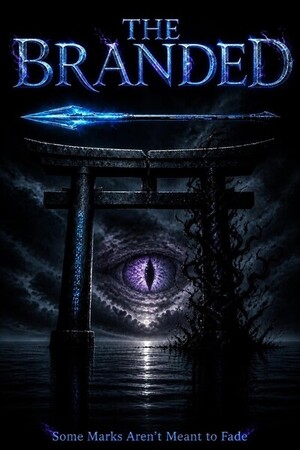
The torii gate stood alone.
No shrine behind it. No path leading up. No forest framing its pillars in green and shadow. Just the gate, rising from a flat expanse of dark water that reflected nothing. The left pillar was solid. Straight. Sharp as memory. The right pillar dissolved halfway down into flowing ink that curled like smoke and never settled.
The water was cold.
Not the cold of winter air or ice underfoot. Something older. Something that seeped into the bones and stayed there. Tetsutaya stood before the gate, his feet bare, the water lapping at his ankles. The cold climbed upward, slow and patient, like it had all the time in the world.
He didn't know how he'd gotten here. He didn't know where here was.
He tried to step forward. The water held him. Not like chains. Like a suggestion. A quiet, insistent pressure that said 'not yet.'
So he waited.
The gate's crossbeam was cracked. A thin fracture running from edge to center. Beyond it, where the shrine should have been, there was only darkness. Not shadow. Not the familiar cold of his Brand. Something else. Something that watched without eyes.
Frost crept across the surface of the water. Thin crystals, spreading outward from the gate's base. They crackled as they grew, spiderwebbing across the dark expanse.
A purple eye opened in the dark.
Huge. Pupil-less. The iris was a spiral of violet and black, turning slowly, lazily, like it had all the time in the world and intended to use it. It fixed on Tetsutaya with an intensity that made his chest ache. The cold deepened. The frost thickened.
He knew that ache. He'd felt it before. In the rain. In the spotlights. In the moment his brother shoved him into the dark and told him to run.
The eye blinked.
And Tetsutaya was falling.
---
Not through the gate. Through darkness. Through cold so deep it burned. He couldn't see his hands. Couldn't feel his feet. There was no water now, no frost, no gate. Just dark. Just cold. Just the sensation of falling without hitting bottom.
He tried to call out. No sound came.
He tried to reach for his shadow. Nothing answered.
He was alone.
A voice. Small. Young. Crying.
Tetsutaya turned — but there was no direction here, no up or down, no left or right. The crying came from everywhere. From inside him. From the dark itself.
He saw himself.
Nine years old. Curled on the ground in an alley somewhere, somewhere dark, somewhere cold. Rain was falling. The boy's back was bare, his shirt torn away, the fresh Brand on his shoulder blades still weeping ink. His hands were scraped raw. His face was wet — rain or tears, Tetsutaya couldn't tell.
The boy was crying.
Not the loud cry of a child in pain. The quiet cry of someone who had already given up. His shoulders shook. His breath came in short, hitching gasps. He had curled himself into a ball against the wall, as small as he could make himself, as if trying to disappear.
No one was coming. His brother was gone. His parents were dead. He was alone in a city that wanted to lock him away.
The boy pressed his face into his knees and cried.
Tetsutaya wanted to reach for him. He couldn't move. He couldn't speak. He could only watch.
The dark swallowed the boy.
The crying faded.
Tetsutaya was alone again, falling again, the cold pressing against him from all sides. He didn't know how long he fell. Seconds. Hours. Years.
Then he stopped.
Not gently. Not like landing. He was simply — suspended. Hanging in the dark like a fly in amber. The cold was everywhere. The silence was everywhere.
And the eye was there.
The purple eye. Huge. Pupil-less. The spiral iris turned slowly, lazily, and it was looking at him. Not through him. At him. Tetsutaya felt the weight of that gaze like a hand around his throat.
The eye blinked.
And the boy was there.
Not the crying boy from the alley. This one stood. This one was dry. This one had violet flickering in his eyes — the same violet as the spiral, the same violet as the gate. His shadow stretched behind him, too large, too tall, arms too long, fingers too many. The shadow moved even when the boy stood still. It rippled. It breathed.
The boy smiled. His mouth opened too wide. Rows of teeth where there shouldn't have been teeth.
"You found me," the boy said. His voice was Tetsutaya's from nine years old, but layered beneath it was something deeper. Older. A second voice speaking the same words a heartbeat later.
Tetsutaya couldn't answer. He was still suspended. Still trapped.
"Or I found you." The boy tilted his head. Too far. His neck bent at an angle that should have hurt. "Same thing, really."
The boy raised his hand. Not toward Tetsutaya. Toward the eye.
The eye closed.
The dark became darker.
And the boy was gone.
Tetsutaya was falling again — no, not falling. Rising. Surfacing. The cold receded. The dark thinned. He could feel his body again, his hands, his chest, the wound in his shoulder—
---
He woke with a start.
The ceiling above him was concrete. Cracks in the corner. A water stain that hadn't had time to become familiar. The air smelled like mildew and old soap and something sharper beneath it — rubbing alcohol. Bandages.
His heart was pounding. His chest was cold. He pressed his hand to his sternum and felt the chill radiating from inside.
'Lance?' he thought. His shoulder throbbed. 'One of the barrier lances? The fight? Safehouse fifteen?'
He tried to sit up. A hand pressed gently against his chest and pushed him back down.
"Movement will disrupt the healing. The wound is closed but the tissue beneath is still unstable. I don't know the exact timeline. I've never done this before."
Diego sat beside him on a folding chair. His hands were clean. No blood. No glow. Just the small, precise fingers of an eleven-year-old boy holding a roll of fresh bandages.
"You're awake. That's good. Nue thought you might sleep longer. I didn't think so. Your heart rate changed ten minutes ago. Were you dreaming?"
"The gate," Tetsutaya said. His voice was a rasp. "I was at the gate."
"What gate?"
Tetsutaya didn't answer. He touched his shoulder. The bandages were neat. Tight. Professionally done. Faint warmth radiated from beneath them — not heat, but something gentler. Like a ray of sun caught in your palm on a cold day. The kind of warmth that didn't burn.
He focused on that warmth. Tried to push the dream away.
"You did this?"
"Han provided the light first. The shadows hit him. He has a mild concussion. I finished it. My light doesn't produce heat unless I feel something that generates heat. I didn't feel that. So it didn't burn."
Tetsutaya stared at him. Eleven years old. Six years sedated. Two weeks conscious. Changing bandages. Describing cauterization like a math problem.
"You saved my life?"
"Yes. That's what Nue said. She also said to sit down. I sat. Then I stood up again to change the bandages. Yuuki showed me the procedure." Diego set the bandage roll on the floor. His gaze moved to the corner of the basement where Cody lay unconscious on a makeshift cot. The boy's left eye was still now. The shutter silent. His ruined suit had been replaced with borrowed clothes.
"I know that boy."
Tetsutaya turned his head. "You know him?"
"Not his name. His face. It was in a photograph. My mother had files on all the Registry's major sponsors. The Archibalds were near the top. She kept their portraits in her study. I looked through them sometimes. There was nothing else to do." Diego paused. "He was younger in the photo. But the face is the same. The eye was covered then too."
Tetsutaya studied Diego's face. The boy's voice was flat. The same flat it always was. But his hands were still on his lap. Too still.
"You're sure it's him?"
"Yes. I don't forget faces. The sedation didn't take those." Diego looked at the boy in the corner. "His parents donated money to the Registry. A lot of money. My mother respected them. She said they understood the importance of the work." Another pause. "They were hiding him the whole time. Sponsoring the system while protecting their son from it. Is that hypocritical or desperate? I don't know which yet."
Tetsutaya watched him. He didn't have an answer. He stayed silent.
Diego waited. Then: "And that bothers you?"
"I don't know if it bothers me. I'm still learning what bothered feels like. My chest is tight when I look at him. Is that bothered? Or is it the cauterization? I used a lot of energy. Yuuki said I should eat more." Diego stood. "I'll get water. For you. Yuuki said fluids are important. She also said if you try to stand up she'll be disappointed. Her tone suggested a threat."
"It is."
"I'll get the water."
Diego walked to the kitchen corner. Tetsutaya watched him go. Then he looked at the ceiling. The water stain. The cracks. The concrete.
The cold from the dream was gone. But the image of the boy — his own face, those violet eyes, that shadow — stayed. The feeling of being suspended before the eye. The helplessness.
He closed his eyes. The boy was still there, waiting behind his lids.
'You found me,' the boy whispered. 'Or I found you. Same thing, really.'
Tetsutaya opened his eyes. The ceiling was still there. The water stain. The cracks.
He didn't answer.
The warmth from the bandages was still there — Diego's light, still lingering, still pressing back against the cold from the dream. He focused on it. Held it. The image of the boy — his own face, those violet eyes — began to fade.
But somewhere across the city, in a different room, under different lights, someone else wasn't sleeping.
Tetsutaya didn't know this. He couldn't. But the cold had to go somewhere.
---
Shinjugo didn't know why he was walking to the fourth floor.
He didn't have a meeting. He didn't have a requisition to file. His feet had just started moving, and now he was in the corridor, and the logistics office door was ahead of him. He could hear voices through the wall — the director's thin, reedy tone, then silence, then the shuffle of papers.
He stopped outside the door. His hand hovered over the handle.
He didn't want to be here. He didn't know why he was here.
He opened the door.
The logistics director looked up from his desk. Thin glasses. Thin patience. His eyes narrowed.
"You again."
Shinjugo stepped inside. The door closed behind him.
"The caloric content hasn't changed," the director said, not waiting for a response. "Your squad receives the standard allotment for Branded operatives. If they're burning more than they're consuming, they need to eat more of the same rations. Not better ones."
"The standard allotment is designed for adult agents in low-intensity roles," Shinjugo said. "Raina is fourteen. Her metabolic rate is elevated by her Brand. Koby's Metallurgy drains his electrolytes faster than supplements can replace. The caloric density of the current rations—"
"Is within acceptable parameters. If you have a complaint, file a requisition form."
"I've filed three."
"And all three were denied. I'm aware." The director adjusted his glasses. "Budget constraints. Nothing I can do."
Shinjugo's hands were at his sides. His barriers didn't flare. His voice didn't rise. He simply stood there, seven feet four inches of controlled frustration, and tried to find a way through the wall of bureaucracy that wouldn't involve putting his fist through it.
The door opened.
The logistics director went pale. Shinjugo turned.
Governor Elias Voss stood in the doorway, a tablet in one hand, a cup of coffee in the other. He looked exactly as he always looked — silver hair, gray suit, the kind of face you'd trust to hold your wallet. His pale eyes swept the room, taking in the director's hunched shoulders, the spreadsheet on the desk, the tension in Shinjugo's stance.
"Squad Leader Awagami. I was looking for you."
"Governor."
Elias stepped inside. He glanced at the logistics director — who had gone very still, his hands frozen over his keyboard.
"I wanted to discuss your report from last night. In person." His pale eyes moved to the spreadsheet, then back to the director. "But it seems I've walked in on something interesting."
The logistics director's mouth opened. Closed. Opened again.
"Governor, I was just—"
"You were just what?" Elias picked up the spreadsheet. His eyes moved across the numbers with the same calm attention he gave everything else. "Processing a requisition? Denying one, from the look of it."
The director's face went pale.
Shinjugo stood motionless. The Governor's attention wasn't on him anymore. It was on the director, and the director was crumbling.
"These numbers," Elias said, still studying the spreadsheet. "The budget for operative nutrition is three percent lower than it was last year. Yet the overall logistics budget increased by twelve percent." He set the spreadsheet down. His pale eyes fixed on the director. "Where did the missing funds go?"
The director's hands shook. His mouth opened and closed. No words came.
"Perhaps you don't know," Elias said. "That's fine. I'll have an auditor review the department's disbursements. If there's been a misallocation, we'll correct it. If there's been embezzlement—" He didn't finish the sentence. He didn't need to.
The director sat down. His legs had stopped working.
Elias turned to Shinjugo. His expression shifted — not warmer, but more focused.
"Your squad will receive upgraded rations by tomorrow. Fresh ingredients. Higher caloric density. I'll sign the authorization personally." He picked up his coffee. "Now. Walk with me."
---
They walked.
The fourth floor corridor was white and fluorescent and empty at this hour. Their footsteps echoed — Shinjugo's heavy and measured, the Governor's lighter, quicker. The tablet was tucked under Elias's arm. The coffee was still in his hand. Behind them, the logistics office door stood open. The director sat motionless at his desk, still in shock, still staring at nothing, his career already over.
"You visit that office often," Elias said. "Surprisingly often, given the director's noted reluctance to approve your requests."
"I advocate for my squad."
"Yes." Elias nodded. "You do."
They turned a corner. Passed a row of closed doors. The building was quiet. Too quiet.
"Your report," Elias said. "You described the engagement. The barriers. The shadow manipulation. The retreat." He paused. "But you didn't describe what he said to you."
Shinjugo's jaw tightened.
"Your brother. Tetsutaya." Elias said the name like he was tasting it. "What did he say?"
Shinjugo walked in silence for a moment. The corridor stretched ahead of them, endless and white.
"He said he'd been looking for me for eight years."
"And what did you say?"
Shinjugo's throat was dry. "I told him he'd become everything I hoped he wouldn't."
Elias nodded. His expression didn't change. "What else?"
They reached the end of the corridor. A window looked out over the city — gray and sprawling, the morning light just beginning to burn through the haze. Elias stopped. Shinjugo stopped beside him.
"He said Mariposa's conditioning was a lie. That everything I believe about him is a lie."
Elias was quiet for a long moment. His pale eyes traced the skyline.
"And do you believe that?"
Shinjugo didn't answer.
"Your brother is a criminal. A fugitive. The leader of a rogue faction that has killed Registry personnel and destroyed Registry property." Elias's voice was calm. Measured. "He is also, by your own account, bleeding and desperate. Desperate people say desperate things."
Shinjugo stared out the window.
"He called me brother," Shinjugo said. His voice was flat. "Even after everything. He still called me brother."
Elias turned to look at him. His pale eyes were unreadable.
"The conditioning Doctor Mari performed on you was thorough. It was necessary. Your emotional attachment to your brother was a liability — to you, to your squad, to the Registry. She removed that liability." He paused. "But attachments like that don't always sever cleanly. Sometimes they leave threads."
Shinjugo said nothing.
"Your report was thorough. Your actions in the field were appropriate. You engaged the target, you inflicted significant injury, you forced his retreat." Elias nodded slowly. "But you didn't capture him. And you're here, in a corridor, staring out a window, instead of debriefing your squad or preparing for the next operation."
He turned to face Shinjugo fully.
"I need to know if you can do this. If you can't — if those threads are still pulling — I need to know now."
Shinjugo met his gaze. Steady. Unblinking.
"I can do this."
Elias studied him for a long moment. Then he nodded.
"Good." He turned back toward the corridor. "The logistics director will be placed on administrative leave pending the audit. I expect the department to operate more efficiently in his absence."
They walked back the way they came. The logistics office door was still open. The director was still sitting at his desk, his hands shaking, his face pale.
Elias paused at the door. He didn't look at the director. His attention was on Shinjugo.
"The Shadow is still out there. Your report was thorough. Unfortunate about the blood loss." A pause. "If he's injured, he'll be desperate. Desperate people make mistakes. Be ready when he does."
"Yes, Governor."
Elias nodded once. Then he walked away, his footsteps fading down the corridor.
The logistics director sat in his chair, staring at nothing. Shinjugo looked at him for a long moment — this thin man with his thin glasses and his thin patience, already unraveling — then turned and walked out without a word.
In the hallway, he stopped. Leaned against the wall. Closed his eyes.
The ache pulsed in his chest. He called it nothing at all. But his hands were still shaking.
'He was bleeding the whole time. He was fighting me, and he was bleeding, and I didn't notice.'
He pushed off the wall. Walked back to the barracks. The blood was still on his uniform. He needed to change. He needed to cook. He needed to do something that made sense.
The ache pulsed.
He called it nothing.
It didn't listen.





Please sign in to leave a comment.