Chapter 11:
Names That Stayed In The Files
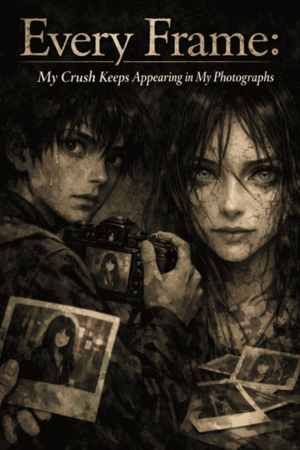
Every Frame: My Crush Keeps Appearing In My Photographs
Golden Week began with rain.
Not dramatic rain. No cinematic downpour. Just the kind that arrived early, stayed low, and made every surface look used before noon.
Yuto texted first.
Found two classmates who remember Mamiya. One said no call. One said maybe. Meeting one at 2.
A minute later, Reina sent hers.
Kuroda signed out archive carts to Shinohara twice this month. Dates line up with when you showed him frame seven.
Makoto read both messages at the desk while the kettle boiled and rain pressed softly against the window.
He wrote the updates into the task notebook first.
Then, because he no longer trusted what counted as ordinary enough not to record, he added:
Rain from 7:10 a.m.
Did not sleep well.
Dreamed of a room with no camera in it and woke relieved.
He stared at that line after writing it, then shut the notebook before he could think too hard about what relieved meant there.
By noon the three of them had regrouped separately. Yuto was meeting the former classmate in Kichijoji at a small diner. Reina was in the equipment room checking booking histories from older systems that had never been fully digitized. Makoto had gone to the prefectural photo society archives because Aiba’s newsletter submission gave them one usable thread.
The archive room sat above a camera repair shop that smelled of dust, oil, and warm metal. An old man with perfect posture and nicotine fingers ran both places with equal contempt for modernity. He did not care why Makoto wanted 1998 amateur newsletters as long as he handled them carefully.
Makoto spent two hours turning pages in a side room above the shop.
Most of the newsletters were exactly what they should have been. Competitions. Notes on film stocks. Arguments about developing temperatures written with the self-importance only hobbyists could sustain for decades.
Then, in the October 1998 issue, he found Aiba again.
Not a feature.
A letter.
Short, unsigned except by surname and initial.
The editor had printed it in a reader column beside a landscape contest notice.
The letter complained about the published crop of the Natsume photograph. The writer said the editor had removed the figure that made the frame truthful. He asked whether photographs could still be called honest if the thing in them that did not belong was precisely what made the image accurate.
Makoto read that line three times.
The thing in them that did not belong was precisely what made the image accurate.
Below it, the editor had replied tersely that submitted prints were sometimes cropped for space and that Mr. Aiba was welcome to send future work if he wished to be “less philosophical.”
Makoto copied the whole page by hand before asking permission to photograph it.
The old shop owner allowed one image only.
As Makoto raised the camera, he hesitated.
The letter lay beneath the room’s single lamp. His hands moved automatically through angle and aperture. But the instant before the shutter, he had the sudden irrational certainty that if he looked through the viewfinder too long, something would be standing in the reflection of the lamp base again.
He took the photograph quickly.
No more than necessary.
On the way down the stairs, the owner called after him.
“You knew him?”
Makoto stopped. “No.”
The man wiped his hands on a cloth and looked at the copied notes under Makoto’s arm.
“He came here once after the newsletter printed that crop. Very polite. Asked if we knew any place that could restore a missing part of a print if the original negative was damaged.”
Makoto turned fully toward him. “What did you tell him?”
“That restoration doesn’t work that way.” The man shrugged.
Makoto asked, “Did you notice anything strange about him?”
The man paused. Then, in a voice skeptical even to himself, said, “He kept looking behind himself while he spoke. Not nervously. More like he was trying to confirm something.”
Makoto’s mouth had gone dry.
He thanked the man, left the shop, and stood under the awning in the rain for a full minute before moving again.
Aiba had not only seen the girl in the frame. He had wanted her restored when she was removed.
That meant more than persistence.
It meant attachment.
By the time Makoto reached the station, Yuto had sent another message.
Classmate talked. Not on phone. Meet us at old diner near Inokashira exit. Reina coming too.
The diner was narrow, warm, and too bright in the wrong places. Steam fogged the front windows. The booths were red vinyl cracked at the corners. A radio hummed old enka behind the counter.
Reina was already there when Makoto arrived, sitting beside a man in his late thirties who looked as though he had once been lanky and had since been pressed flatter by office life. He wore an expensive watch and the expression of someone who had agreed to this meeting against good judgment.
Yuto sat opposite them, stirring ice around in a glass he had not touched.
“This is Fujisawa,” Yuto said. “He knew Mamiya.”
Fujisawa gave a stiff nod.
Makoto sat.
For a few seconds no one spoke. Rain traced the outside of the window beside them in weak silver lines.
Then Fujisawa said, “I only came because Naruse promised you weren’t trying to make content out of this.”
Yuto opened his mouth.
Reina cut him off. “We’re not.”
Fujisawa looked at Makoto next. “You’re the one who found something.”
It was not a question.
Makoto felt the now-familiar dislike of being recognized through absence. “Yes.”
Fujisawa leaned back slightly in the booth.
“Mamiya was good,” he said. “That’s the first thing people forget because they prefer the story after. He wasn’t some unstable amateur who got seduced by a creepy idea. He was one of the best eyes in our year. Too serious. Terrible with people. But his work held.”
Makoto listened without moving.
“The project started normally,” Fujisawa went on. “Street images. Commuters. Corridors. Transitional places. Then he began saying the same woman appeared at the edge of unrelated frames. At first everyone thought he meant it metaphorically. But he meant literally.”
Reina asked, “Did you see her?”
Fujisawa’s fingers tightened once around his cup.
“In two prints, yes. In another three, maybe. In one contact sheet, not at all. The problem was that it wasn’t consistent enough between viewers to become consensus. That’s what made him furious. He kept saying we were looking and then looking away.”
Yuto glanced at Makoto.
Neither said anything.
Fujisawa went on. “He took it to Shinohara because Shinohara was his advisor.”
Makoto asked quietly, “And?”
Fujisawa gave a small humorless laugh.
“And Shinohara did what smart adults do when a student describes an impossible thing in a frightened voice. He translated it into a manageable failure. Stress. Projection. Overwork. Formal instability. He wasn’t cruel about it. That almost made it worse.”
Rain beat harder against the glass.
Reina said, “Then Mamiya disappeared.”
Fujisawa nodded. “Not all at once. That’s the part people flatten because clean stories feel better. He disappeared in pieces first. Started missing meetings. Then stopped sleeping, I think. Then he would show up and talk as if conversations had happened that no one else remembered. The last time I saw him, he asked me if I’d ever noticed that some people in photographs turn away before the shutter opens.”
Makoto’s throat tightened.
Fujisawa looked at him sharply. “You’ve seen that too.”
No one at the table moved.
Yuto broke the silence first. “You never told anyone that?”
Fujisawa’s mouth hardened. “I told myself enough people already had. You’re all students. You still think institutions are made of decisions. Most of the time they’re made of drift.”
That line landed too accurately to resist.
Makoto asked, “Did Mamiya ever mention Aiba? Or Natsume?”
Fujisawa frowned. “Aiba, no. Natsume... maybe once. Or maybe I’m remembering it because you said it now. There was a town name in one of his notebooks after he started comparing cases. I never read closely. I wish I had.”
Reina said, “Cases.”
Fujisawa looked tired suddenly. “Yes. Toward the end he stopped speaking like this had only happened to him. He said he found older examples. A teacher. A hobbyist photographer. A shrine complaint. I thought it was obsession finding furniture to move into.”
Makoto reached into his bag and took out the copy of Aiba’s letter.
Fujisawa read it and went pale by degrees.
“That’s the language,” he said softly. “That’s exactly the language Mamiya started using. Not haunting. Not apparition. Accuracy.”
Yuto sat back.
For a moment none of them spoke.
Then Fujisawa said, “Be careful around Shinohara.”
Reina’s eyes narrowed. “Why?”
“Because he cared,” Fujisawa replied. “And when adults care after they’ve failed once, they become dangerous in very quiet ways.”
That sentence stayed with Makoto all the way home.
Back in his apartment, long after the others had gone, he laid out the day’s papers in order.
Aiba’s printed letter.
The note about restoring the missing part of a print.
Fujisawa’s memory of Mamiya asking about people turning away before the shutter opened.
The line about cases.
The warning about Shinohara.
Then he opened his old notebook and found frame seven again.
No visible figures.
The box around those words looked smaller now than it had at first. Not because the wound mattered less. Because it had become part of something larger and older than his own neat habits.
Makoto sat in the dark for a while with the papers spread under the desk lamp.
At some point he realized he was no longer looking at the photographs or the notes.
He was looking at the patch of shadow just beyond the lamp’s circle, waiting to see whether wanting something to appear was different from calling it.
He did not know how long he sat there before the phone buzzed.
A message from Reina.
Did Fujisawa’s line about Shinohara bother you too?
Makoto stared at the screen. Then typed:
Yes.
Three dots appeared, vanished, then returned.
Good, she wrote.
It should. I think he’s already moving pieces we haven’t seen yet.
Makoto looked from the message to the papers on the desk.
Then to the window, where only his own dark reflection sat waiting.
For now.
He turned the lamp off anyway.








Please sign in to leave a comment.