Chapter 15:
Natsume
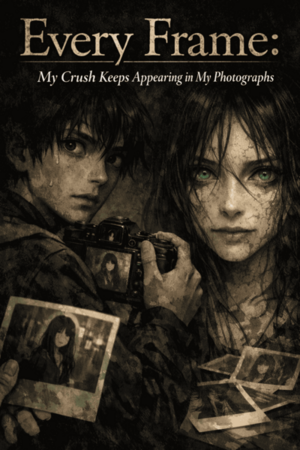
Every Frame: My Crush Keeps Appearing In My Photographs
They did not find anything useful for most of the day.
That, more than anything, made the town feel difficult.
If Natsume had been openly strange, if people had gone quiet too quickly when they heard Aiba's name, it would at least have given the problem a shape. Instead the town remained ordinary in the stubborn, irritating way small towns often do. Roads. Utility poles. Storefronts with faded lettering. A river running past a line of houses whose curtains were half drawn against the afternoon glare. Nothing announced itself. Nothing invited interpretation.
They started near the station.
The tourist desk yielded nothing but a map and a brochure from three years ago. The woman behind the counter smiled politely, repeated the name “Aiba” once as if testing whether it meant anything to her, then shook her head. At the pharmacy, an old man stocking boxes of masks and cold medicine said he had only moved to Natsume in 2008. At the post office, a clerk frowned thoughtfully and then apologized. At a dry cleaner, they were told to try the camera shop. The camera shop had been closed for years and now sold secondhand furniture. The man there only laughed when Yuto asked whether anyone remembered an amateur photographer obsessed with a woman in his prints.
“Sounds like half the men who used to come through here,” he said.
Yuto did not laugh back.
By noon, they had circled half the town on foot.
Makoto’s shirt clung damply to his shoulders. The day had warmed, though the sun still kept slipping in and out behind high clouds. Somewhere nearby, someone was frying something in oil that had been reused too many times. The smell drifted in and out with the wind. Bicycles clicked over uneven road seams. A dog barked once from behind a gate and then lost interest.
Reina checked the printed town map again and again, though by now it had become more gesture than guidance.
“This isn’t working,” Yuto said.
“It has been five hours,” Reina replied. “That is not enough time for a real investigation to become impossible.”
“It is enough time for my legs to become uncooperative.”
Makoto said nothing. He had stopped speaking much about an hour earlier.
At first, neither of them noticed. That was not unusual for him. But as the afternoon wore on, his silence changed. He kept slowing at windows. Not stopping fully. Just enough to fall half a step behind. Once, outside a stationery store with dark glass, Reina turned to say something and found him staring at the reflection instead of listening.
“Makoto.”
He blinked and looked at her.
“What?”
“You’ve done that three times.”
“Done what?”
“Left.”
Yuto looked between them. “That is ominous.”
Makoto rubbed one hand over his face. “I’m fine.”
Reina’s expression said clearly that she did not believe him.
They bought bottled tea from a vending machine and sat for ten minutes on a bench near the river. The bench was metal and still warm from the earlier sun. Across the water, weeds had grown thick along the concrete bank. A fisherman in a blue hat stood farther downstream with his back to them, motionless except for the small adjustments of his hands.
Makoto unscrewed the cap of his tea and left it open in his hands, unmoving.
He had seen her twice already.
Not clearly. Not enough to say it aloud without sounding ridiculous even to himself. Once in the side mirror of a parked delivery truck. Pale face, dark hair, gone the moment a cyclist passed between him and the glass. Once in a classroom window at the closed elementary school they had just walked past. Just the outline of a woman where there should have been only old desks and curtains.
Each time his heart had kicked hard and fast in his chest.
The first time it felt like fear.
The second time it felt less clean than that.
That was what he hated.
He set the tea bottle beside him and looked out toward the river, because looking at moving water was easier than looking at glass.
Yuto tore open a packet of salted crackers and held them out toward him.
Makoto shook his head.
“You need sugar,” Yuto said.
“I need people to stop saying things that aren’t sugar as if they are.”
“That was almost lively,” Yuto said. “This is progress.”
Reina leaned forward, forearms on her knees. “Talk.”
Makoto did not answer.
“Makoto.”
He looked at her finally. “I keep thinking I see her.”
Yuto’s hand stopped halfway to his own mouth.
“Where?”
“Everywhere that reflects.”
Reina’s face did not change, but her voice did. It became flatter. More practical.
“How clear?”
“Not enough.”
“That isn’t a useful scale.”
“I know.”
A breeze moved over the river and brought with it the damp smell of mud and cut grass.
Yuto lowered the crackers into his lap. “All right. New rule. You do not drift off alone even for twenty seconds. If you see something, you say it immediately.”
Makoto looked back at the water. “That sounds manageable in theory.”
“In practice too,” Reina said. “We’re not improvising anymore.”
They resumed after that, but the town only became worse.
Not stranger. Worse.
Because once Makoto had admitted it, he began seeing her more often. A pale face near the edge of a shop window. A dark shape at the far end of a narrow side street. A woman crossing behind a line of laundry where there had been no one a second earlier. Each sighting vanished as soon as he turned properly toward it. Each one left him a little less steady than the last.
Twice, Reina had to catch his sleeve and pull him back when he drifted toward the road without noticing the traffic light had changed.
Once he followed, for half a block, the back of a woman in a light dress before Yuto came jogging after him and grabbed his shoulder.
“That is not us moving with purpose,” Yuto said, breathing hard. “That is you getting abducted emotionally.”
Makoto jerked his arm free.
“I saw—”
“I know,” Yuto said, more gently than the joke should have allowed. “I know. You still say something first.”
Makoto turned and looked back down the street. The woman was gone. In her place stood a mother and child outside a bakery, the little boy holding a cream bun in both hands.
He felt suddenly sick with embarrassment and anger, though he could not have said clearly at whom.
By late afternoon, Reina’s patience had grown sharp at the edges.
“This is going nowhere,” she said after they got nothing from an elderly barber who remembered everyone except the one person they wanted. “We have a photographer, a town, and a dead trail. That’s all.”
Yuto wiped sweat from the back of his neck with a handkerchief. “Then maybe we’re asking in the wrong place.”
“We have asked in every place that should matter.”
“Exactly,” Yuto said. “So let’s ask somewhere that shouldn’t.”
Reina turned to him. “What does that mean?”
He took the folded town map from her hand and tapped the upper corner with one finger.
“There’s a shrine.”
She stared at him. “I thought you took that map for investigation.”
“I did.” He looked weirdly ecstatic.
“That is not an answer.”
Yuto spread the map against his thigh. “Maybe we’ll find something. Paranormal stuff and shrines are connected in most cases, you know.”
Reina looked at him for a long second. “You say that as if you have categories.”
“I absolutely have categories.”
Makoto had stopped paying full attention halfway through the exchange. He was starting to feel paranoid. Ever since coming to this place, he was seeing her more and more. Whether he actually saw her or it was all happening in his head, he could no longer say.
Reina snapped the map shut.
“Fine,” she said. “We go to the shrine.”
The shrine stood uphill from the older part of town, past a road lined with narrow houses and one abandoned lot thick with weeds. The stone steps were worn at the center. Moss had grown along the base of the lanterns. At the foot of the stairs stood a weathered signboard listing festival dates and donation requests. A bell rang somewhere above them, once, carried thinly down through the trees.
The air changed as they climbed.
Cooler. Less traffic noise. More cedar and damp earth. The gravel at the top had been recently raked in broad shallow curves that were already half disturbed by footprints. Off to one side stood a low building with sliding doors and a veranda. Wind moved lightly through the prayer ribbons tied near the offering box.
No one was in the courtyard at first.
Yuto looked around with a kind of hopeful suspicion.
“You see?” he said quietly. “This is where things happen.”
“This is where you embarrass yourself in a more scenic location,” Reina replied.
Makoto had gone still. His eyes were hyper-focused on a spot.
A woman in a pale kimono had just crossed from the side building toward the main hall carrying a lacquer tray. She moved with the easy balance of someone used to doing the same task every day. Her hair was pinned neatly at the back. The pattern on her kimono was simple, soft gray with faint leaves near the hem. Your average woman in a shrine, but for Makoto, she was more than that.
The same pale line of the face. The same dark hair against light cloth. The same calm, unreadable mouth. For one impossible second, it felt as though the dead image he had been chasing through paper and glass had stepped out into sunlight and taken weight. It was not an image anymore. Not a mere reflection. She was there. Right in front of his eyes. Breathing. Alive.
His vision narrowed. His heart thudded at impossible speed.
The courtyard tilted.
He felt like someone was calling his name. He could not tell who.
Then the gravel came up too fast, and the world went black.








Please sign in to leave a comment.